

The Marshall Spectator
December 10, 2025


In This Issue:
From The Skittles Room
Endgame Corner, by IM Silas Esben Lund
No Senior Moments at this Chess Tournament, by Vivien Schweitzer
Chess Toons
En Passant
Problems, Problems, curated by Alexander George
Editor’s Note

Welcome back, fellow chess players, to this edition of the Marshall Chess Club’s fortnightly bulletin, The Marshall Spectator.
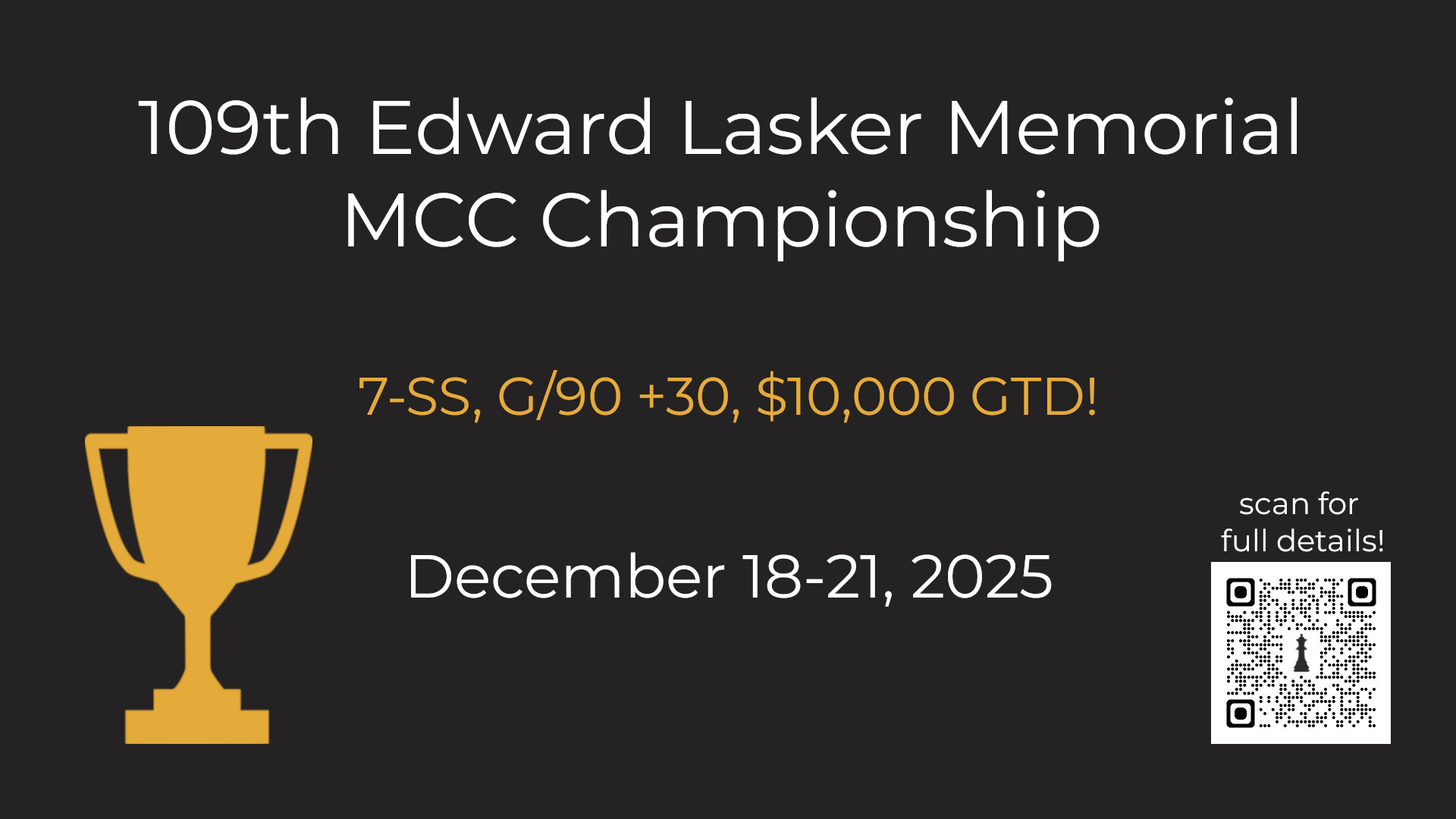
We are now just one week away from the 109th Edward Lasker Memorial Club Championship. The event will be held from December 18-21, and feature the following prizes: $10,000 GTD $5000-2500-1000-500, U2300 USCF: $500, U2100 USCF: $500. The title of “2025 Marshall Chess Club Champion” goes to highest-scoring MCC Member. The title will be determined by a blitz playoff in the case of a tie.
Club members only rated 2100+ USCF or FIDE, GMs, IMs, WGMs, WIMs, FMs & Qualifiers from the Marshall Women’s, Senior and Amateur Championships or by special invitation. Escalating entry fee, GM entry fee refunded upon completion of the tournament 1. $125 – Nov. 24 – Dec. 7 2. $150 - Dec. 8 - 17
No day-of registrations. Register here.
This December, we will have several days of chess camp at our historic club located at 23 West 10th Street. All details can be seen here. The camp dates are December 23, 26, 29, 30, 31. Be sure to register for these in advance as attendance will be limited and they are likely to sell out.
Looking further ahead on the calendar, our Camp Sales are now live for next summer! Save up to 25% on each week of camp that you purchase! You can purchase discounted weeks here.
This summer, we had 10+ GM and IM instructors and guests, including simuls with GMs Andrew Tang, Vojtech Plat, Alexander Shabalov, IMs Carissa Yip, and Mykola Bortnyk. That’s not all- our top five most active campers saw huge rating growth, with an average gain of 140 rating points since attending their first summer camp!
Not only that, our data shows that kids who attended one or more weeks of camp saw their ratings jump an average of 86-125 rating points, with the value increasing the more weeks they attended. You can purchase the package here.
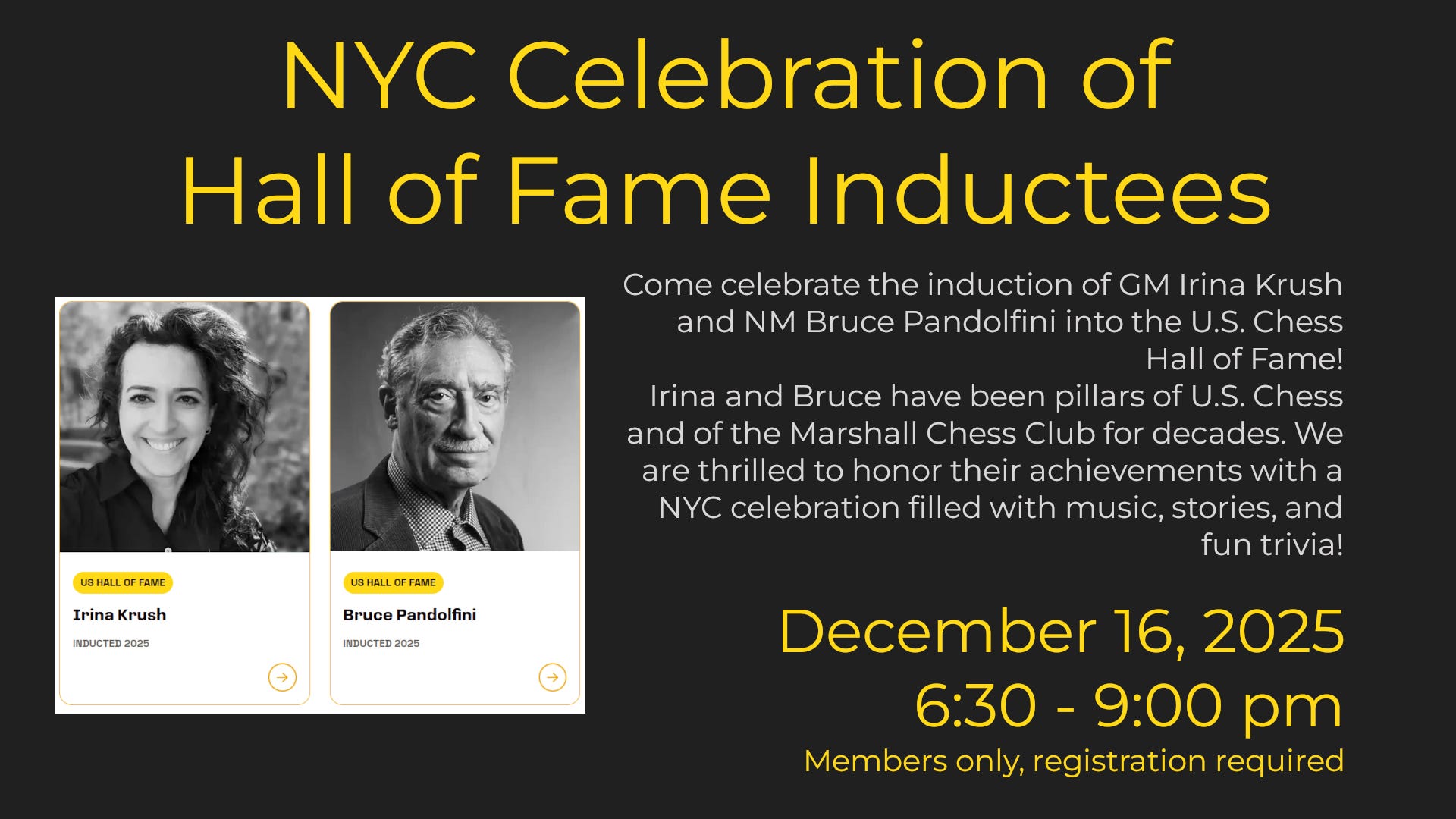
Looking ahead on the calendar, one of the most exciting events this month will be held on December 16, when we will be celebrating Chess Hall of Fame Inductees NM Bruce Pandolfini and GM Irina Krush. We will come together to celebrate their achievements and highlight some of the most memorable moments from their careers with a celebration-filled evening of music, stories, and fun trivia.
Finally, if you’re looking for some GM Chess Prep, consider joining the Elite Membership Program featuring Grandmaster Rashad Babaev, who has a track record of success with working with some of the country’s brightest chess stars.

Looking back over the last two weeks, we have had a plethora of events for our members to participate in.
The Under 2000 Morning Action on December 6 had 47 players registered and was won by the following players who scored a perfect 3 out of 3 to win $103 each: Gavin Liu, Rohit Jagga, Kenny Bollin, and Gary Chan. Jacob Yang scored 2.5 out of 3 to win a class prize of $177.
The Morning Masters on December 6 had 6 players registered and was won by the following players who scored 2 out of 3 to win $25 each: FM Aditeya Das, William Alexander Aepli, and CM Aiden Li.
The Saturday Game 50 Open on December 6 had 32 players registered and was won by IM Jay Bonin who scored a perfect 4 out of 4 to win the $192 first-place prize, while FM Justin Chen and FM Leif Pressman scored 3.5 out of 4 to win $64 each. Armaan Jain, Zhuoyuan Ryan Xu, and Sean Huang scored 3 out of 4 to win $32 each.
The Saturday Game 50 Under 1800 on December 6 had 41 players registered and was won by Ekam Anand, who scored 4 out of 4 to win $246, while Ethan Kim and Axel Peters won $143.50 each for their 3.5 out of 4 score.
The FIDE Blitz on December 5 had 59 players registered and was won by GM Maxim Dlugy who scored 7.5 out of 9 to win the $270 first-place prize. The following players won $70 for their performance: IM Nico Chasin, IM Alexander Katz, FM Jonathan Subervi, Lev Shangin, and Thomas Egelhof. While Viyaan Doddapaneni and Rohan Lee scored 6 points to win $35 each.
The Afternoon Action tournament on December 5 had 6 players registered and was won by Evan Rosenberg who scored a perfect 3 out of 3 to win the $45 first-place prize, while the following 4 players won $7.50 each for their 1.5 out of 3 score: Kenny T Bollin, Thyge Knuhtsen, Garold Minkin, and Samuel Segal.
The Thursday Action on December 4 had 28 players registered and was won by IM Kevin Wang and IM Jay Bonin, who scored 3.5 out of 4 to win $87.50 each, while Evan Rosenberg, Evan Kauffmann, Travis Patay, and Alan Stolyarov scored 3 out of 4 to win $26.50 each. Kristian Jacome won $53 for their 2.5 out of 4 score.
The Morning Under 1600 on November 30 had 10 players registered and was won by Curtis Priester who scored a perfect 3 out of 3 to win $75, while Dylan Lam and Katy Liao scored 2.5 out of 3 to win $25 each.
The Sunday Quads on November 30 had 55 players registered and featured many winners. The following players won $50 for winning clear first-place in their quad: Suvan Baranwal, Anthony Li, Daisy Yuen, Oliver Liu, Garry Portugal, Adurami Lasile, Darwin Wong Okyere, Jordan Kim, Chase Yuen, and Dakota Affield. The following players tied for the top spot in their quad, netting a $25 prize each: Anson Leong, Lillianna Gao, Ayden Spellman, Ari Hoffman, Harry Lai, and Kyle Tse, while Rui Lin Feng and Shivani Wood won $12.50 each for their 2 out of 3 point performance in the small swiss.
The Rated Beginner Open on November 30 had 23 players registered and was won by Cheikh Diamanka, Aaden Anderson, and Raphael Morgenshtern who scored 3 out of 3 to win $96 each.
The Under 2000 Morning Action on November 29 had 44 players registered and was won by Nico Alvarado-Yoshida and Manuel Najera who scored a perfect 3 out of 3 to win $175 each, while the following players won $25 each for their 2 out of 3 performance: Jaydenra Jog, Aaron Zhang, Esrom Samson, Woobin John, Nikola Scekic, and Benjamin Ginsberg.
The Saturday Game 50 Under 1800 on November 29 had 34 players and was won by William Chen, Vladimir Chesbro, and Luis Lopez who scored 3.5 out of 4 to win $138.67 each.
The Saturday Game 50 Open on November 29 had 24 players registered and was won by IM Jay Bonin who scored 3.5 out of 4 to win $138, while Richardson Qiao, Kai Waters, and Rhyan Grennan scored 3 points to win $53.67 each.
The FIDE Blitz on November 28 had 44 players registered and was won by GM Aleksandr Lenderman, who scored 8.5 out of 9 to win the $210 first-place prize. FM Marcus Miyasaka won $105 for his 7.5 out of 9 performance, while the following players won $53 each IM Aaron Jacobson, FM Justin Chen, Oliver Chernin, Naveen Paruchuri, and Kevin Stern.
The Black Friday Action on November 28 had 63 players registered and was won by GM Aleksandr Lenderman who scored a near-perfect 5.5 out of 6 to win the $500 first-place prize, while FM Marcus Miyasaka, FM Megan Paragua and IM Jay Bonin scored 5 out of 6 to win $200 each. George Chachkes also won $200 for his 4.5 out of 6 performance, and Aziz Abdijalilov and Samir Radjabov shared in a class prize, winning $100 each for their 3.5 out of 6 score.
We look forward to seeing you at the club soon!
Endgame Corner, by IM Silas Esben Lund
Here is yet another example from The Positional Chess Handbook by Israel Gelfer, and like in the last Endgame Corner article, I shall focus on the idea of ‘the anchored bishop’. As I mentioned last time, Gelfer does not present the concept of the anchored bishop, neither by examples nor by name. In fact, his selection of 495 games have only rudimentary comments, with diagrams at what he considers the critical moments. It’s a great game and study collection for those who want to investigate further on their own. The following game starts in the early middlegame, and the game ends with 4 pieces each on the board, including the queens. Thus, on the surface of it, it is hardly an endgame. However, with his strategy, Black is preparing long-term, and I do discuss transformations into endgames that are winning.
You can play through the examples with annotations here.
Bilek, Istvan - Smyslov, Vassily
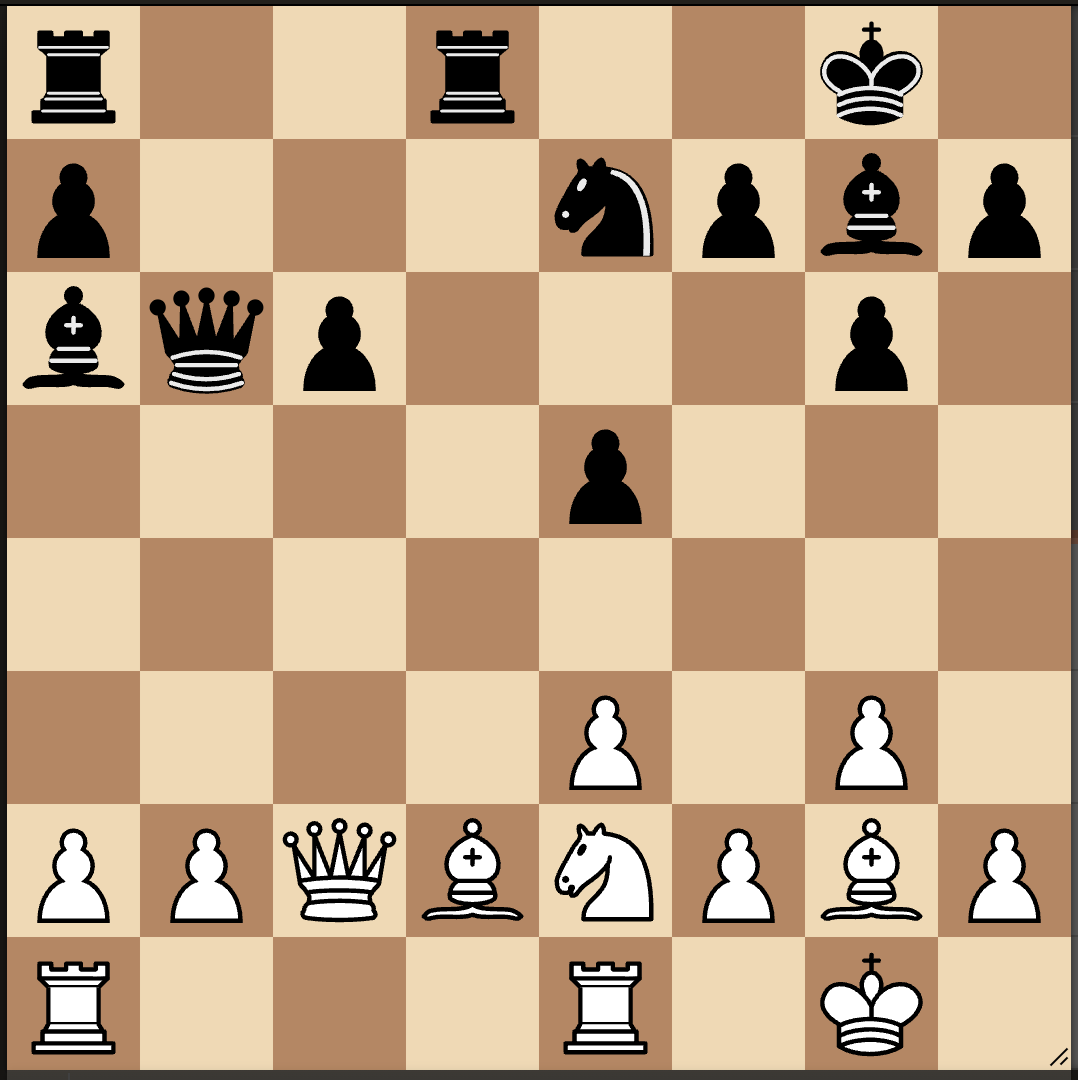
Position after 16.Bd2: Black to move. White has inflicted damage in Black’s pawn structure, but at the price of being behind in development. Black uses his slight initiative to build up pressure, and the idea of the anchored bishop plays an important role.
16...Bd3 17. Qc1 Nd5 (17... e4 is too early and gives up squares in the center. White is doing OK after 18. Bc3)
18. Nc3 (White can try 18. e4 before Black plays the move, but that leads to other issues. Nb4 19. Bxb4 Qxb4 20. Qc3 and now for instance (20. Qxc6 Rac8 traps the queen.) 20... a5 Like in the game continuation, Black’s slight initiative allowed him to trade off White’s dark-squared bishop. The bishop pair is generally regarded as an advantage. In my view, a big advantage of the bishop pair is the transformational power it gives - it is simply easier to shape the position to your liking if you possess the bishop pair. In the game, Black transformed the position by trading bishop for knight and entering a middlegame with same-colored bishops.) (18. a3 stops the knight from jumping to b4 but weakens b3. Black is firmly in control after e4 19. Nc3 Qb3)
18... Nb4 On the way to c2. 19. Na4 Qb5 20. Bxb4 Qxb4
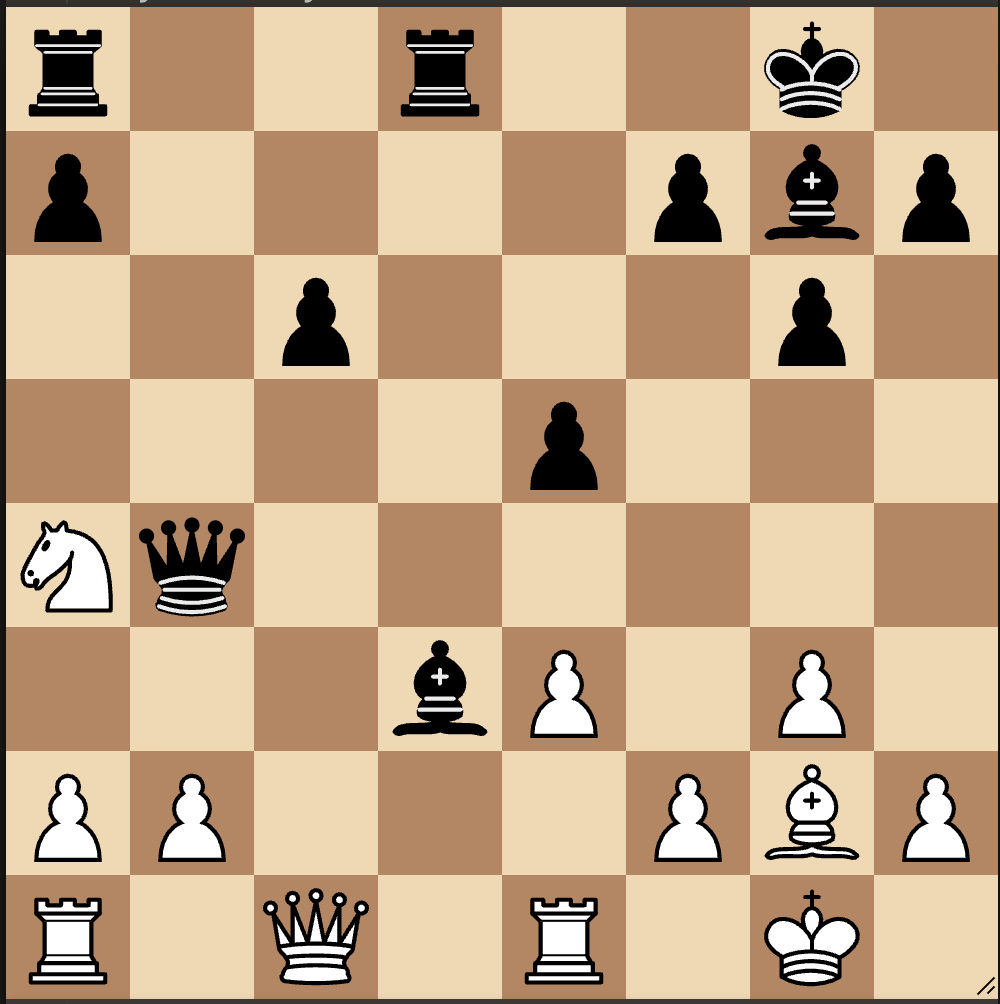
21. Nc3 (Last chance to hang on in the game was 21. Nc5 e4 22. Nxd3 exd3 23. Rd1 The idea is that Bxb2 is answered with 24. Rb1 While the position after 23.Rd1 is unpleasant for White, the passed d-pawn can be blocked due to the opposite-colored bishops, and it’s not as easy to find a breakthrough for Black as in the game. To me, it is not a big surprise that the salvation for White lies in getting rid of Black’s anchored bishop on d3...)
21... e4 22. Rd1 Rab8 23. Rd2 c5 24. Qe1
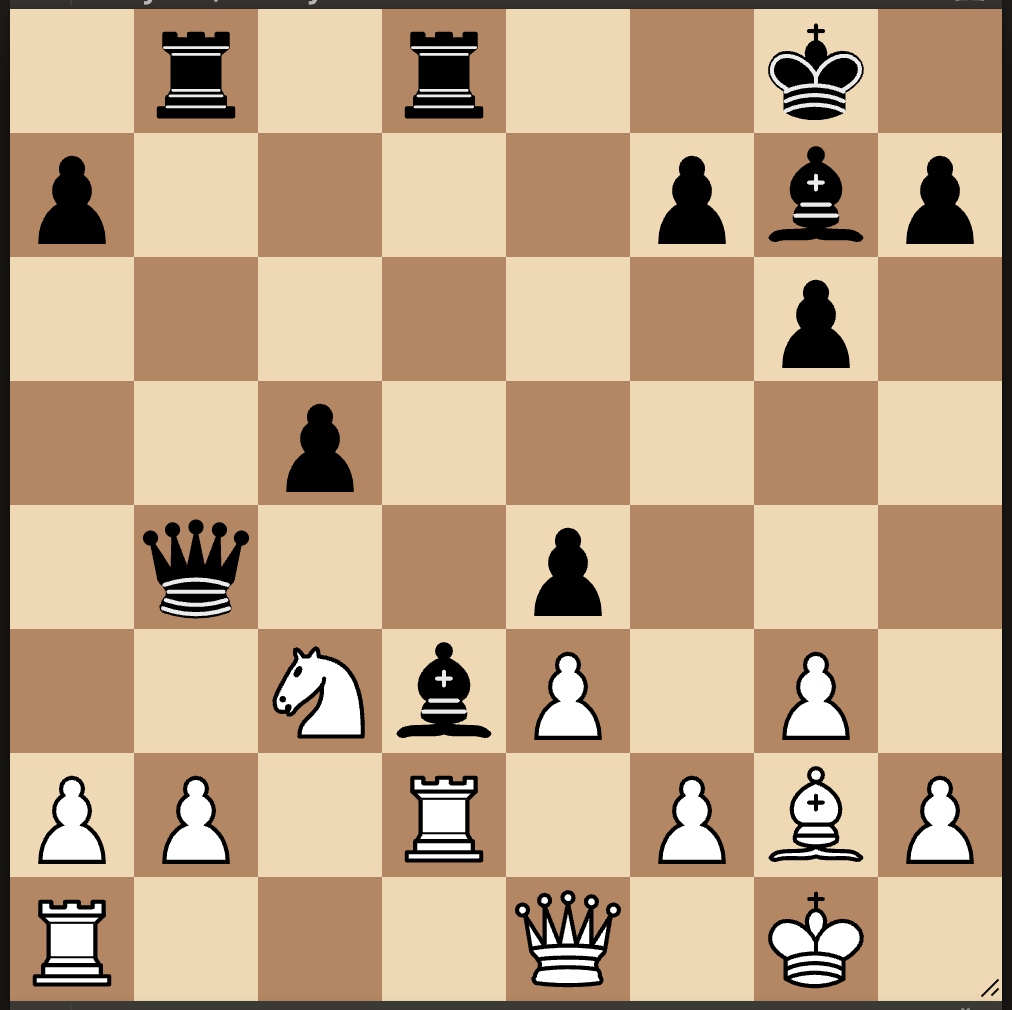
24…Bxc3 25. bxc3 Qa5 Black’s intention was not to win a pawn. (25... Qxc3 26. Bxe4 and White makes a comeback as Bxe4 loses the queen after 27. Rxd8+ Rxd8 28. Qxc3)
26. Rc1 c4 This diagram features in Gelfer’s book. Black has a beautiful anchored bishop on d3, in the heart of White’s position. If White trades it off, Black will instead have a far-advanced protected passed pawn. Black’s bishop on d3 is not attacking anything on its own, so assistance from queen and both rooks are needed. The bishop controls b1, allowing Black to use the b-file. The white pawns on a2 and c3 are the main targets, and White has no real counterplay.
27. Qd1 Rd5 28. Qg4 Rdb5 29. Qf4 (29. Bxe4 loses to f5) 29... Qa3 30. Rdd1 Re8 31. Bh3 Rb2 32. Bd7 Re7 33. Bg4
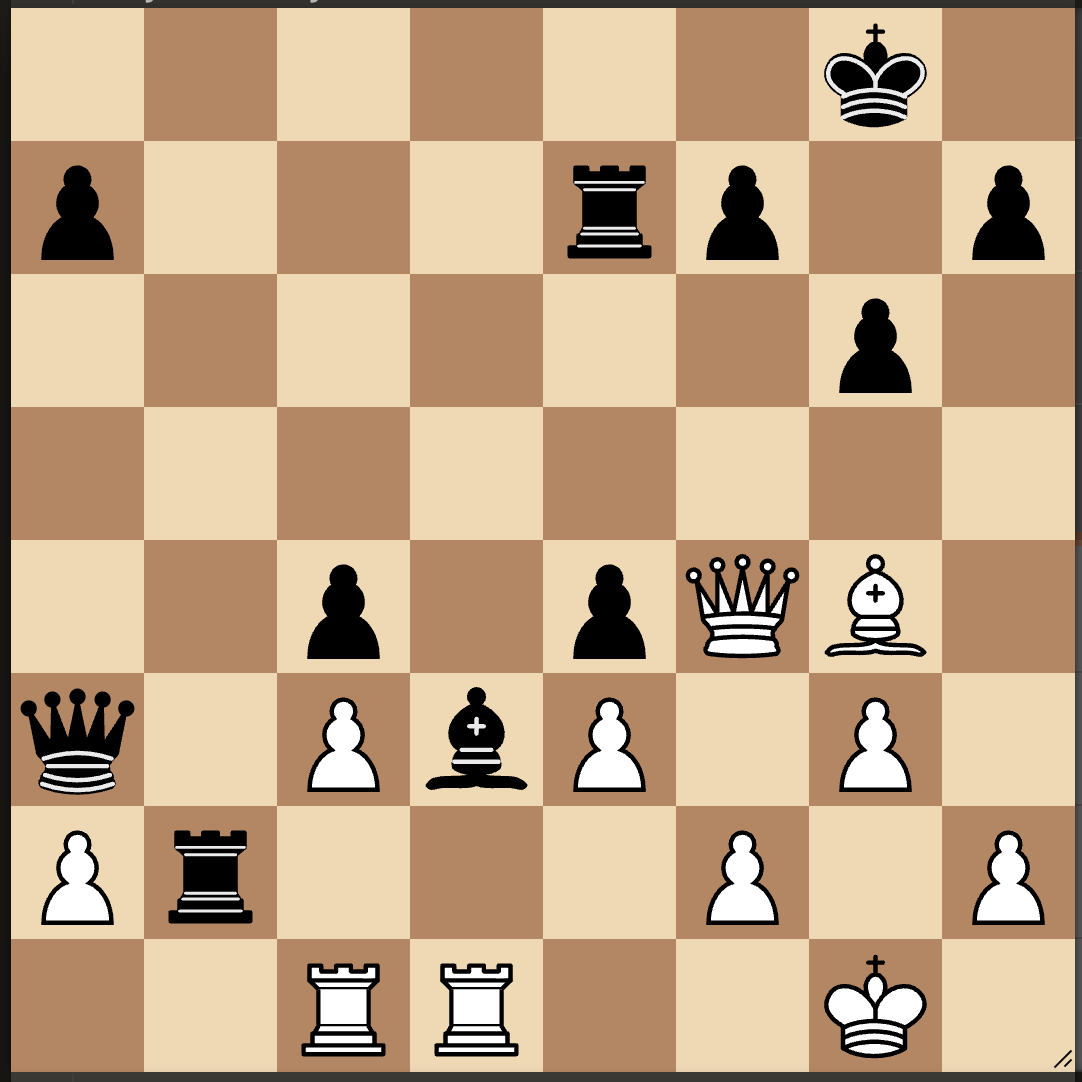
33…Qc5 (Black could cash in now with 33... Rxa2 but he prefers to keep control of the position. The issue is 34. h4 {with the idea of h4-h5, and} h5 {allows complications after} 35. Bxh5 gxh5 36. Rb1)
34. Qf6 (34. h4 h5) 34... Qe5 35. Qa6 (35. Qxe5 Rxe5 Without queens on the board, White has no attack, and the additional two rooks is enough support for the anchored bishop to win the endgame for Black.)
35... Kg7 36. a4
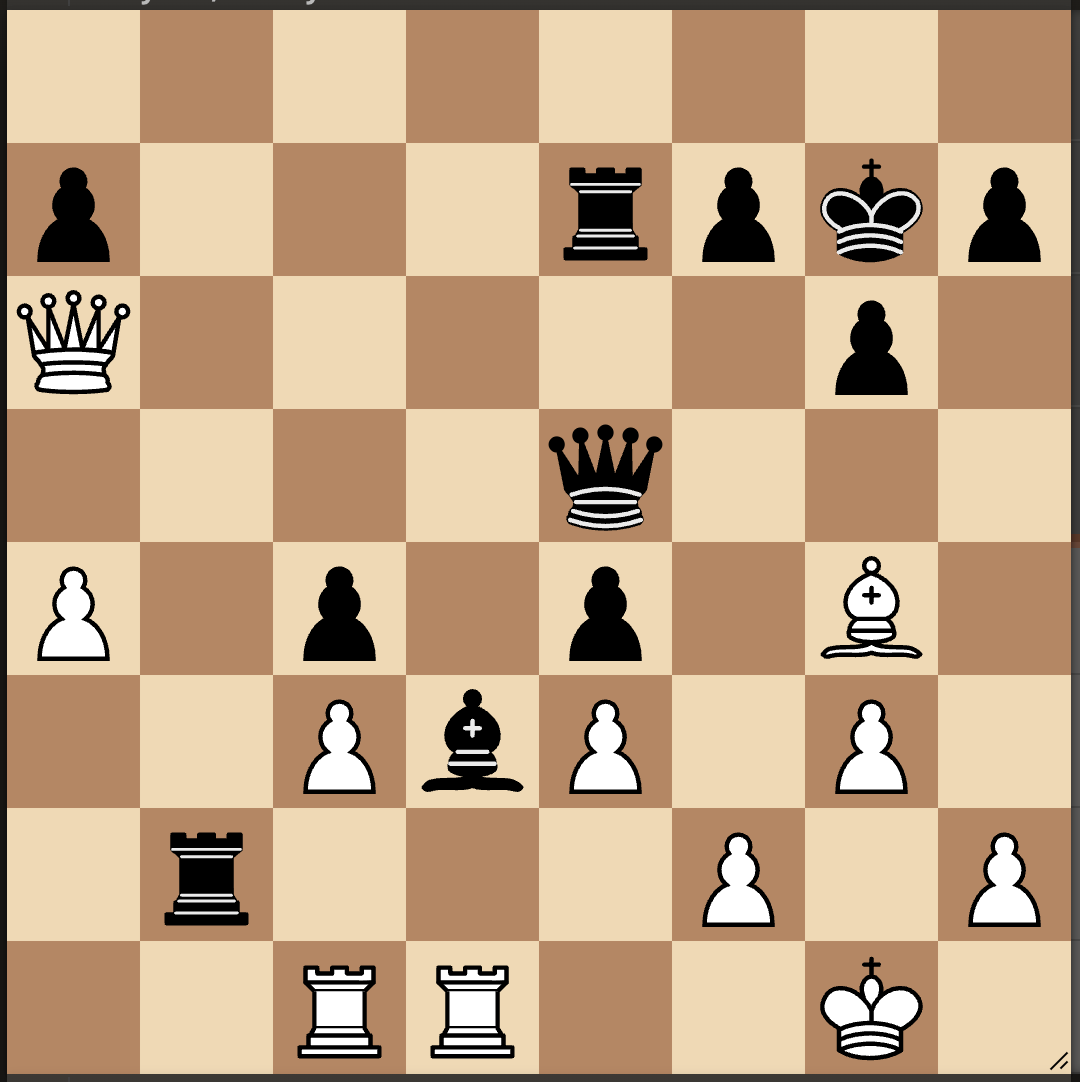
White was strategically lost, but after this move, his queen gets trapped on a6.
36…Rc7 37. a5 (Threatening 37. Rb6) 37... Rb5 38. Ra1 (Threatening 38. Rxa5) 38... Rbc5 White resigned as 39. R5c6 is coming, trapping the white queen.
IM Silas Esben Lund, Marshall Spectator Contributor
No Senior Moments at this Chess Tournament
In late October at the Costa Brada hotel near Gallipoli, Italy, hundreds of chess players from all over the world lined up to go through tight security during the FIDE World Senior Individual Chess Championship. My husband, Sarathi Ray, a United States Chess Federation (USCF) chess master, was one of them! He wanted to celebrate his 50th birthday by competing in an international tournament and I was very happy to tag along.
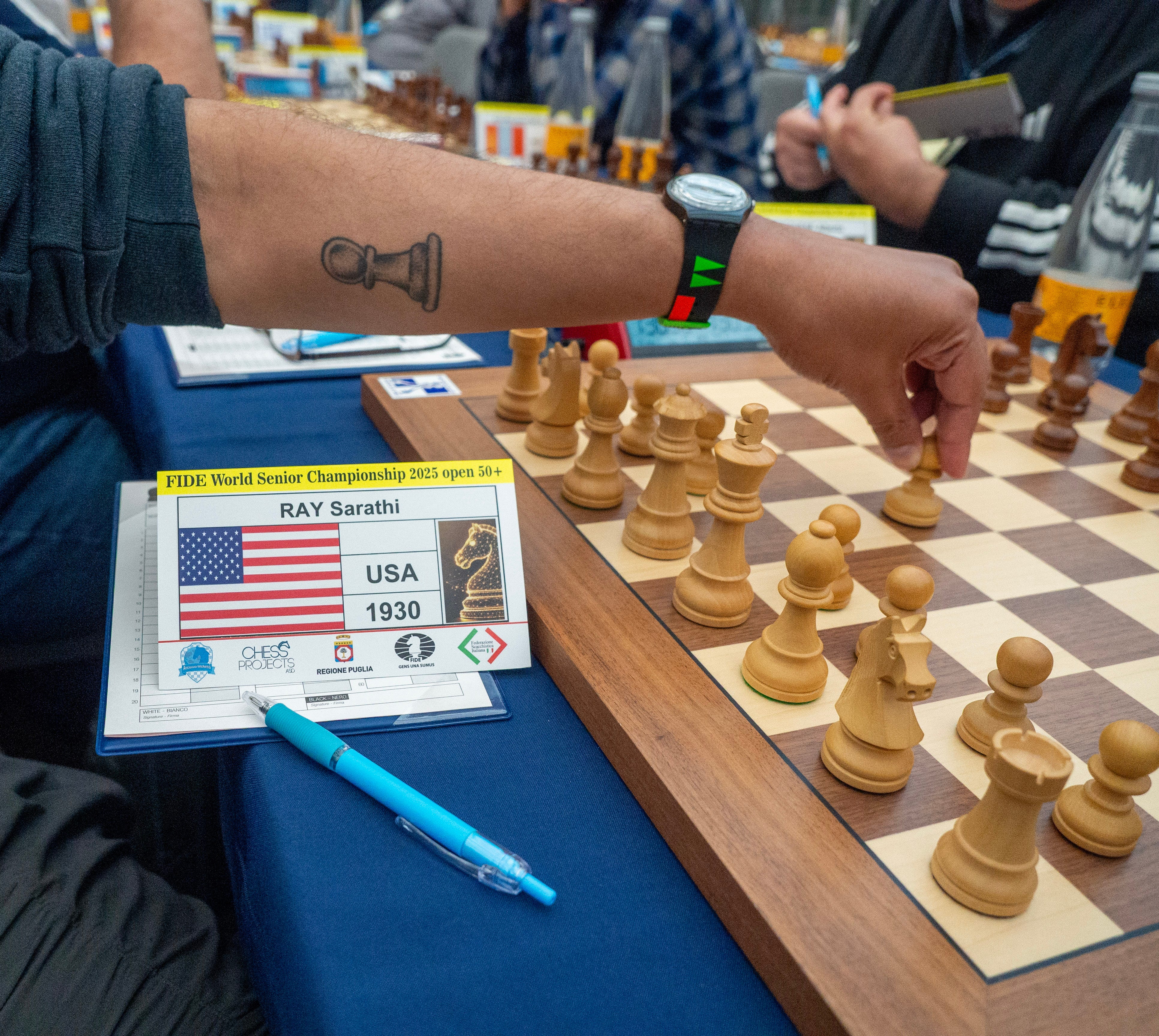
Well known players at this event included the 62-year-old Swedish grandmaster Pia Cramling and the 84-year-old Georgian grandmaster Nona Gaprindashvili, who in 1978 became the first woman awarded FIDE’s grandmaster title. She sued Netflix for $5 million when she was mentioned by name in the final episode of the fictional series The Queen’s Gambit and described as a world champion who “has never faced men.” In reality, Gaprindashvili frequently competed against men and still does, including in a blitz tournament in 2024 at the Marshall Chess Club in Manhattan. Netflix settled for an undisclosed amount.
In this tournament, which took place Oct. 20th-Nov. 2nd, men and women played separately, divided into 50+ and 65+ age categories. Gaprindashvili competed in the women’s section and Helen Milligan of New Zealand was the only female competing in the mens’ division.
Chess games – at least the classical format ones – are often Wagnerian in length. (In contrast, blitz games, also known as speed chess, move at eye popping speed.) In this tournament, games started at 3pm and some were still going at 8pm. Competitive chess is not for the faint of heart, but unfortunately the intensity of the game can actually cause heart issues. During pivotal moves in high stakes games, heart rates can soar. Two members of the Italian Red Cross camped out in the lobby every day during the tournament. I saw the medics attend to quite a few participants slumped in armchairs placed strategically at exits. Fortunately, there weren’t any serious health issues.
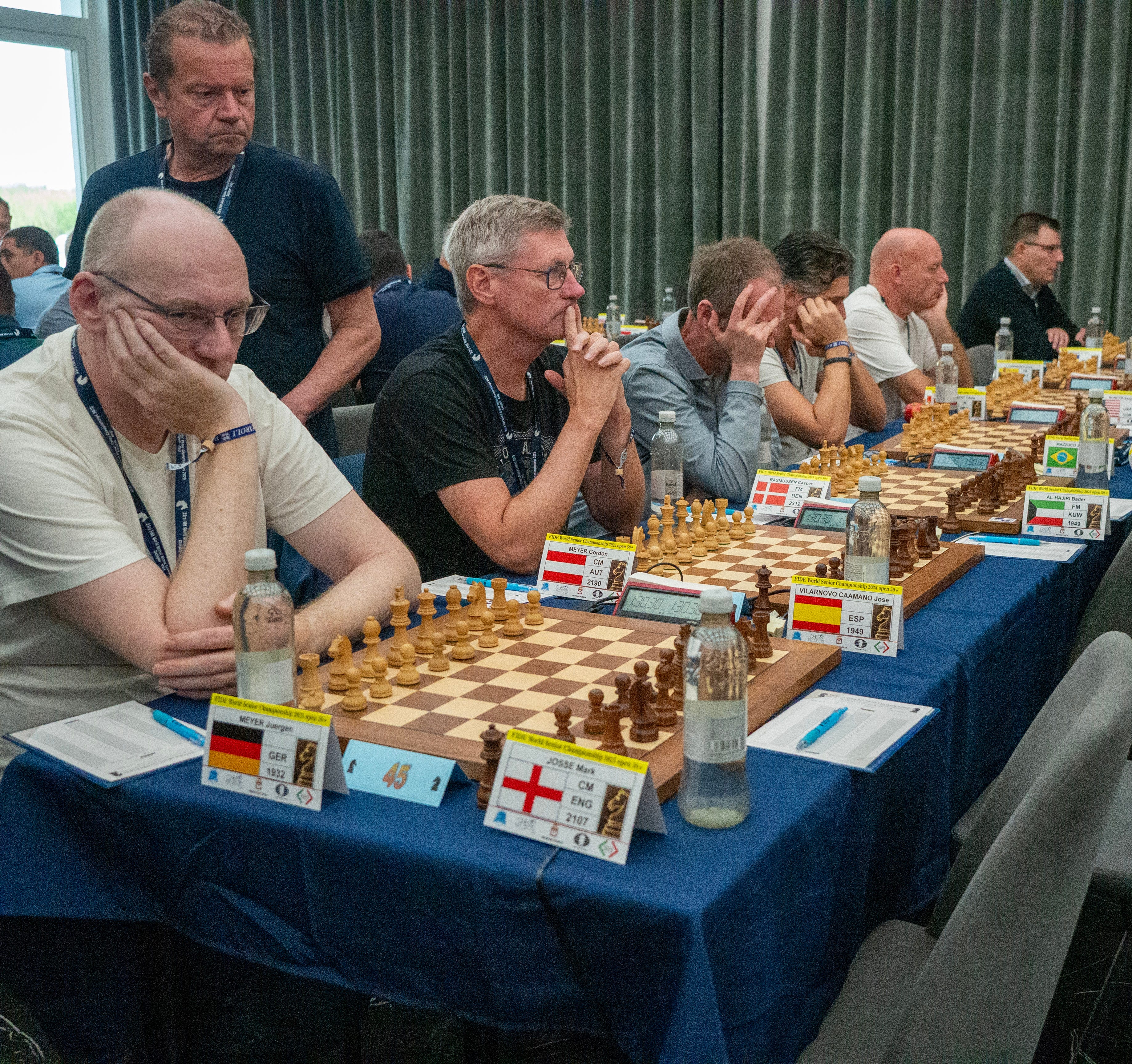
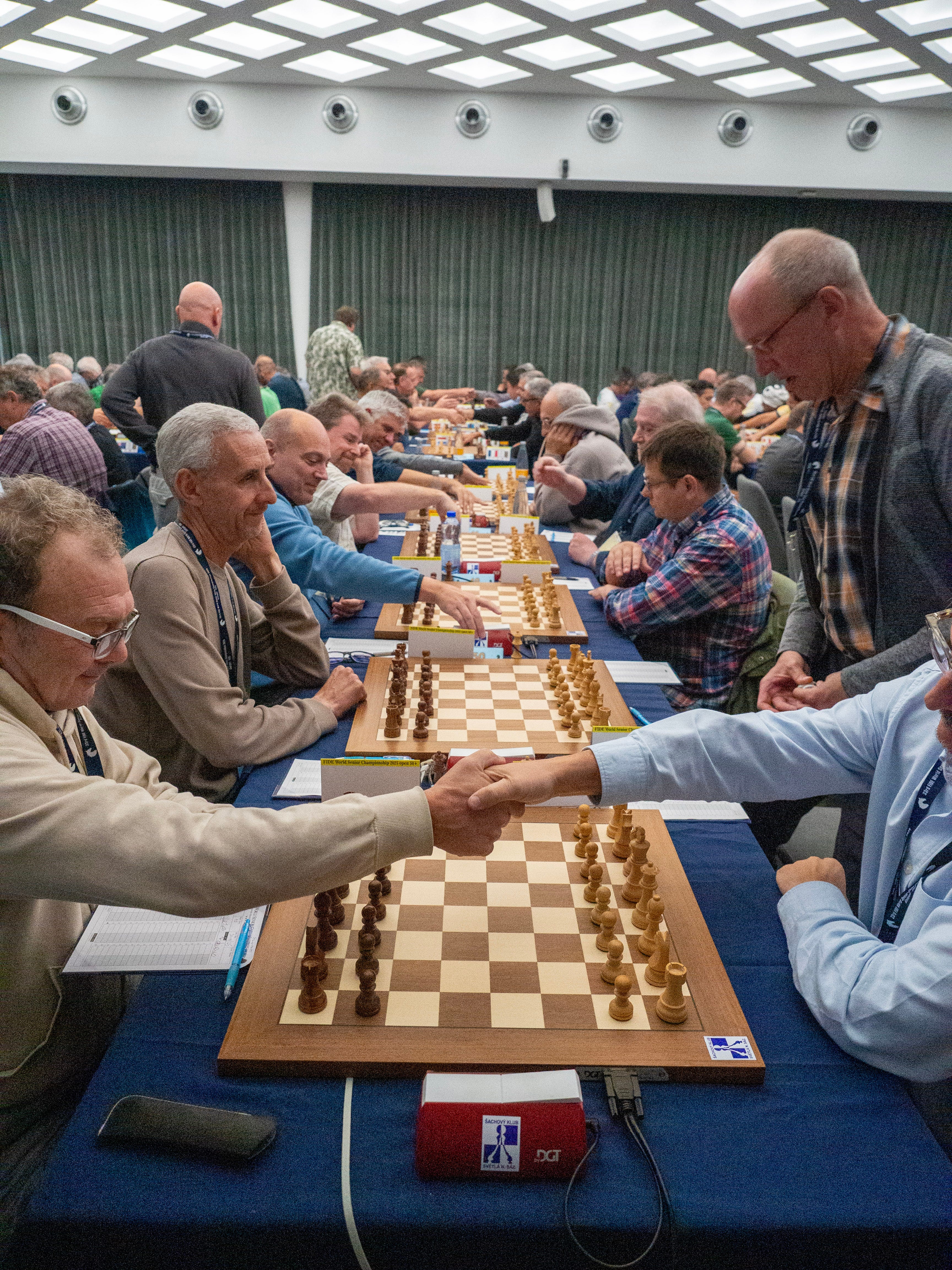
Left: Pre game vibes in the 50+ division. Right: Game on!
In the chess world, you might see a seven-year-old girl playing a seventy-year-old man. I was stunned the first time I saw tiny children, mothers hovering nearby, competing against grizzled seniors during the World Open in Philadelphia. One player at the Costa Brada joked that it’s embarrassing the first time an eight-year-old beats you, but then you get used to it. That’s of course one benefit of ‘senior’ tournaments: there’s no danger of losing to a second grader.
The cash prizes for this event were relatively small, but the winner of each category automatically receives the coveted title of grandmaster. There are strict protocols to prevent cheating during chess tournaments: before each game, players have to surrender phones and are screened for hidden electronic devices. They can’t wear watches or even take a pen in or out of the playing room. Arbiters monitor players for unusual facial or body movements that might indicate nefarious behavior. Games are broadcast ‘live’ with a 15 minute delay to prevent co-conspirators aiding and abetting a competitor.
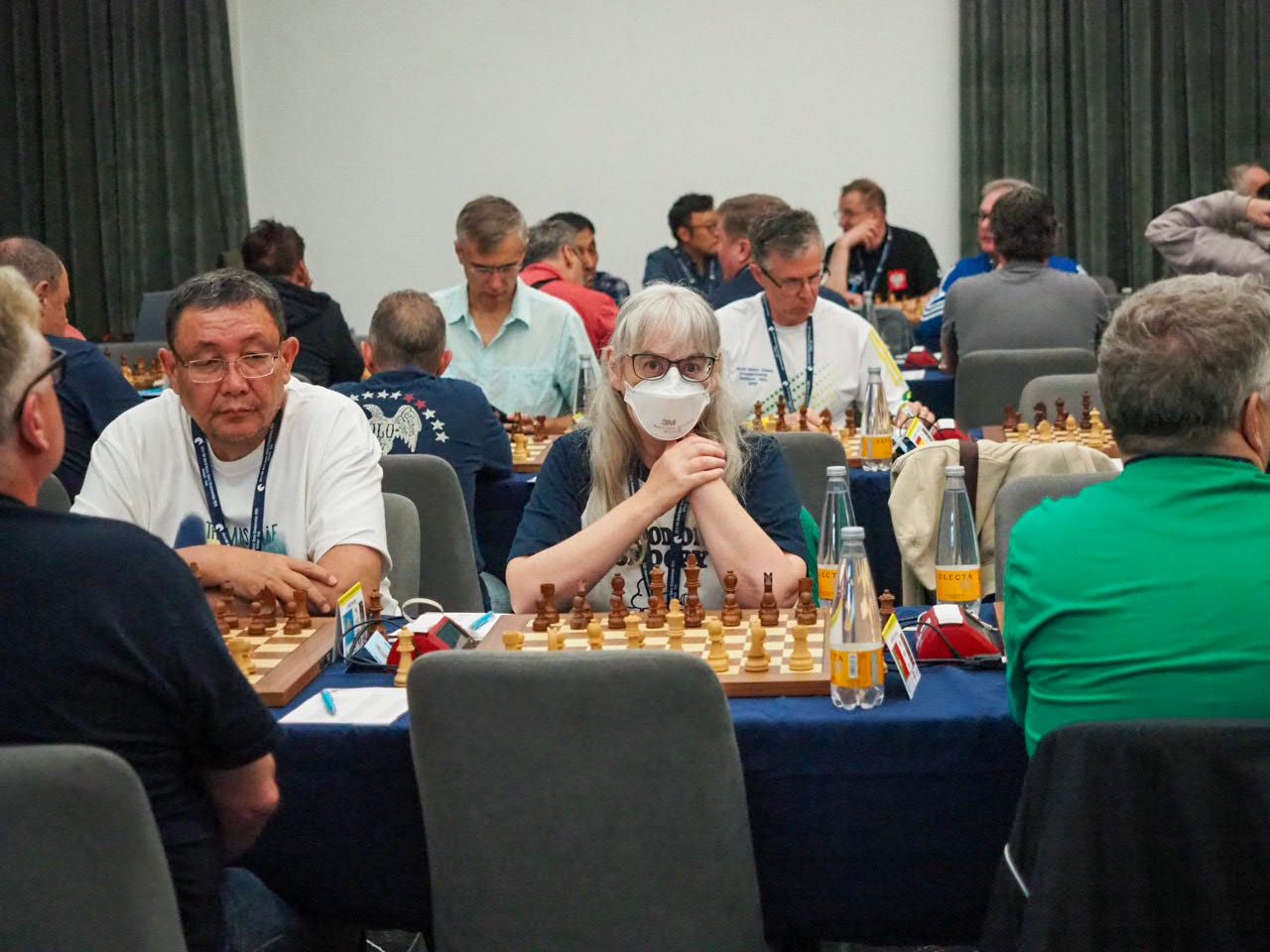
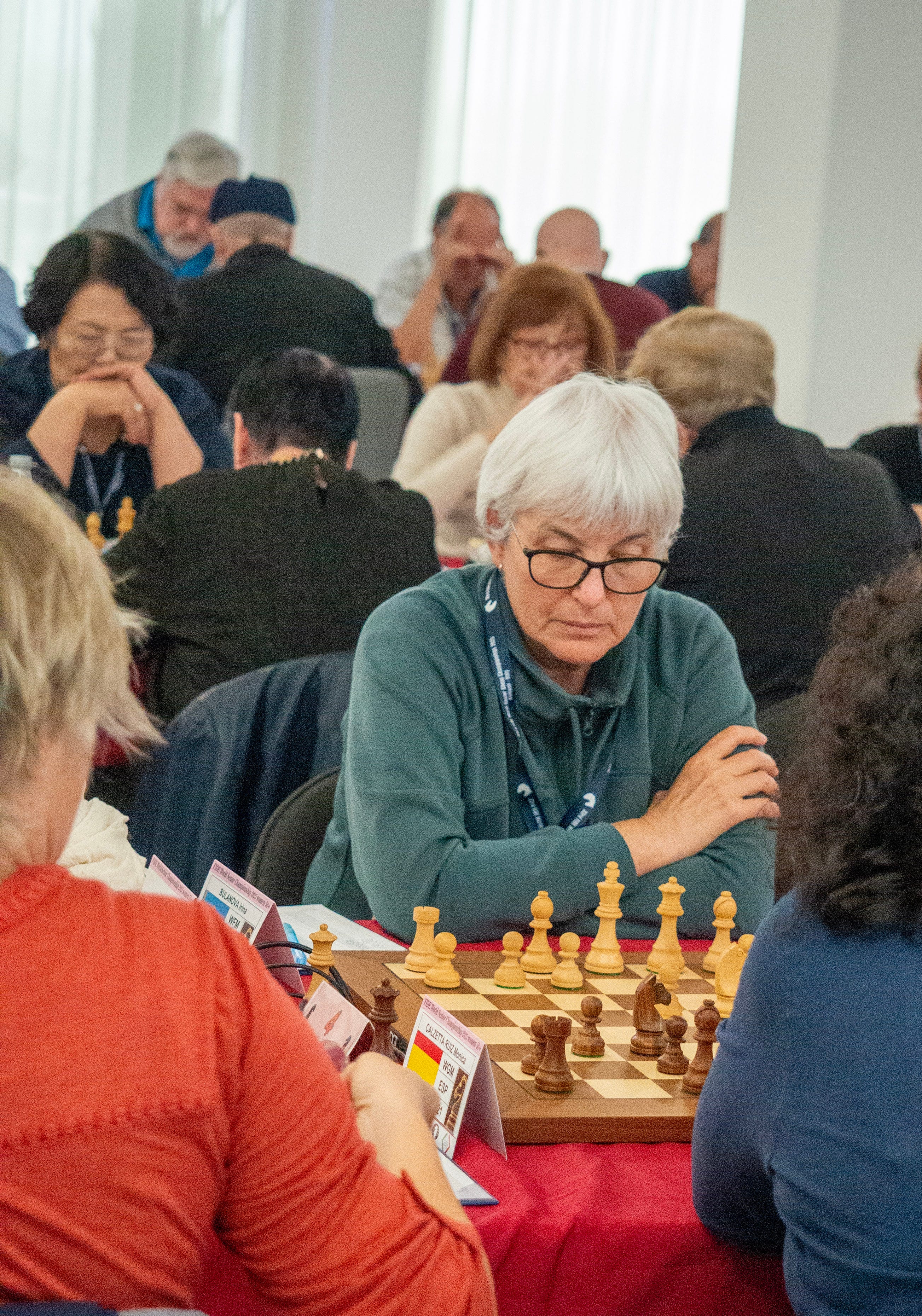
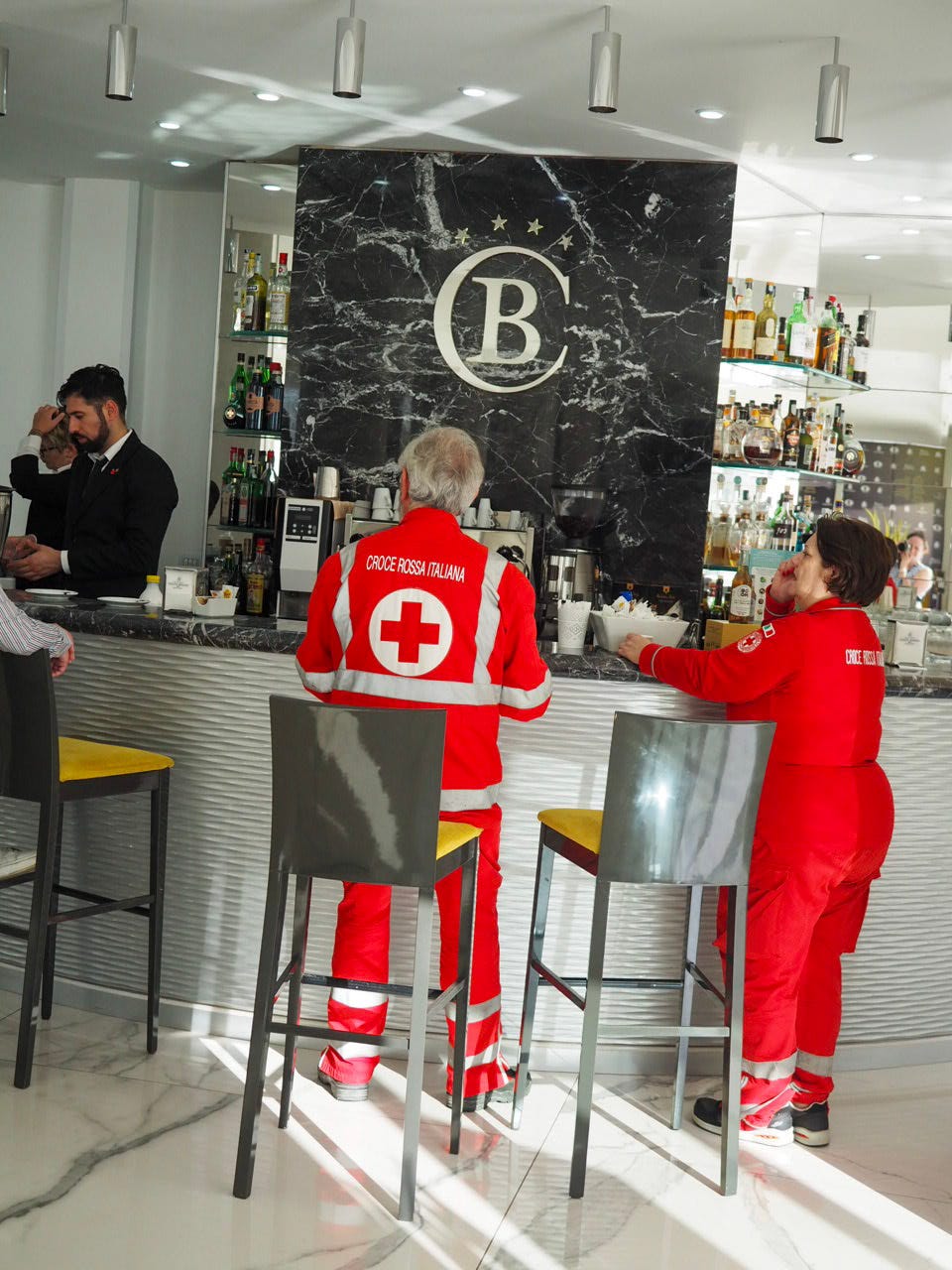
Women competing in the tournament and medics taking a coffee break in the Costa Brada lobby
Despite the tension, there was a congenial vibe overall at this tournament. After every game, opponents shook hands, analyzed their games together and enjoyed a well-deserved drink at the hotel bar or on the lobby overlooking the Ionian Sea.
At weekend tournaments at the Marshall Chess Club, where Sarathi is a board member (and former president), there is a game on Friday night, two on Saturday and two on Sunday. There was only one game a day at the Costa Brada, so we rented a car to sightsee during the mornings.
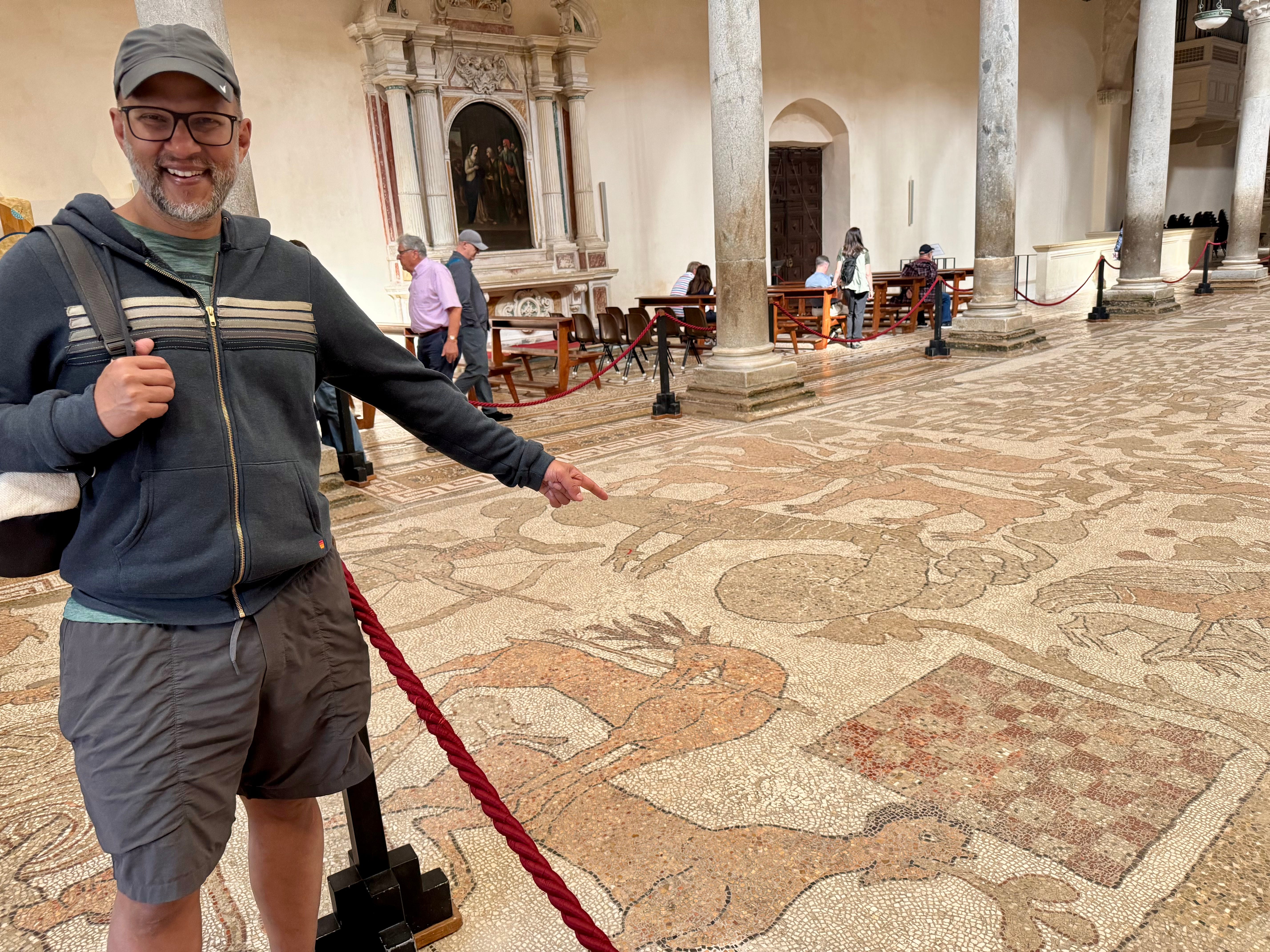
We loved Otranto, on the Adriatic coast of Salento, Puglia. We visited the medieval castle and then the Cathedral of Otranto, consecrated in 1088. After a while, church interiors started to look indistinguishable to me, but this one was unforgettable. Behind the plain exterior facade is an ornate floor mosaic that was created by a monk and features a giant Tree of Life. There are scenes from the Old and New Testaments, mythological creatures, horned devils, monkeys, kings, conquerors and yes, a chessboard! (Obviously very on brand for this trip). The church’s Moorish wooden ceiling is also beautiful.
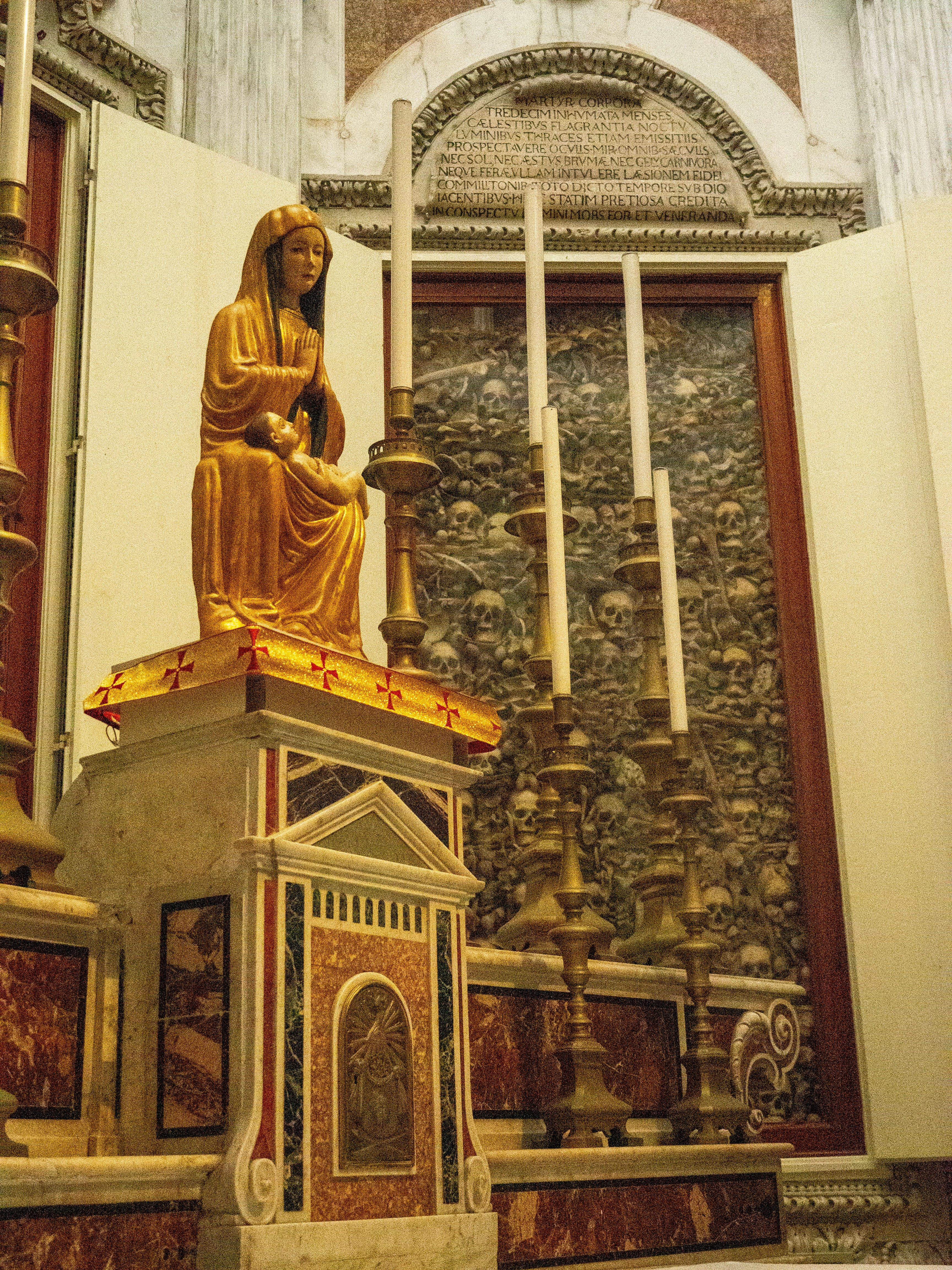
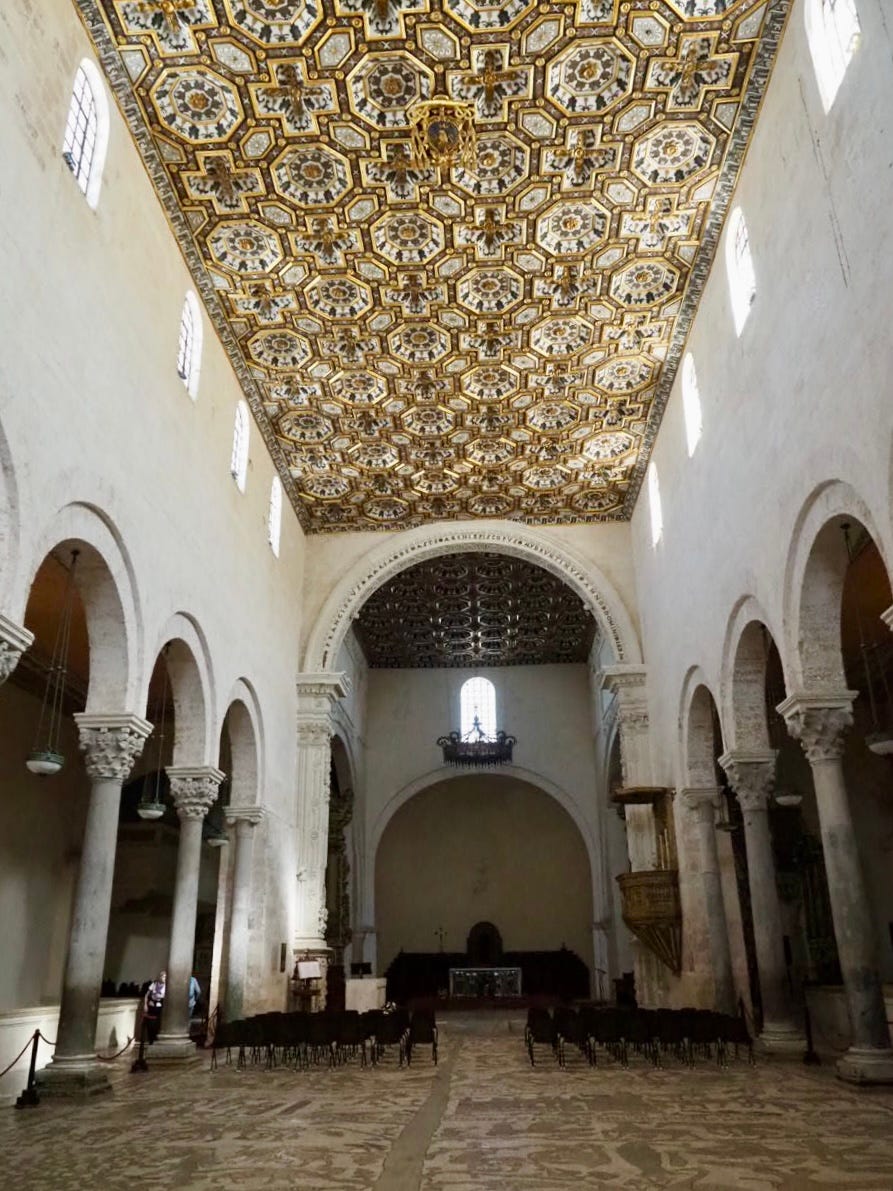
Left: The martyr’s skulls / Right: Interior of the cathedral
The human remains were….not so beautiful. I hadn’t read about the church’s history and was startled to see skulls piled up in glass cases behind the Virgin Mary. The skulls and bones of the Martyrs of Otranto, as they are known, date from 1480, when some 800 local men were killed by Ottoman invaders. The church was briefly turned into a mosque but reconverted to a church when the Ottomans were expelled in 1481.
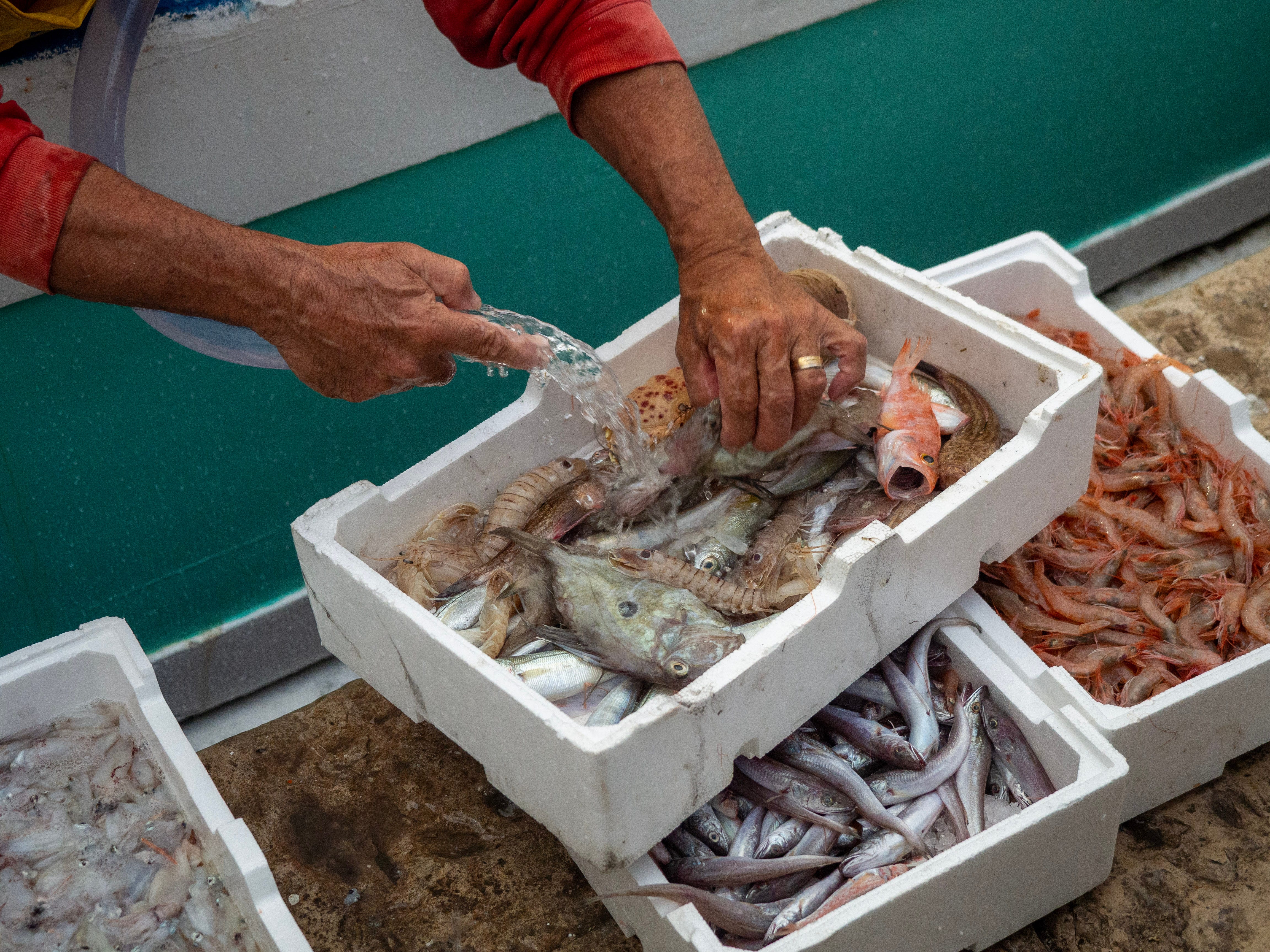
That macabre sight might have killed our appetites, but in Italy, nothing could really vanquish our appetites. We wandered into the waterfront Trattoria Pizzeria Bibbó and had an incredible meal of seafood pasta and a luxuriant four-cheese pizza. Fish is a staple ingredient of local cuisine in Salento, where we watched fishermen hawk their wares.
Sarathi won four games and drew two in the tournament. While he was bent over the board, I did some additional sightseeing. It’s true that life in the fast lane in Italy is really fast, but once I got used to the endless roundabouts and the merciless tailgating, the driving was less stressful than NYC and NJ. Hell hath no fury like the George Washington Bridge at rush hour or the honk-happy drivers of Jersey City.
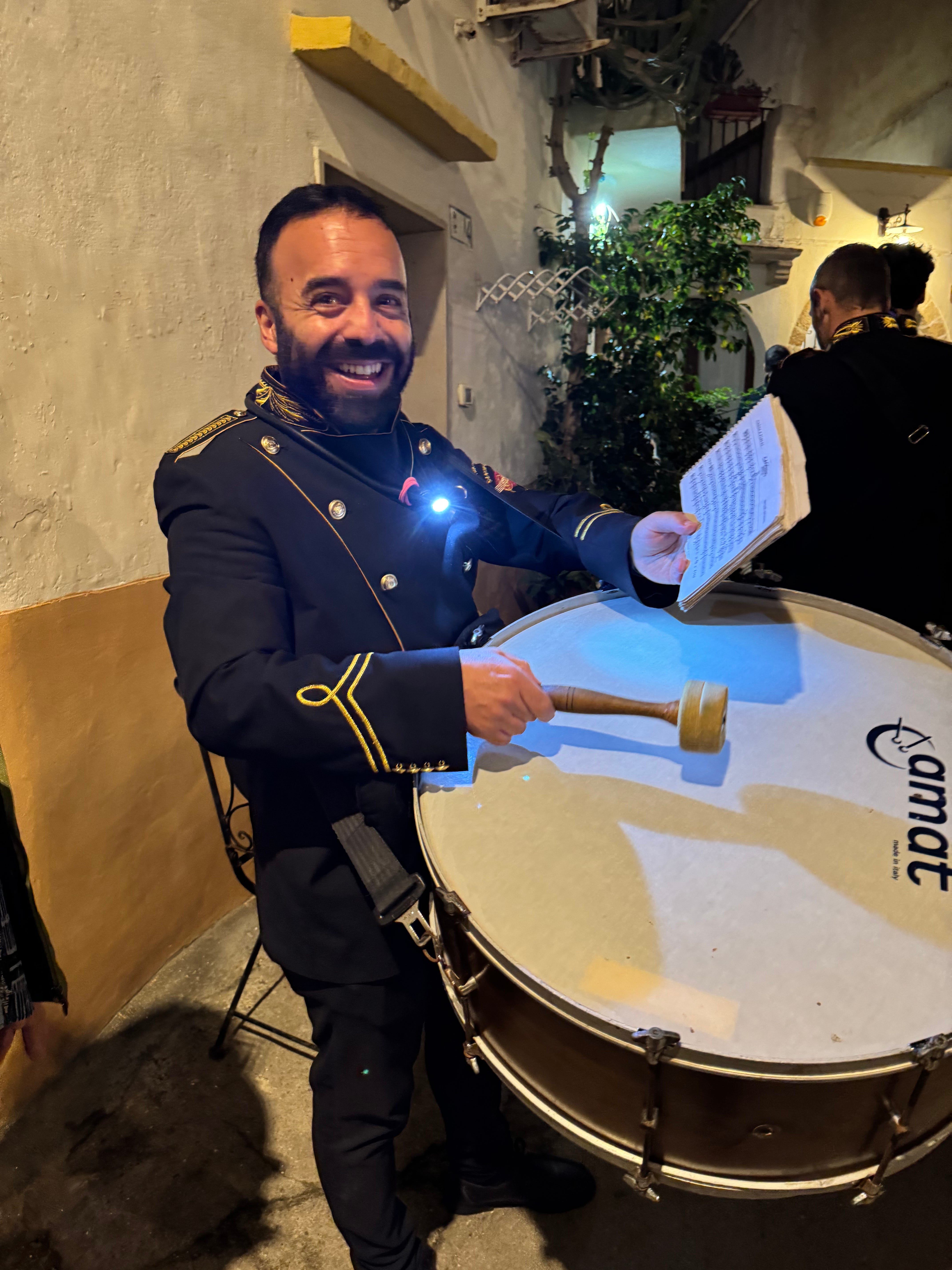
On an outing with Lily Ginsburg, the daughter of International Master Mark Ginsburg, I went to the tiny village of San Simone to hear pizzica music, which I wrote about in my last newsletter. On our final night in Puglia, Sarathi and I enjoyed a musical surprise when we bumped into a parade in the cobbled streets of Gallipoli.
Unfortunately, that was followed by a nasty surprise when Sarathi was hit from behind by a kid on an electric scooter. The kid (a boy of perhaps 11) was profusely apologetic and tried to help Sarathi stand up. Two German tourists helped Sarathi hobble down the street and a kind local called an ambulance and waited with us.
Sarathi was carted off to Gallipoli’s local public hospital, where the docs did x-rays, bandaged him up and when they saw that nothing was broken, sent us on our way. When the medic was printing out some forms, I assumed it was a bill. “Non siamo in America” (“We’re not in America”) he said caustically. He was printing after care instructions and didn’t charge us a penny. We were grateful for their care.
In Italy, as in every sane, developed nation except the U.S., emergency care is free but public and private systems co-exist. After our flight back to Newark was cancelled, we wanted to check the wound wasn’t getting infected. It was a national holiday and not much was open, so the hotel receptionist found a local doctor to come to our room. “Superficiale,” the doc declared upon inspecting the damage, seemingly disappointed that the wounds weren’t deeper. It cost 250 Euros to have the bandage changed. “Thank you for your money,” he said as he left.
I’m happy to report that Sarathi is doing fine. I also turned 50 this year, although I am not ready to accept being a ‘senior.’ (Note to the AARP – please stop sending us stuff! I’m 35 in my head!) But in the interest of keeping my middle-aged brain fresh, I’m finally learning how to play chess!
For more content like the above, please follow my substack here.
Vivien Schweitzer, Marshall Chess Club Member
Chess Toons
En Passant
India’s Sarwagya Singh Kushwaha has become the youngest player in chess history to earn an official Fide rating at the age of three years, seven months and 20 days.
IM Eric Rosen announces his marriage to IM Irene Sukandar.
GM Nodirbek Abdusattorov had already won the London Chess Classic Elite Tournament with a day to spare, and all draws in the final round meant he finished two points clear on 7.5/9.
FIDE has announced the passing of Casto Abundo, Executive Director of the Asian Chess Federation, whose five decades of service left a lasting mark on the global chess community. A respected arbiter and organiser, he played key roles in major international events and helped strengthen the institutional framework for chess across Asia.
Next Monday, the final of the Freestyle Grand Slam 2025 will begin in Grootenbosch (South Africa). To mark the opening, a diving chess competition was organised in Cape Town, which was won by Hans Niemann.
Problems, Problems, curated by Alexander George
W. A. Shinkman, 1901
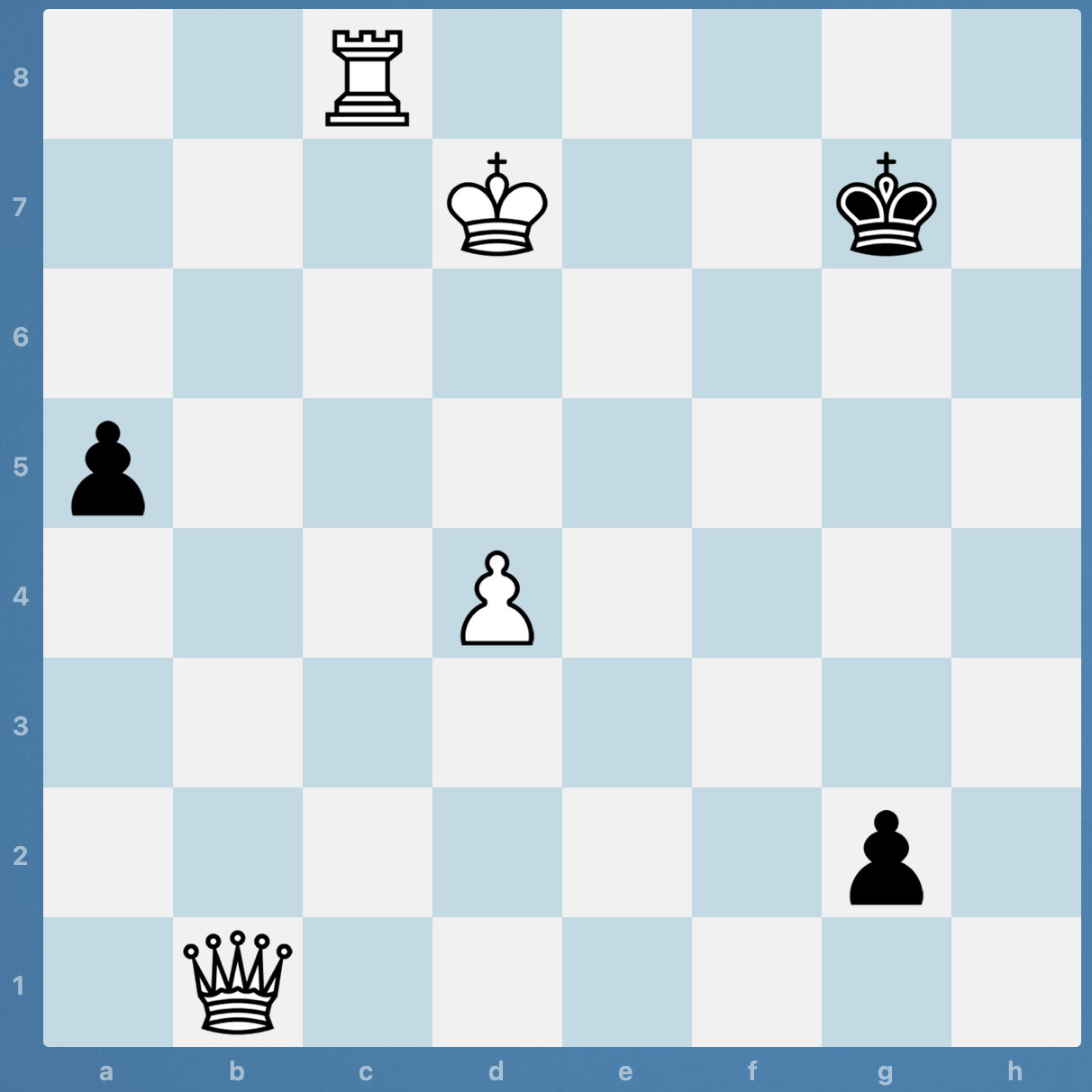
White to mate in 3.
In chess, we often seek to restrict the movement of the enemy king as we try to close the mating net. Sometimes art thumbs its nose at life.
---
Solution to last issue’s problem (W. Shinkman, 1887):
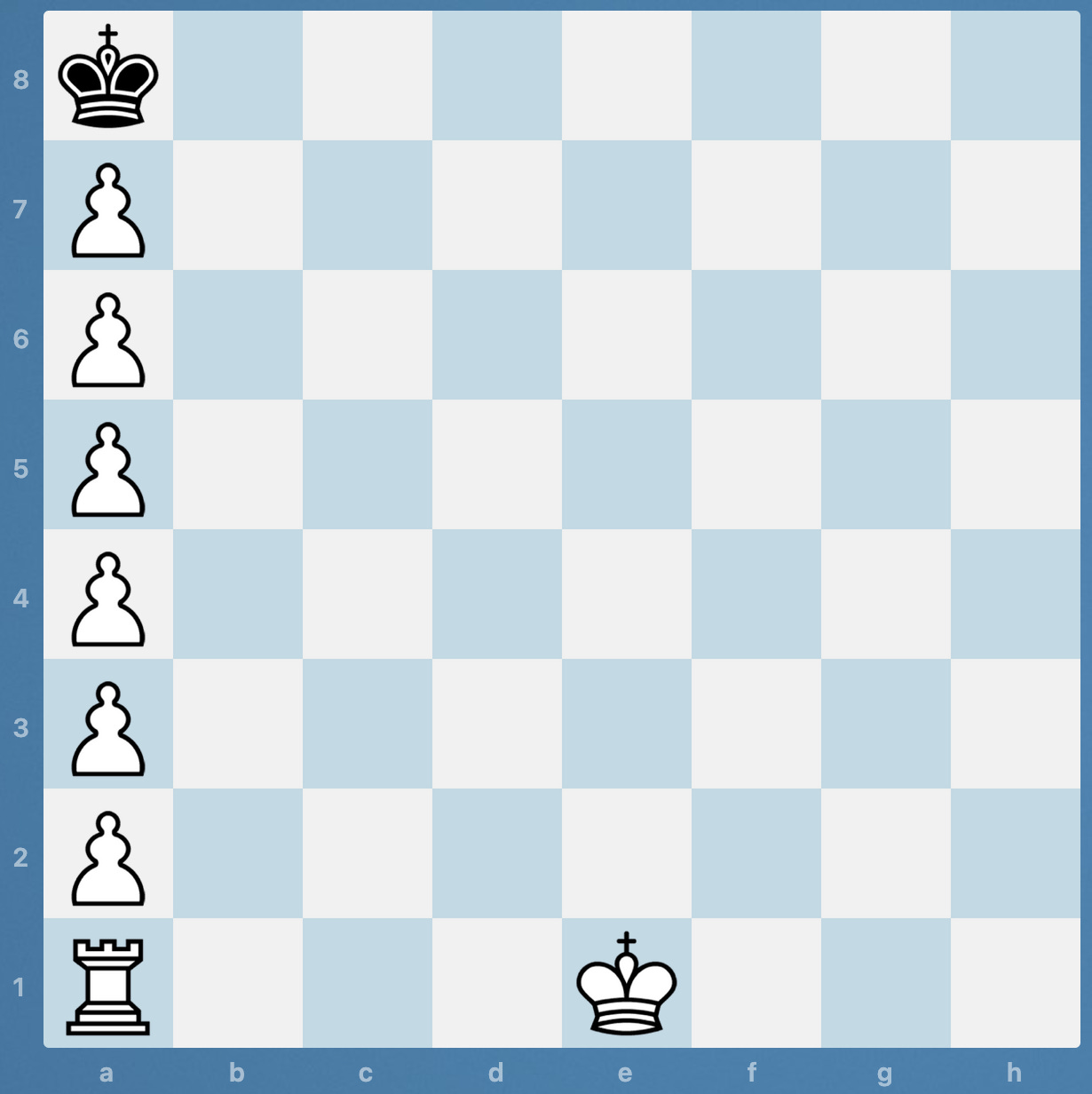
White to move and mate in 8
Solution: 1.0-0-0 Kxa7 2.Rd8 Kxa6 3.Rd7 Kxa5 4.Rd6 Kxa4 5.Rd5 Kxa3 6.Rd4 Kxa2 7.Rd3 Ka1 8.Ra3 mate.
Sadly, there’s an alternative solution that starts with 1.Kd2. But it seems that Shinkman never intended it to be a sound mate in 8! It seems, rather, that he intended it to be the final position of a retroanalytical problem: find the game that leads to this position after Black’s 34th move! For the fascinating story behind the retroanalytical challenge and the hunt for a sound setting of the mate in 8, see the entry in Tim Krabbé’s (wonderful) Chess Curiosities.
---
Alexander George
Editor’s Note
As always, if you have any feedback, comments, or would like to submit an article please contact us directly at td@marshallchessclub.org.
Enjoy, and thanks for reading!
The Marshall Chess Club
23 West Tenth Street New York, NY 10011
212.477.3716

Thanks for reading The Marshall Spectator! Subscribe for free to receive new posts and support the club.
Really enjoyed Vivien's piece on the senior championship in Gallipoli. The contrast betwen the intense anti-cheating protocols and that congenial postgame analysis culture shows competitive chess atits best. Also wild that emergency care was free while a bandage change cost 250 euros, the Italian healthcare system in a nutshell there.