

The Marshall Spectator
June 10, 2026


In This Issue:
From The Skittles Room
Three Siblings, Three National Chess Titles by The Doron-Repa Family
Funeral Announcement, Ian Fleischman
Chess Toons
En Passant
Problems, Problems, curated by Alexander George
Editor’s Note

Welcome back, fellow chess players, to this edition of the Marshall Chess Club’s fortnightly bulletin, The Marshall Spectator.
Last night, the Marshall Chess Club held our Annual Meeting, which included an election for 5 open seats. After votes were tallied, it was determined that the following candidates won the election and will be seated for a three-year term: Ken Kubo, Vladimir Bugayev, Stephane Derveaux, Luka Glinsky, and Evan Rosenberg. The editorial staff of The Marshall Spectator would like to congratulate the newly elected and reëlected board members and look forward to their contributions to the club. We would also like to thank the members Jeremy Graham and Micah Jameson who campaigned in this election and participated in the democratic process of governance, but fell just a few votes shy of gaining a seat in this race.
Last week we were lucky to be visited by two wonderful chess authors, Shernaz Kennedy came to the club on Tuesday and just a few short days later IM Danny Rensch visited the club on Friday. Both gave engaging talks about their respective books followed by lively discussions and a question and answer period. If you were unable to join, both events will be viewable in their entirety soon on our events replay page.
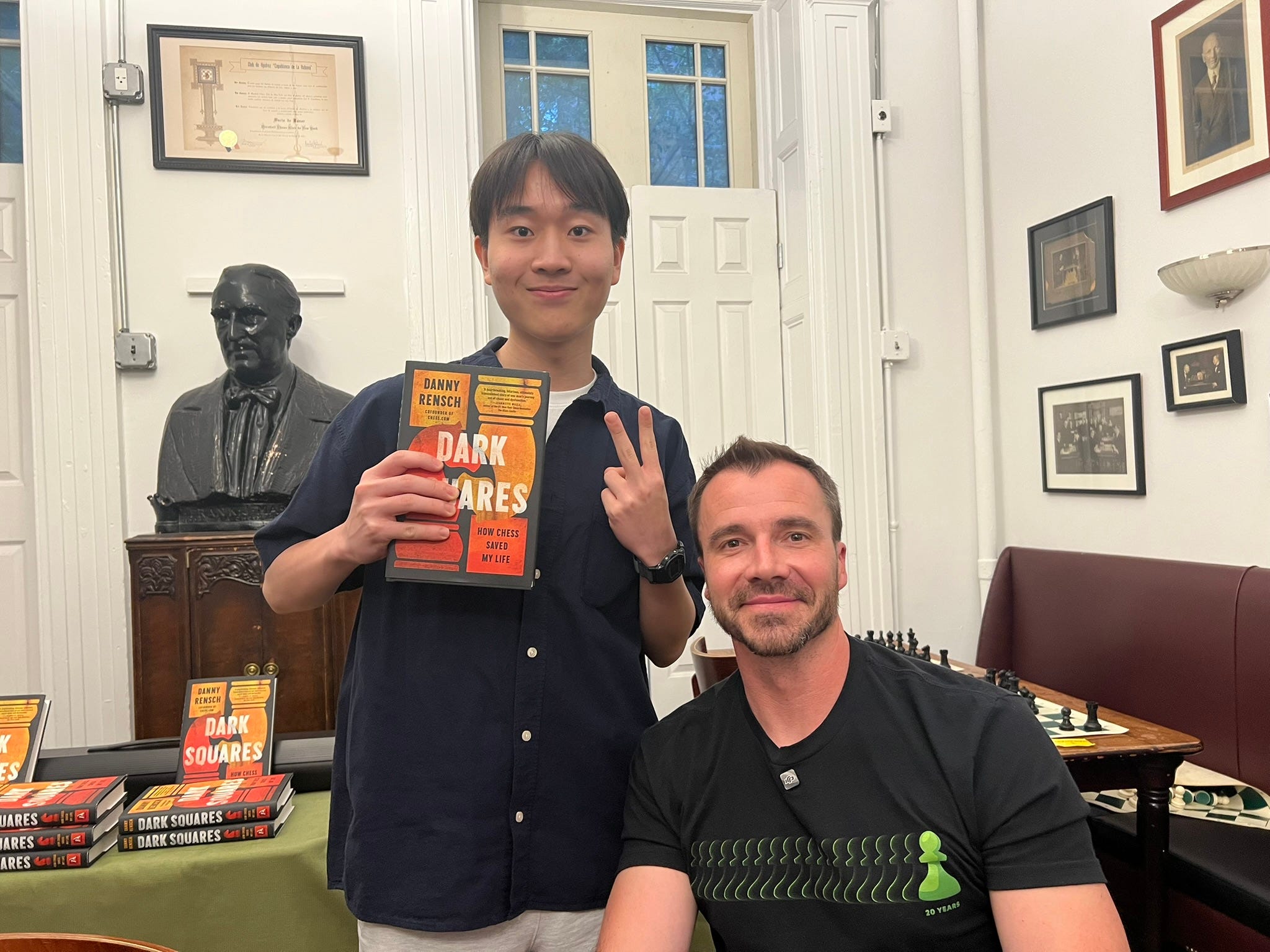
One notable guest of the club was Chess enthusiast Woosung Lee, pictured below with his signed copy of “Dark Squares.” Woosung traveled all the way from Korea to the Marshall Chess Club just for the opportunity to meet IM Danny Rensch, and get his book autographed. He is a rising senior and is captain of his high school chess team.
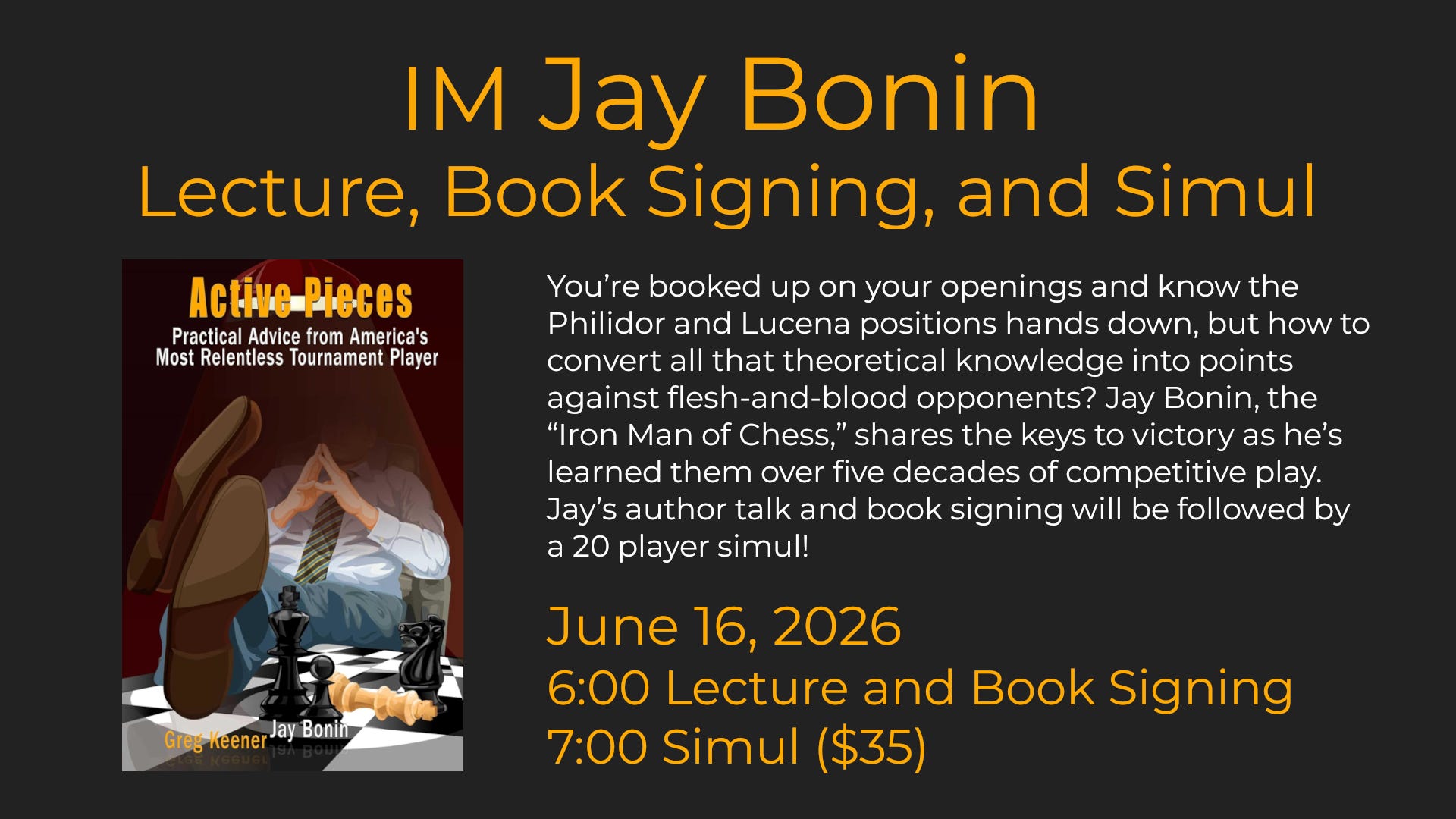
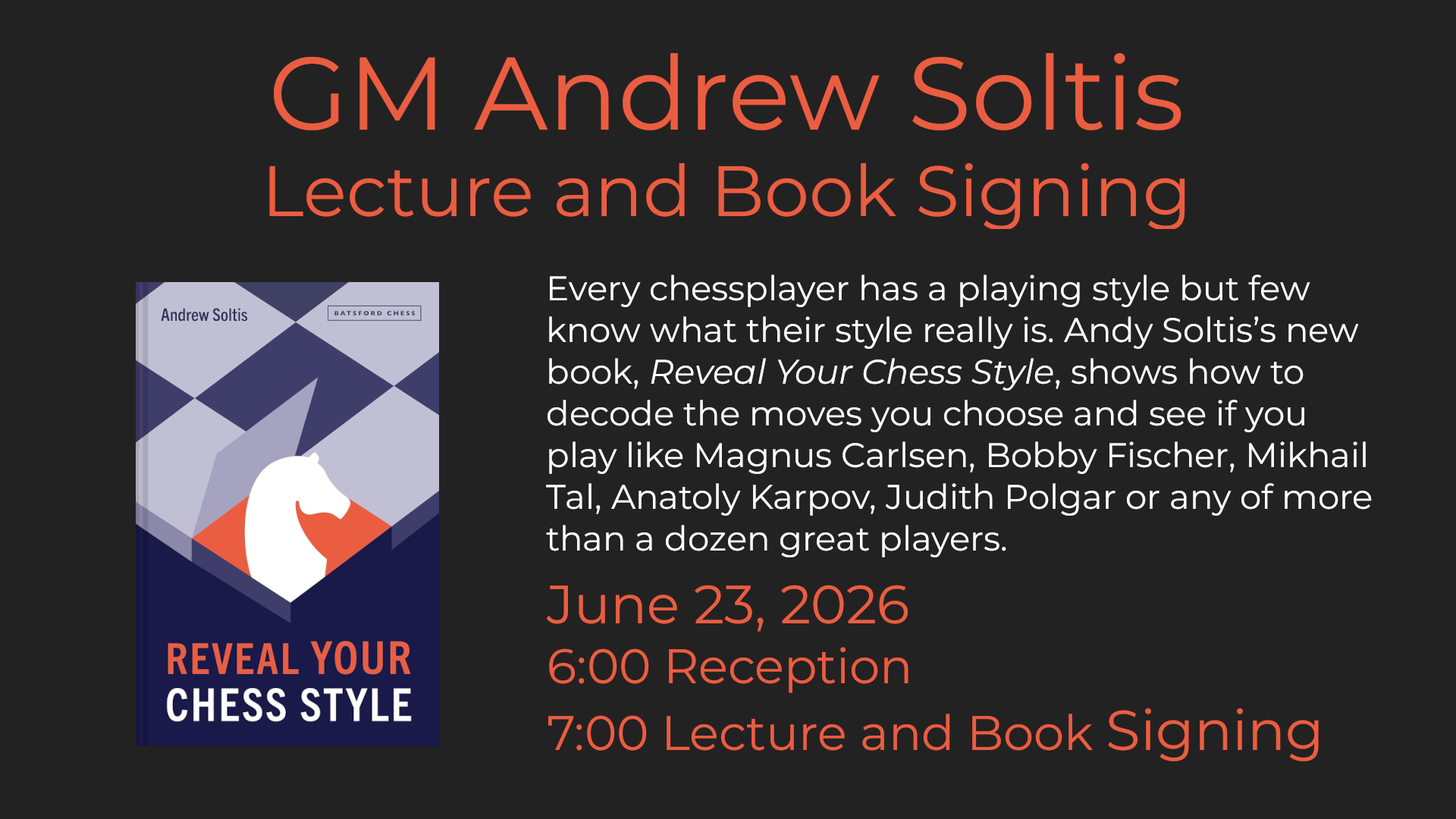
Looking ahead to future book events, GM Andrew Soltis and IM Jay Bonin will also be presenting at the club in June!
Summer is around the corner! We are excited to share that this summer, GM Djurabek Khamrakulov will be onsite all weeks, as well as an additional GM for most weeks of the summer! This means that the top two groups will receive GM instruction.
June 15, 16, 17, 18, 19
June 22, 23, 24, 25, 26 (GM Oliver Barbosa)
June 29, 30, Jul 1, 2, 3 (GM Andrei Maksimenko)
July 6, 7, 8, 9, 10 (GM Andrei Maksimenko)
July 13, 14, 15, 16, 17 (GM Andrei Maksimenko)
July 20, 21, 22, 23, 24 (GM Andrei Maksimenko)
July 27, 28, 29, 30, 31 (GM Andrei Maksimenko)
August 3, 4, 5, 6, 7 (GM Elshan Moradiabadi)
August 10, 11, 12, 13, 14 (GM Elshan Moradiabadi)
August 17, 18, 19, 20, 21
August 24, 25, 26, 27, 28
We are also excited to share some additional perks if you register multiple weeks in advance this summer:
2 weeks: 1 Marshall Chess Academy Shirt
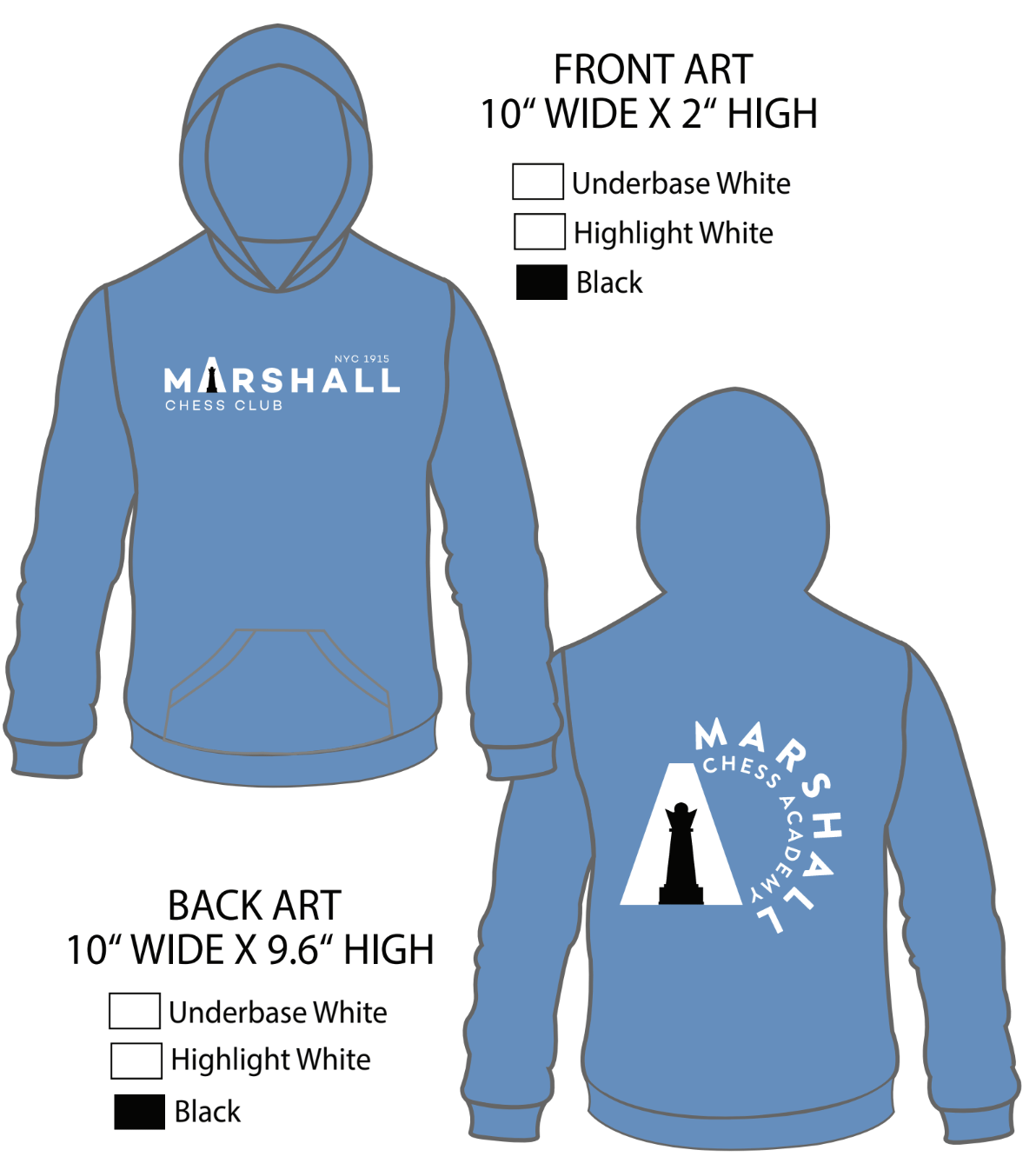
2 weeks: 1 MCA hoodie
3 weeks: $50 tournament credit per week registered
4 weeks:  1 year club membership extension
Financial support will be available- please reach out directly to Kevin at kevinf@marshallchessclub.org
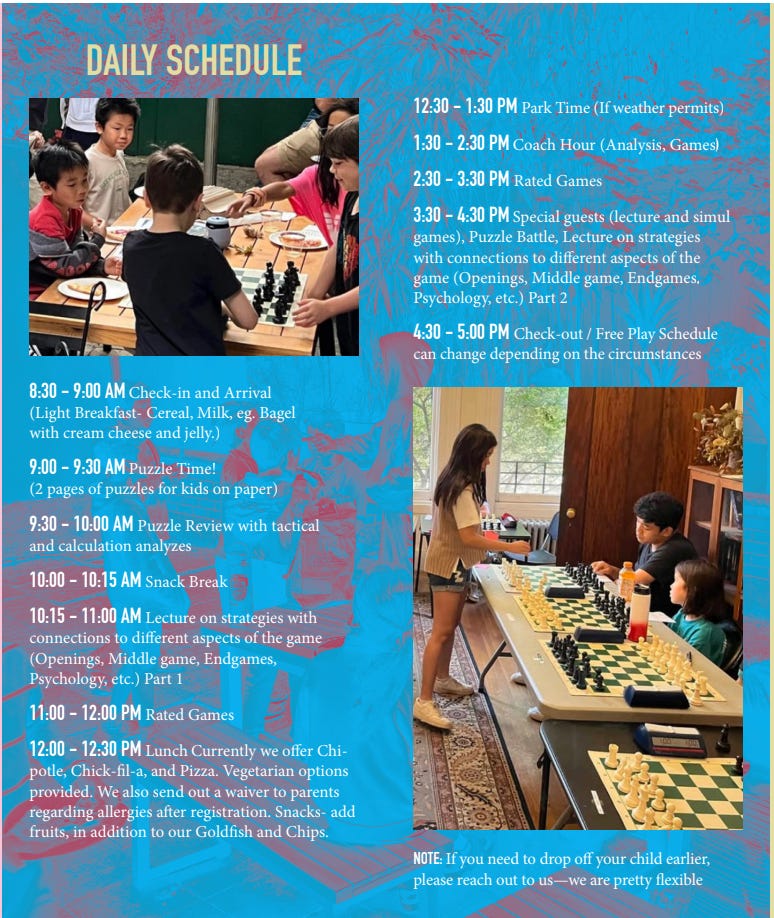
Also coming up we will be having the second Marshall Chess Academy Blitz Championship:
Date: June 28
Format: 9-SS, G/3 +2
Entry Fee: $100 (Members Only)
Eligibility & Discounts
GMs, IMs, and FMs: Free
Camp Attendees: $35
Contact: kevinf@marshallchessclub.org to register
Tournament Format
After the 9-round Swiss, the Top 4 players (by tiebreaks) qualify for playoffs.
Semifinals:
2 games, G/3 +2
If tied 1–1, additional games are played until a winner is decided.
Final & 3rd Place Match:
2 games, G/3 +2
If tied, continue playing until the first decisive result.
Schedule
Round 1: 1:30 PM
Remaining rounds: ASAP
Pizza & Soda Break: 4:00 PM
Semifinals: 4:30 PM
Finals: 5:15 PM
Awards Ceremony: 6:00 PM
Prizes ($1,450 GTD)
1st Place: $600 + MCA Hoodie
2nd Place: $400
3rd Place: $200
4th Place: $100
U1900: $75
U1700: $75
Trophies to all playoff finishers
Additional Information
Pizza and soda provided at 4:00 PM
Live commentary during the event
Winner’s interview after the finals
Maximum 3 byes (must request at entry)
Registration closes 2 hours before the event starts
Marshall Chess Club Academy Blitz Championship U1500 — At Club!
Date: June 28
Format: 9-SS, G/3 +2
Entry Fee: $75 (Members Only)
Eligibility & Discounts
Camp Attendees: $25
Contact: kevinf@marshallchessclub.org to register
Schedule
Round 1: 1:30 PM
Remaining rounds: ASAP
Pizza & Soda Break: 4:00 PM
Awards Ceremony: 4:15 PM
Prizes ($600 GTD)
1st Place: $200 + MCA Hoodie
2nd Place: $150
3rd Place: $100
U1000: $75
U600: $75
Trophies to all finishers
Additional Information
Pizza and soda provided at 4:00 PM
Live commentary during the event
Winner’s interview after the finals
Maximum 3 byes (must request at entry)
Registration closes 2 hours before the event starts
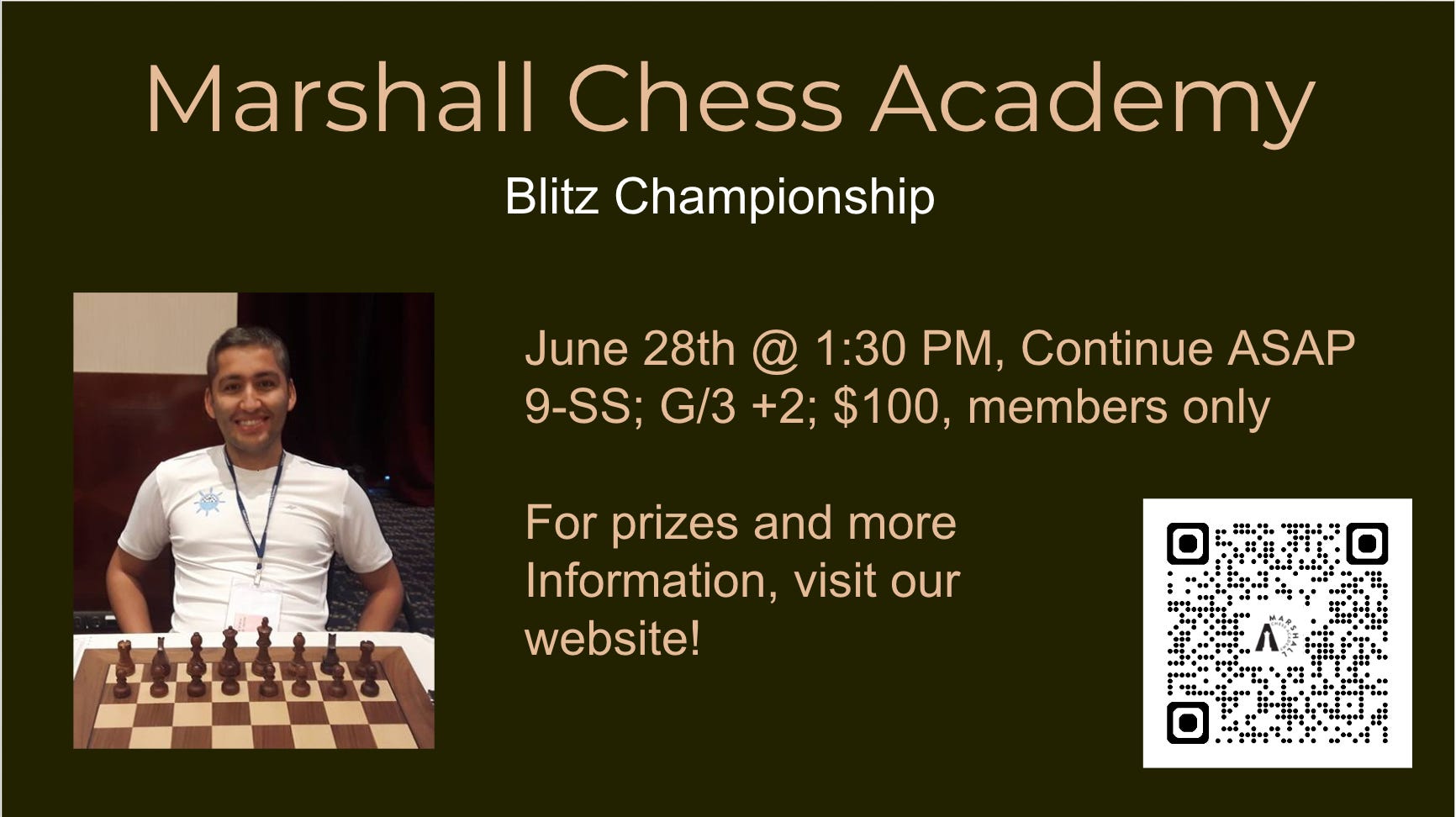
Looking further ahead to this summer, we’re thrilled to announce our annual Super Swiss will once again be held at 23 West 10th Street.
The tournament will be held from July 15-19, 2026.
Prize Fund: $10,150, Norms possible!, Rating floor: 2000+ FIDE
Escalating entry fee: $550 Now through June 30th, $650 July 1st-12th, $750 July 13th-15th.
Registration is now live on our event webpage. You can register HERE.
Looking back over the last two weeks, we have had a plethora of events for our members to participate in.
The Thursday Open on June 7 had 41 players registered and was won by FM Aditeya Das who scored a perfect 4 out of 4 to win $216, while IM Tanitoluwa Adewumi and FM Leif Pressman scored 3.5 out of 4 to win $126. Denys Bashmakov won a $108 class prize for scoring 3 out of 4, while the following players won $36 each for their 3 out of 4 performance: Daniel Frank Johnston, WFM Julia Elizabeth Sloan, and Adam Gordon.
The Saturday Game 50 Under 1800 on June 6 had 32 players registered and was won by Leah Cai and Bo Pang who scored 3.5 out of 4 to win $214.50 each, while Jephson Matthew and Daniel Han scored 2.5 out of 4 to share in a class prize winning $66 each.
The Morning Masters on June 6 had 12 players registered and was won by FM Arun Dixit who scored a perfect 3 out of 3 to win the $120 first-place prize, while GM Michael Rohde scored 2.5 out of 3 to win $90.
The Under 2000 Morning Action on June 6 had 23 players registered and was won by Christopher Weldon and Cameron Hull who scored a perfect 3 out of 3 to win the $141.50 each, while Kemar Lynch, Woobin John, and Vincent Zhu scored 2 out of 3 to win $40.33 each.
The Saturday Game 50 Open on June 6 had 27 players registered and was won by FM Justin Chen who scored 4 out of 4 to win $208, while Thomas Li and Arhan Javeri scored 3.5 out of 4 to win $124.50 each.
The Rated Beginner Open on May 31 had 46 players registered and was won by the following players who scored a perfect 3 out of 3 to win $95.83 each: Gabriel Gaidamour, Benjamin Reiner, Jabari Benjamin, Vasily Baskin, Ben Bar, and Matthew Bartsch.
The Morning Under 1600 on May 31 had 30 players registered and was won by John Thomas McDowell, Jayden Roh, and Kevin Yu who all scored 3 out of 3 to win $175 each.
The Sunday Quads on May 31 had 21 quads and featured a small swiss of 7 players as well, with many prize winners. The following players won $70 each for winning their quad: Jack Boyer-Olson, Misha Raitzin, Jesse Lee, Darren Wu, Aileen Lou, Takki Tanaka, Bryant Anson Chen, Jonathan Tieng, Nathan Lewinger, Ryan Isaiah Saavedra, Aden Lexian Deng, Jesper Liu, Laksh Mehta, Max Debenedittis, and Tim Li. The following players split their quad winnings, netting $35 each for their performance: Naveen Paruchuri, Kyle Cheung, Miles Hinson, Zhuoyuan Ryan Xo, CM Grayson Xiang, Aayansh Pramanik, Thomas Li, Leqi Han, Dervin Kouyate, Liam Kojuharov, William Chan, and Mark Xu. And Mingyang Li, Jodan Kim, and Henry Mingzhe Li won $23.33 each for their 2 out of 3 performance ending in a 3-way tie.
The Under 2000 Morning Action on May 30 had 57 players registered. Ophelia Guan won a $300 class prize for her perfect 3 out of 3 score, while the following players won $139.80 each for their perfect 3 out of 3 performance: Mio James Kong, Salah Al-Din Bouillon, Ratan Kumar Chinni, Reed Shlisky, and Maximilian Almers.
The Saturday Game 50 Under 1800 on May 30 had 54 players registered and was won by the following players who scored 3.5 out of 4 to win $181 each: Anthony Asseviro, Lawrence Lin, Francois Duan, and WCM Kara Chan. Jacky Zheng and Jeffrey Robert Horn scored 3 out of 4 to win $111.50 each.
The Morning Masters on May 30 had 18 players registered and was won by FM Aditeya Das who scored a perfect 3 out of 3 to win the $170 first-place prize. FM Arun Dixit scored 2.5 out of 3 ot win the $128 second-place prize.
The Saturday Game 50 Open on May 30 had 43 players registered and was won by IM Jay Bonin who scored a perfect 4 out of 4 to win the $336 first-place prize, while the following players won $75.67 each for their 3.5 out of 4 score: FM Arun Dixit, FM Leif Pressman, GM and Michael Rohde. Thomas Li and Jeremiah Beckles won $87 each for their 3 out of 4 performance.
The FIDE Blitz on May 29 had 63 players registered and was won by IM Bryan Lin who scored a near-perfect 8 out of 9 to win the $413 first place prize. GM Brewington Hardaway scored 7.5 points to win $207, FM Linxi Zhu scored 7 points to win $104, Gavin Liu also won a $104 class prize for a 5.5 performance, while the following players won $52 each for scoring 6 out of 9: GM Arthur Guo, NM Elliott Goodrich, Michael Glick, and Rohan Lee.
The Afternoon Action on May 29 had 15 players registered and was won by FM Arun Dixit who scored a perfect 3 out of 3 to win the $113 first-place prize, while Nicolas Marchese scored 2.5 out of 3 to win $75.
The Thursday Action on May 28 had 32 players registered and was won by FM Arun Dixit who scored a perfect 4 out of 4 to win $168, while Nathan Lewinger won an $84 class prize for his 3 out of 4 score, while the following players won $56 each for their 3 out of 4 performance: IM Tanitoluwa Adewumi, IM Jay Bonin, Luc Hoffman, Sasha Kagle, and Mike Ching. The upset prize was won by Laurel Turner.
The Marshall Masters on May 26 had 19 players registered and was won by IM Tanitoluwa Adewumi who scored 3.5 out of 4 to win the $240 first-placed prize. IM Alexander Katz and FM Arun Dixit scored 3 out of 4 to win $120 each, while Isaac Hart Statz and Corin Gartenlaub scored 2.5 out of 4 to win $30 each.
The Memorial Day Action on May 25 had 41 players and was won by GM Michael Rohde who scored 5.5 out of 6 to win the $325 first-place prize. Kenny Bolling took the $195 second-place prize for his 5 out of 6 score, while Leif Pressman won the $65 third-place prize for his 4.5 out of 6 performance. Naveen Paruchuri won a $130 class prize for his 4.5 out of 6 score, while the following players won $43.33 each for scoring 4 points: Anthony Kozikowski, Maximillian Mills-Wren, and Kyle Cheng. Eithan Sapir and Victor Kenny-Maheux shared in the remaining class prize, winning $65 each for their 3.5 out of 6 score.
We look forward to seeing you at the club soon!
Three Siblings, Three National Chess Titles
Chess has been a part of the Doron-Repa family’s life for more than a decade, when all three children in the family achieved national championship results in scholastic chess. What started as an opportunity to spend time with friends eventually grew into a shared family experience that led Maya, Hillel, and Yotam each to reach the top of a major national event at different stages of their chess careers, an unusual accomplishment for a single family.
The first championship came in 2015, when Maya Doron-Repa tied for first place in the Under-10 section of the All-Girls National Championships in Chicago, scoring 5.5 out of 6 points. Ten years later, her brother Hillel won the K–8 Under 1700 section at SuperNationals VIII in Orlando, finishing with 6 out of 7 points and earning first place on tiebreaks. In 2026, Yotam Doron-Repa tied for first at the National Middle School Championship in Round Rock, Texas, scoring 6.5 out of 7 and also securing the championship on tiebreaks.
The family’s involvement in chess began when Maya joined the chess team at PS 282 in Brooklyn as a kindergartener. Neither parent played chess competitively, but they supported their children’s growing interest in the game. Their mom, Neot, who is well known throughout New York scholastic chess circles for her volunteer work and long-standing support of youth chess programs and events viewed the tournaments as “play dates with chess interruptions,”
Over the years, all three siblings benefited from the guidance of coaches and organizations that have long been central to New York City’s scholastic chess community.
Maya studied under Steve Colding and later worked with coaches including Levy Rozman, Alex Ostrovsky, and the chess program at Speyer Legacy School under Sunil Weeramantry. Hillel and Yotam also trained with Colding, as well as with Saudin Robovic, Majur Juac and Furqan Tanwir before continuing their substantial development at IS-318 under Elizabeth Spiegel and her coaching staff - who were very instrumental in the kids’ progress and in their love of chess.
The family credits much of their children’s growth to the broader scholastic chess community, particularly Chess in the Schools led by Shaun Smith, The Right Move, founded and led for many years by the late John McManus, Impact Coaching Network led by Russell Makofsky and Ian West, and the historic Marshall Chess Club in Manhattan, which served as a frequent tournament and playing venue throughout their scholastic careers.
Today, Maya is a student at Princeton University studying Computer Science, Mathematics, and Music Theater, while continuing to volunteer as a chess coach for young girls in Her Move Next organization. Hillel and Yotam are completing eighth grade at IS-318 and preparing to enter high school.
For the family, the championships are meaningful milestones, but they are only part of a larger experience shaped by learning, mentorship, community, and a lasting enjoyment of the game.
Answered Questions by Maya:
Tell us a little about yourself. How old are you, and how did you first get interested in chess?
Hi! I’m Maya, and I’m 20 years old. I’m currently a rising senior at Princeton University, majoring in Computer Science and minoring in Mathematics and Music Theater (the Music Theater minor is something not many people know about!)
I first got interested in chess when I was around 5 or 6 years old. Honestly, the main reason I tried it at first was that my best friend was on my elementary school’s chess team, and I wanted to join her. I did not know much about chess yet, but I loved games, and once I became part of the team, I quickly realized how amazing the chess community could be.
The funny part is that, although I do not remember this myself, my parents were apparently told I had not made the team. Then Mr. Colding realized he had confused me with another kid, and I actually had made it. From there, chess became a huge part of my childhood. At some point I became the top ranked girl in New York state and one of the strongest young female players in the country. When I joined the Royal Panthers (as our team was called) I made some of my closest elementary-school friends through chess. I also discovered how much I loved strategy, creative thinking, and problem-solving. Those interests have stayed with me ever since, eventually carrying into my love for math and, later, computer science.
What was going through your mind during the game you’ve selected for this newsletter? Why did you choose this particular game?
You can play through the game here.
2015 KCF All-Girls National Championships
Dorina Breznyan vs Maya Doron-Repa
1. e4 e5 The final round. I was given Black against an opponent rated over 100 points higher than me, and we were playing on board 2. The only two players still on a perfect 5/5 were seated to my right on board 1, so realistically, my chances of becoming a champion were low: they depended not only on winning my own game, but also on board 1 ending in a draw. Still, all I could control was my own game.
These days, I usually prefer the Caro-Kann or French, but back then I met her 1.e4 with 1...e5, ready for a long fight, however many moves it would take.
2. Nf3 Nc6 3. Bc4 Nf6 4. Ng5 As soon as my opponent played 4. Ng5, I knew I was in for something sharp. Scary, yes, but also exciting. My coach at the time, Mr. Colding, had taught me a risky, aggressive line against this move, and now I had the chance to play it on the board. And it plays out as follows.
4... Bc5 It is worth noting that after this move, Stockfish gives White about a +1.0 advantage, whereas the position had previously been ‘equal.’ Still, it was very early in the game, and at our level, a small engine edge meant much less than practical familiarity with the position. Since this was an unusual line, I suspected I might be better prepared for the next few moves, giving me at least a psychological advantage.
5. Nxf7 Bxf2+ From what I can recall, my opponent spent a decent amount of time on this move. At my rating then, just shy of 1300, an early sacrifice could easily look suspicious, or simply like a blunder. But she was right to be careful: this was a non-trivial position, and I had several traps in mind.
Stockfish considers the position ‘equal’ whether she accepts the sacrifice with 6. Kxf2 or declines it with 6. Kf1. But in the final round on board 2, and in such an unusual opening, the decision was not so simple. I felt that my preparation again gave me a practical edge here, even if the engine evaluation was still balanced.
6. Kf1 Qe7 7. Nxh8 Although I lost a rook, I knew the position was still playable because of the following resource: 7....d5! Once again, Stockfish evaluates the position as roughly equal. But over the board, neither of us was playing with computer-level precision, and my greater familiarity with the position continued to matter. Since I was more familiar with the ideas in this line, I was also able to play these moves quickly, building a significant time advantage over the last few moves.
7... d5 8. Bxd5 Unfortunately for her, she missed the deflection tactic I had set up with 7....d5. At first glance, the pawn may look free: White can consider taking it either with the bishop or with a pawn. But if my opponent takes with the bishop, it is a blunder because of the follow-up .8...Bg5, trapping the queen with help from the hanging bishop still sitting on f2! If taken with the bishop, the pawn on d5 deflects the bishop from being able to come back to e2 to save the queen.
8... Bg4
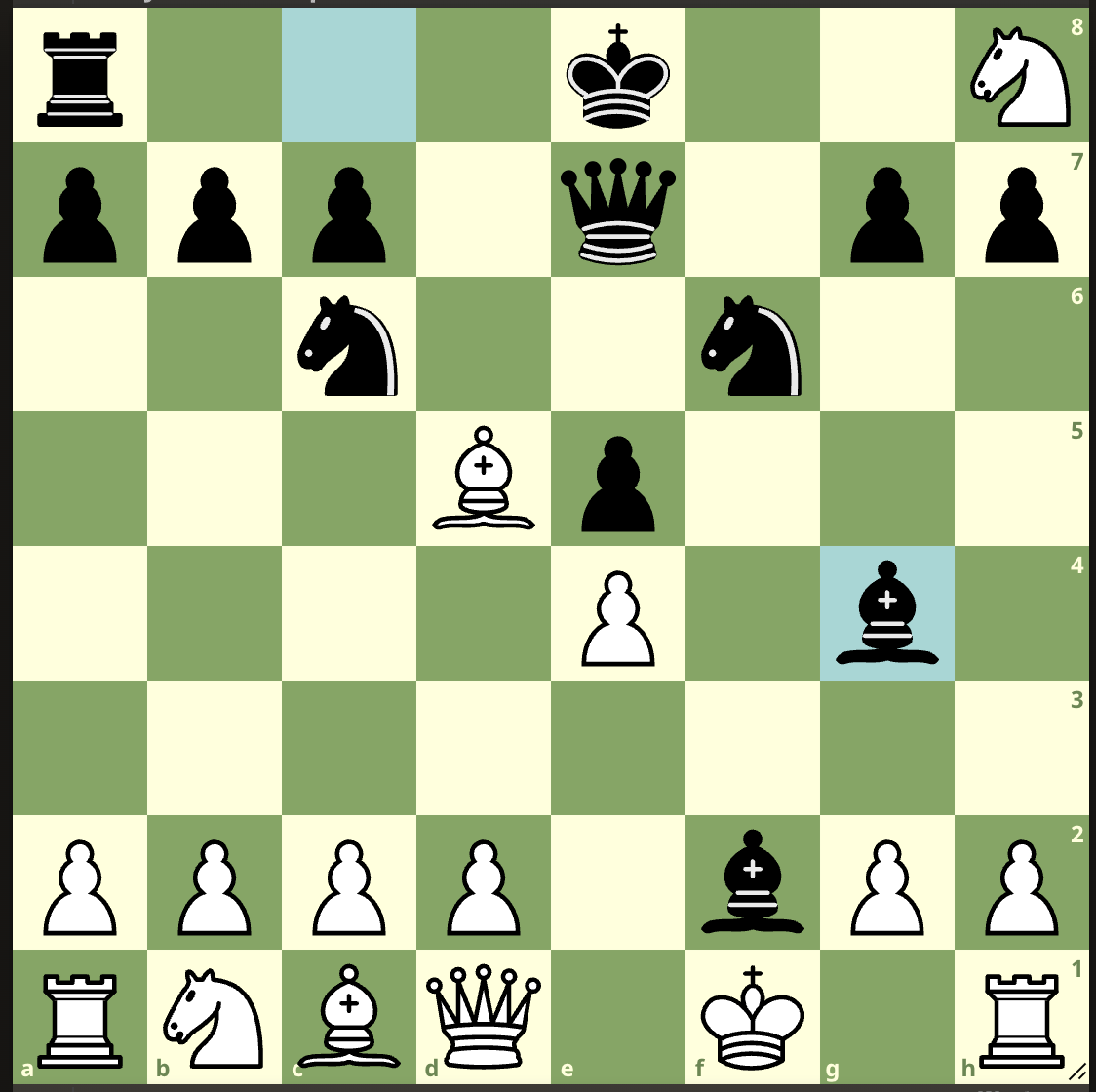
After I played this move, my opponent started crying. I felt sorry for her, but the game was still in progress. She got up several times, walked around, and drank multiple cups of water for the next 50 minutes before eventually settling back down (which I wrote down in the ‘notes’ section of my notation book, since I felt bad).
During that long pause, I was caught between several thoughts at once: feeling relieved about my position, wondering when my opponent would come back to the board, and trying to calculate how I would continue. At some point, I also looked over at board 1, where the result still mattered for my own chances. From what I could tell with my 1300-rated brain, they were still deep in the opening, with no obvious sacrifices or decisive advantage for either side.
Maybe, just maybe, there was still a chance they would draw.
But even if that happened, I still had to finish my own ‘won’ game.
9. Kxf2 Bxd1 10. Rxd1 Nxd5 11. exd5 Nd4 12. Na3 Qf8+ 13. Ke1 Qxh8 Here I won the queen and also picked up the knight on h8, so I felt very good about my position. Of course, my moves weren’t flawless, and Stockfish points out a few inaccuracies along the way, but the position should still have been winning as long as I avoided blundering anything major back.
14. c3 Nf5 15. Nb5 Kd7 16. Na3 Qf8 17. b3 Qf6 18. g3 Nh6 Again, I was still ahead here and knew it at the time, but even in a ‘won’ game, there are always things to improve on in post-game analysis, (especially at 1300, but really at any rating).
Although 18....Nh6 followed the same general attacking idea, I had missed the stronger tactical shot 18....Nxg3, a sacrifice that leads to mate in 3. The point is to trap the king while opening the f-file, preparing Rh8 and a queen-supported checkmate. Nh6 also opens this file, but it gives White chances to run with moves like Ke2 or d4, escaping the forced mate. (I left the Nxg3 mate in the study for anyone curious.) (18... Nxg3 19. hxg3 (19. d4 Qf1+ 20. Kd2 Qf2+) 19... Rf8 20. Ke2 Qf3+ 21. Ke1 Qf2#) 19. Nc4 Rf8 20. Ke2 Qf3+ 21. Ke1 Qf2# 0-1
Even without 18....Nxg3, a similar fate awaited White. And just like that, I had finished the tournament undefeated, with 5 wins and 1 draw across all 6 rounds of the All-Girls National Championships.
I shook my opponent’s hand, said “good game,” and took one final glance at board 1. They were still deep in the middlegame, with no obvious winner in sight. There was hope.
An hour or two later, I found out that they had indeed drawn. That meant I was one of three champions in my section, each finishing with 5.5/6. It may have been an unconventional final game, and an unconventional path to the title, especially since I had not played either of the other two co-champions, but it was a victory.
I celebrated over the phone with my dad and with Mr. Colding, and then in the team room with my mom and the two coaches, Ian West and Vladimir Bugayev, who were kind enough to offer me, since I had traveled without my team, to go over my games.
Looking back, the lesson of this game feels fitting: sometimes the best chance is not to play a ‘perfect’ game, but to reach a position you understand better than your opponent, trust your preparation, and be brave enough to make the game complicated.
I chose this game because it was not just the final round of the tournament, but also the game that gave me a chance to become one of the champions in my section. Going into the round, I was with 4.5/5 points, while the only two players still on a perfect score were playing each other on board 1. That meant I needed two things to happen: I had to win my own game, and they had to draw. I could not control what happened on board 1, so my mindset was really just to focus on my game and give myself the best chance possible.
The game itself also felt memorable because it became sharp very early. After my opponent played 4. Ng5, I entered a risky, aggressive line that my coach at the time, Mr. Colding, had taught me. Even though Stockfish now points out that the position was not always better for me, over the board I felt that I had a practical advantage because I knew the ideas in the position better. At that rating level, especially in a final-round game with nerves involved, preparation and familiarity can matter a lot.
I think I chose this game because it captures a lot of what I loved about chess as a kid: preparation, risk, psychology, and the feeling that anything can happen until the last result is known. It was not a perfect game, but it was a brave and memorable one.
How would you describe your playing style? Do you enjoy attacking, defending, tactical battles, endgames, or something else?
I would describe my playing style as aggressive and tactical, but also very practical. I enjoy positions where there is a lot to calculate, especially ones with sacrifices, threats, and unclear consequences. Those positions are more fun to me, and they also tend to be the ones I learn the most from afterward.
One idea I have always liked is that if a position is confusing for me, it is probably confusing for my opponent too. Of course, this does not mean making random moves or creating chaos for no reason, but I do think there is value in being willing to enter complicated positions and then trusting yourself to think them through.
That said, I also appreciate slower games and endgames more now than I did when I was younger. Attacking chess is exciting, but being able to convert an advantage, defend patiently, or understand a long endgame is just as important. So if I had to summarize my style, I would say I like active, tactical, and creative chess, especially when it gives both players real problems to solve.
================================================
Answered Questions by Hillel:
You can play through a selected game here with annotations.
Hillel D. vs Morgan Mayo
1. d4 c6 2. Bf4 d5 (2... Qb6 3. Nf3 Qxb2 4. Nbd2 Qb6) 3. e3 (3. Nf3 Nf6 4. e3 e6 5. c4 Bd6 6. Bg3) 3... Nf6 4. Bd3 e6 5. Nd2 Bd6 6. Bxd6 Qxd6 7. f4 Nbd7 8. Ngf3 c5 9. c3 c4 10. Be2 (10. Bc2) 10... Ng4 11. Nf1 Ndf6 12. Ne5 Nh6 13. Ng3 (13. g4 Nd7 14. g5 Nf5) 13... Nf5 14. Nxf5 exf5 15. O-O Ne4 16. Bf3 h5 17. Bxh5 g6 (17... Qh6 18. Nxf7 (18. Bxf7+ Kf8 19. h3) 18... Qxh5 19. Nxh8) 18. Bf3 Qe6 19. Bxe4 fxe4 20. h3 f6 21. Nxg6 Rh6
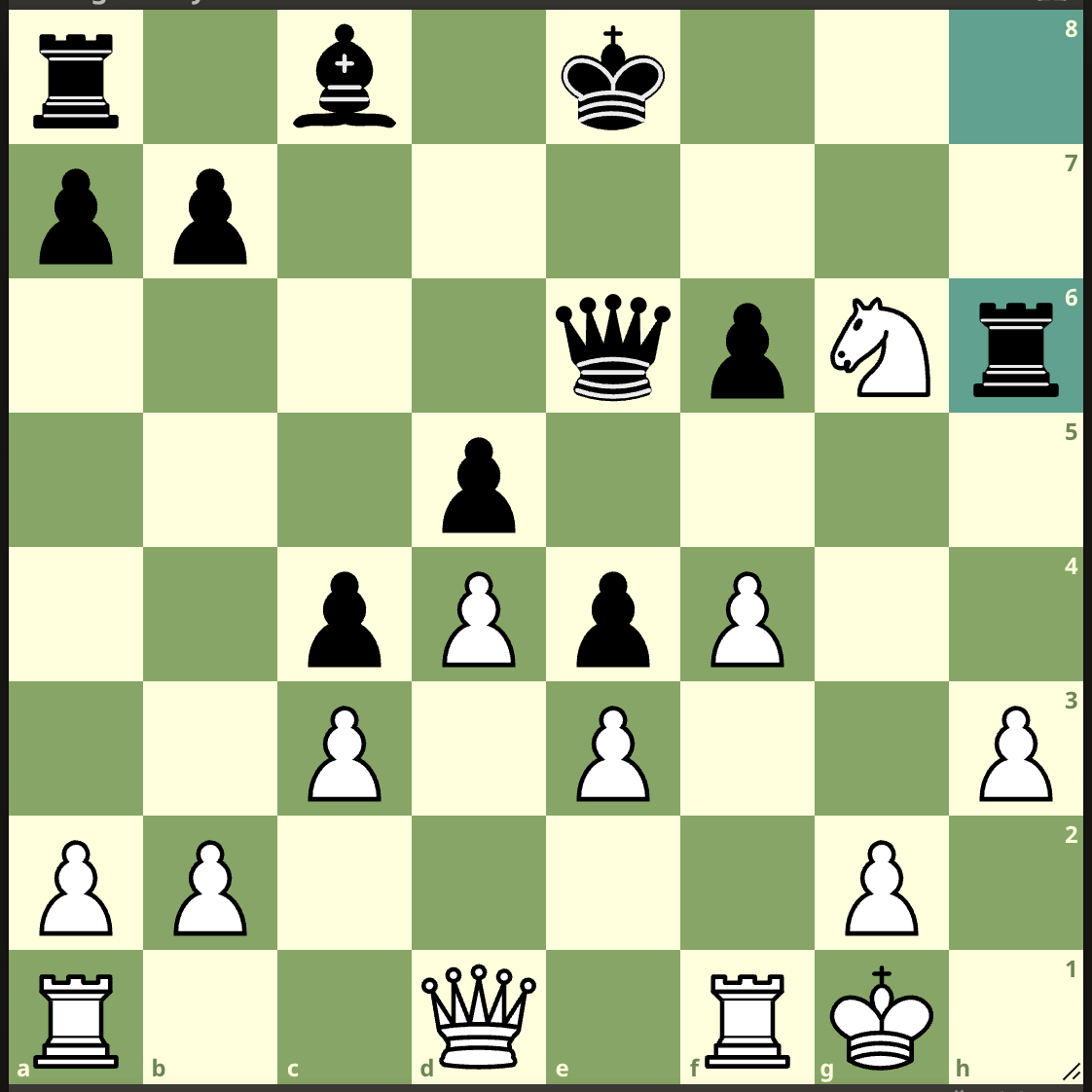
(21... Rxh3 22. gxh3 Qxh3 23. Qe2) 22. f5 Qf7 23. Qg4 Bxf5 24. Rxf5 Rxg6 25. Qh5 O-O-O 26. Raf1 Qg7 27. Qe2 Rg8 28. R1f2 Rh8 29. Rh5 Rd8 30. b3 b5 31. bxc4 bxc4 I missed Rd5, Because after Rxd5, Qxc4+ Wins the rook back.
32. Qb2 (32. Rxd5) 32... Qd7 33. Qa3 Qb7 34. Qc5+ Kb8 35. Qa3 (35. Rhf5 Qb1+ 36. Kh2 Rdg8 37. Rxf6) 35... Qb1+ 36. Kh2 Qe1 37. Qb2+ Ka8 38. Qd2 (38. Rh7 Rb8 39. Qa3) 38... Qb1 39. Rh7 Qb8+ 40. Kh1 Qb1+ 41. Kh2 Qb8+ 42. Rf4?
I should’ve just moved my king and not gone Rf4, but they missed the draw
42... Rdg8 (42... f5! 43. Kg1 Rdg8 44. Rf2) 43. g4 Rg5 44. Rf7 R5g6 45. Kg2 Qd6 46. Qf2 Rf8 47. Rxf8+ Qxf8 48. Rf5 Qd8 49. Qb2 Qa5 50. Rh5 Rg8 51. Rf5 Rg6 52. a3 Qd8 53. Qb5 Rg5 54. Qc6+ Kb8 55. Qxf6 Qxf6 56. Rxf6 1-0
Did well but shouldn’t have gone Rf4, giving them counterplay and making it a draw or me worse.
What achievement in chess are you most proud of so far, and why does it stand out to you?
My biggest achievement in chess that I’m most proud of is winning supernationals. It stands out to me because it is my first and only national victory and supernationals is not like other nationals. It happens only every 4 years so winning a section in that is a huge feat for me.
How would you describe your playing style? Do you enjoy attacking, defending, tactical battles, endgames, or something else?
I enjoy defending the most. Most people would probably say attacking but for me, it’s defending. I’m really good at defending and my mind just naturally sees a defense for most attacks my opponents try to do against me. That’s why I don’t attack much because I see ways for them to defend themselves.
What is it like having siblings who are also strong chess players? How has that influenced your development?
Having an older sister who was very known for playing chess gets me recognized a lot for being related to her. People come up to me and ask “Are you the brother of Maya?”. It’s definitely influenced my development by giving me motivation to become stronger than what she once was so maybe I could be in the place where everyone recognizes me.
================================================
Answered Questions by Yotam:
What was going through your mind during the game you’ve selected for this newsletter? Why did you choose this particular game?
You can play through the game with annotations here.
MS Nationals Game 7 | Ron Li vs. Yotam Doron-Repa
This was the most important match of the entire tournament. If I won, I would be national champion; if I lost, I would have a measly 10th place finish. I was preparing my lines before this game, something I hadn't done with any of my other games.
1. e4 c6 2. d4 d5 3. Nc3 dxe4 4. Nxe4 Nf6 5. Nxf6+ exf6 6. Be3 Bd6 7. c3 O-O 8. Nf3 Re8 9. Be2 Be6 10. O-O Nd7 11. Re1 Nf8 12. Qd2 Ng6 13. Bd3 f5 I played f5 to block the bishop’s view of my knight. I wanted to push my h-pawn to create issues, and if the bishop had a line of sight, it could take and ruin my pawn structure even more.
14. Qc2 Qd7 15. Ng5 f4 16. Nxe6 Rxe6 17. Bf5 (Bf5 was not a good move, it simply gives up 2 pieces for the rook.)
17…fxe3 18. Bxe6 exf2+ 19. Qxf2 fxe6 20. Qe2 Bc7 I didn't defend this pawn because I wanted the queens to get traded; the only way I would lose this game is if he mated me with his queen. Even though it cost me a pawn, thouI ght it was worth it, as it was a winning endgame.
21. Qxe6+ Qxe6 22. Rxe6 Kf7 23. Re2 Rf8 24. Rf1+ Kg8 25. Rxf8+ Kxf8 26. c4 Ne7 I played Ne7 to block his rook’s vision, so I could bring my king to attack the queenside and his d-pawn.
27. h3 Ke8 28. Kf2 Kd7 29. Rd2 b5 30. d5 cxd5 I just completely missed that bxc5 wins a pawn.
31. cxd5 Kd6 32. Kf3 Ng8 33. Ke4 Nf6+ 34. Kf5 Bd8
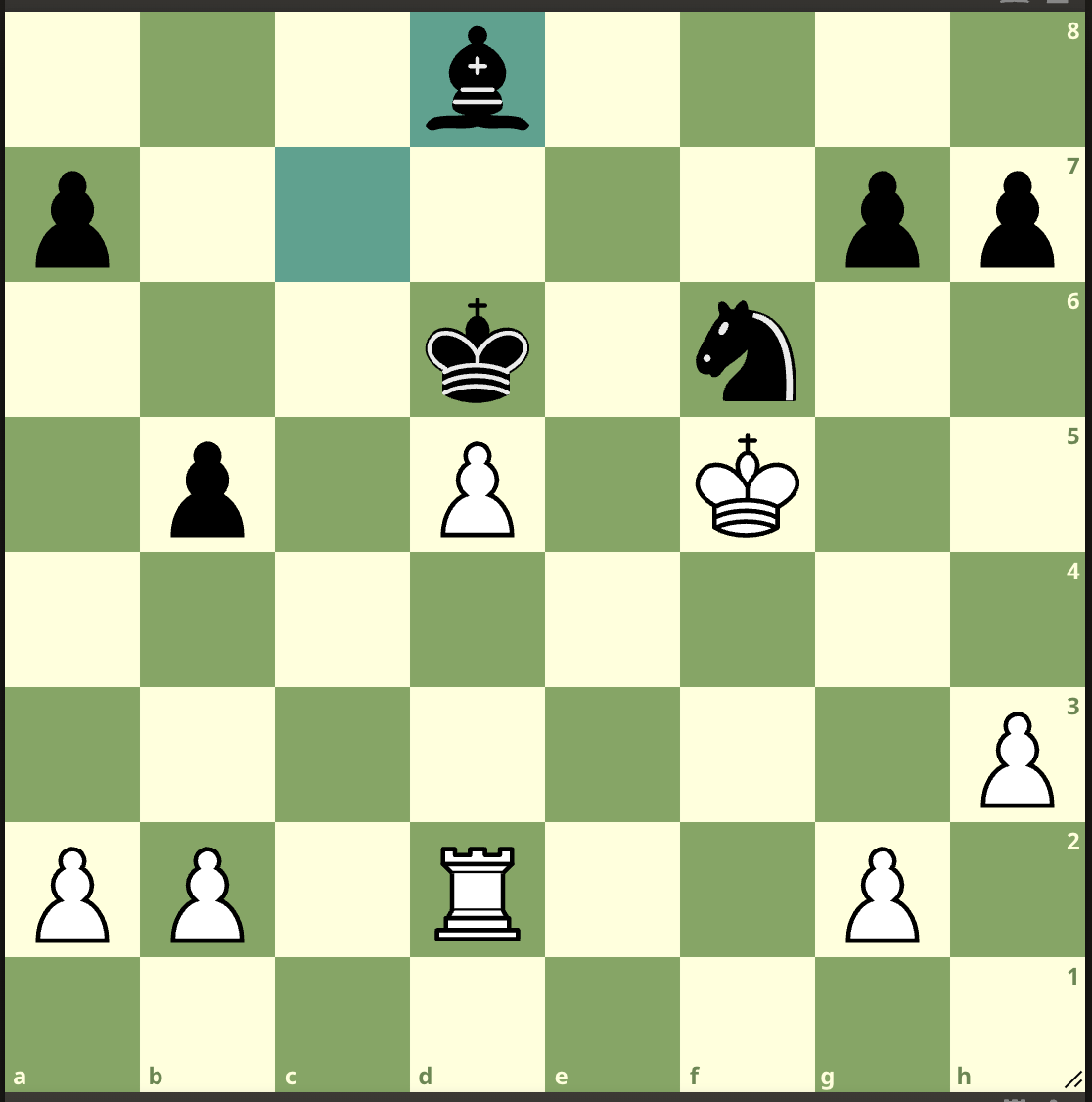
I am very proud of this moment, and I believe it was a critical point in the game. Even though the computer thinks it was a blunder with perfect play, I thought it was winning. I played Bd8 to defend my Knight on f6 to then play g6 and h6 to pry his king away from the “defense” of the d5 pawn.
35. Rd3 g6+ 36. Kf4 h6 37. g4 Bc7 38. b4 a5 39. a3 axb4 40. axb4 Bd8 I missed Kd7, I thought had to reroute the Bishop to d8 and e7, targeting the b5 pawn.
41. Rd1 Bc7 I brought the Bishop back to prepare Kd7+ again.
42. g5 Kd7+ 43. d6 Bxd6+ 44. Rxd6+ Kxd6 45. gxf6 Ke6 46. Ke4 Kxf6 47. Kd5 g5 48. Kc5 h5 49. Kxb5 g4 50. hxg4 hxg4 51. Ka6 g3 52. b5 g2 53. b6 g1=Q 54. b7 Qa1+ 55. Kb6 Qd4+ 56. Ka6 Qd8 57. Ka7 Qa5+ 58. Kb8 Ke7 0-1
I chose this game in particular because it was the most important game by far. I had to play for a win, otherwise I wouldn’t be national champion. I was feeling unbelievable amounts of stress before the game, and I drank so much water and did the techniques my coach, Ms. Spiegel, taught me to calm my nerves so many times during the game. Even when I started winning, I kept walking around repeating a mantra to myself: “the game’s not over yet.”
Can you describe a critical moment in the game when you had to make an important decision? What were you calculating?
Move 34. Bd8. I was trying to pry the king away from the defense of the d5 pawn, or get my king off the d-file. In order to do that, I had to make sure his king couldn’t come any closer to my very limited amount of pawns. So, I played Bd8 to defend my Knight on f6, to play for g6 and h6, preventing his king from advancing. After that happened, I was threatening Kc5, which won me the game.
How would you describe your playing style? Do you enjoy attacking, defending, tactical battles, endgames, or something else?
I like positional play the best, honestly. I like outmaneuvering my opponents and creating weaknesses in their positions to exploit later in the endgame. This is shown in the game I selected, with my move 34. Bd8, planning to carry out a multiple-step plan to gain an advantage.
Doron-Repa Family, Marshall Chess Club Members
Funeral Announcement
We are deeply saddened to report the loss of a member. From his brother, Eric Fleischman,
Dear chess friends and chess community:
I am sorry to inform you of the death of my brother Ian Fleischman (avid chess player and former member of the Marshall Chess Club) who died on June 6, 2026. Funeral services will be held on Wednesday, June 10th 5-7 pm at English Bros. Funeral Home, 2203 Avenue Z, Brooklyn, NY 11235 (718) 743-8459. Ian’s obituary is posted soon on their website.
For Shiva and other details, please visit the club memorial page.
Chess Toons
En Passant
Russia's chess establishment on Friday formally endorsed incumbent FIDE president Arkady Dvorkovich for another term at the head of world chess.
GM Praggnanandhaa Rameshbabu is the Norway Chess 2026 champion after beating GM Vincent Keymer to complete an amazing run of four classical wins to end the tournament.
Anastasiia Hnatyshyn won the European Women's Chess Championship in Batumi outright after scoring 9/11 as the 76th seed. The 15-year-old Ukrainian WFM finished half a point ahead of Sabrina Vega, Olga Badelka and Nurgyul Salimova, gained 214.4 rating points and secured the WGM title directly, along with an IM norm.
Problems, Problems, curated by Alexander George
Arthur Mackenzie, 1900
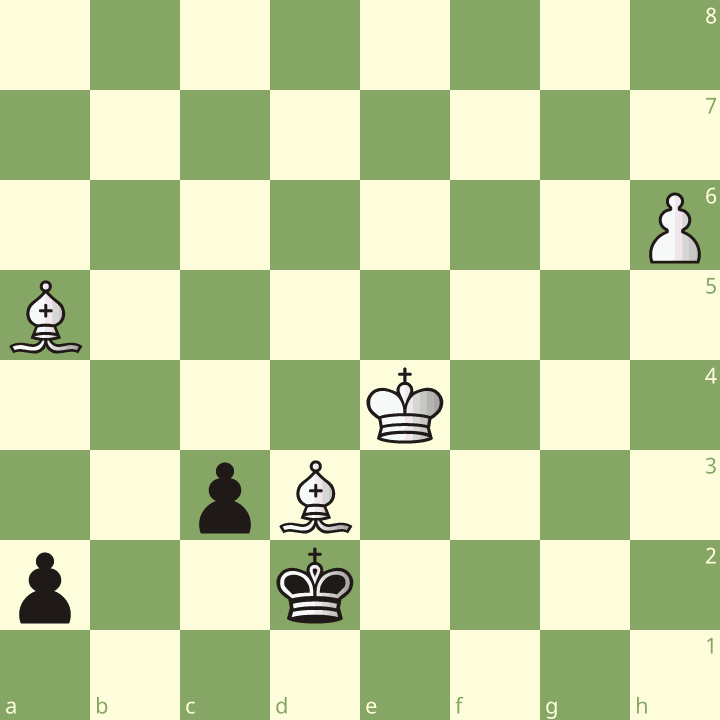
White to move and win.
Do you believe in chess rebirth? In Greek mythology, the Phoenix is a bird that is reborn again and again. In the religion of chess problem composition, a Phoenix is a piece that is captured and then reborn via promotion.
---
Solution to last issue’s problem (Hugh Blandford, 1949):
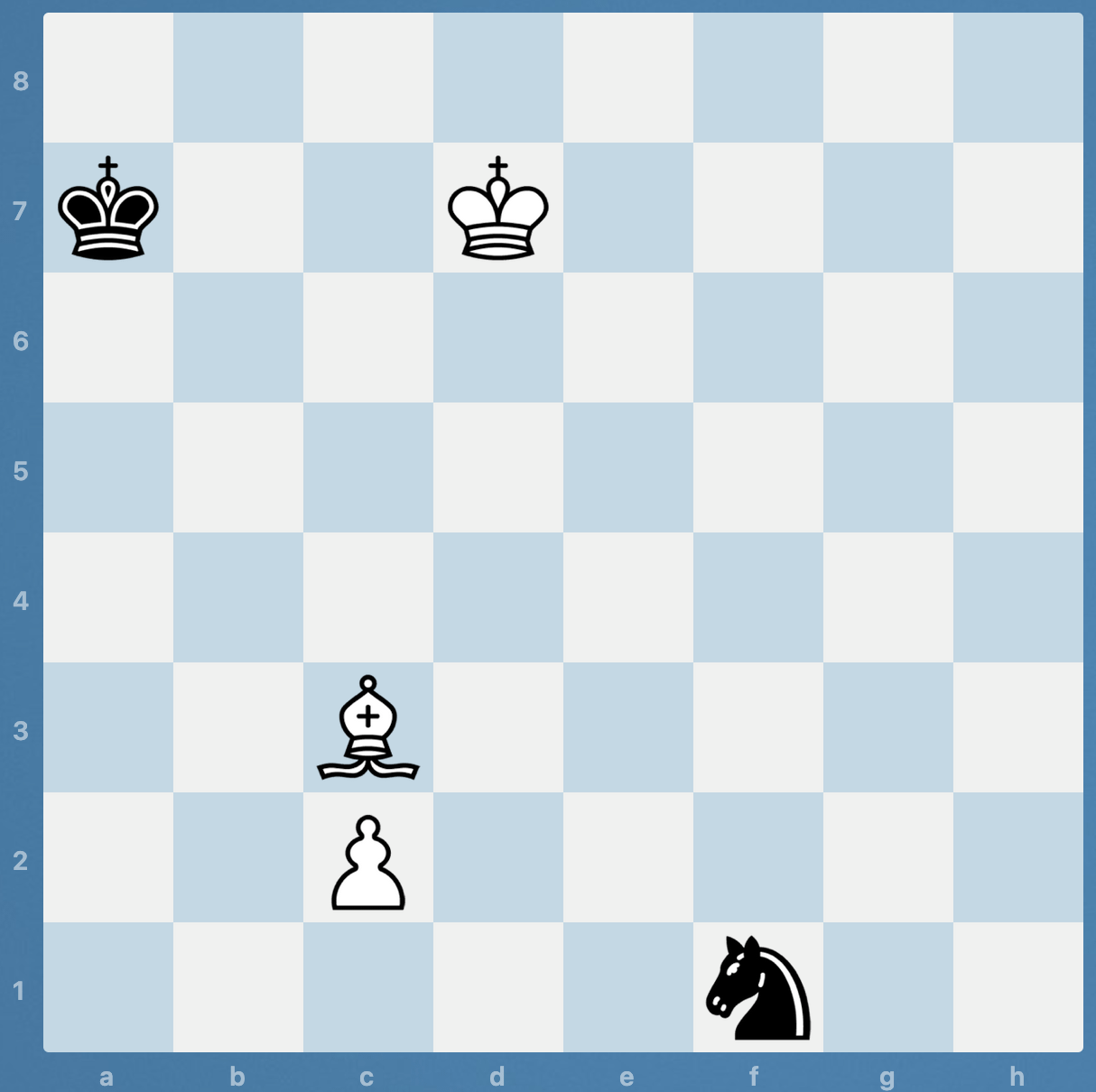
White to move and win.
1. Bd4+! Ka8! Super cunning in trying to set up a stalemate attempt.
2. c4 Nd2 3. c5 Nb3 4. c6 Na5! 5. c7 Nc6 Can't be taken! 6. c8=R+! To foil the stalemating attempt! (6. c8=Q+? Nb8+ And what a sickening feeling overwhelms White! 7. Kd6 stalemate)
6... Nb8+ 7. Kd6 and wins.
---
Alexander George
Editor’s Note
As always, if you have any feedback, comments, or would like to submit an article please contact us directly at td@marshallchessclub.org.
Enjoy, and thanks for reading!
The Marshall Chess Club
23 West Tenth Street New York, NY 10011
212.477.3716

Thanks for reading The Marshall Spectator! Subscribe for free to receive new posts and support the club.