

The Marshall Spectator
November 26, 2025


In This Issue:
From The Skittles Room
Endgame Corner, by GM Aleksandr Lenderman
Across the Table, with Sydney Strauss
Chess Toons
En Passant
Problems, Problems, curated by Alexander George
Editor’s Note

Welcome back, fellow chess players, to this edition of the Marshall Chess Club’s fortnightly bulletin, The Marshall Spectator.
This past weekend was the Jerry Simon Memorial and Marshall Chess Club Amateur Championship. The event was sold out a week in advance, when it was capped at 106 entrants! Top finishers in the event will be welcome to participate in our upcoming 109th Annual Edward Lasker Memorial and Marshall Chess Club Championship.
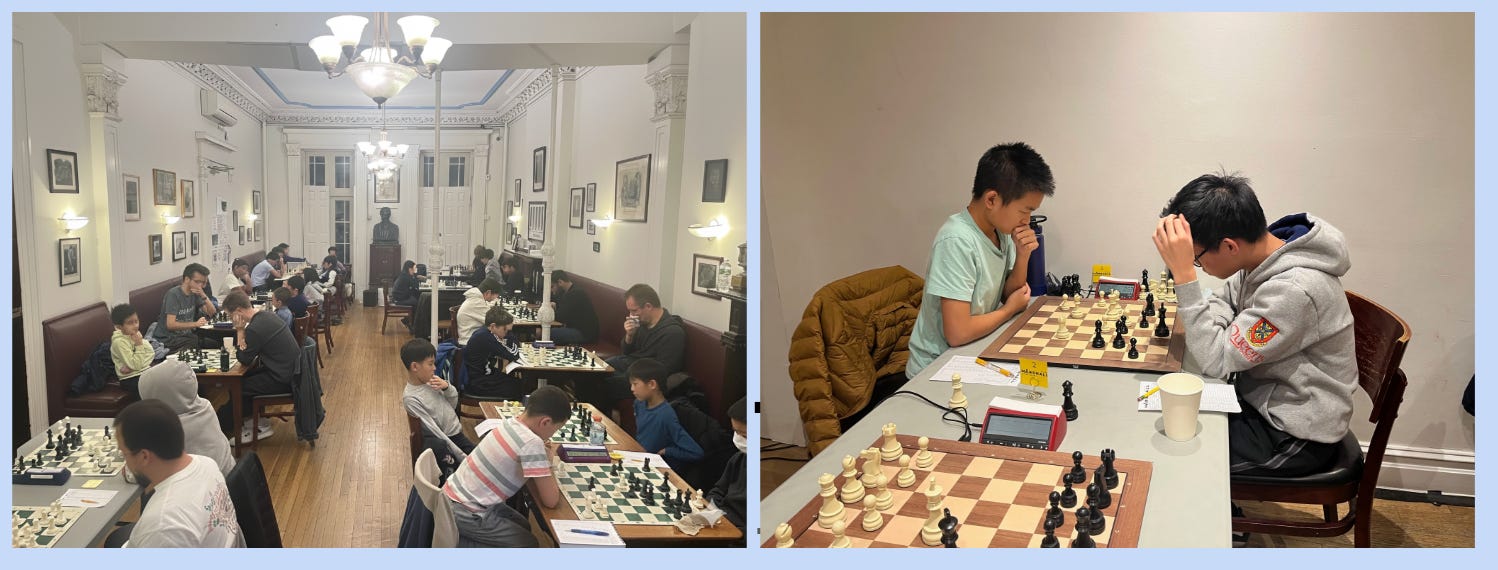
Congratulations to this year’s winner, Connor Wang, who won the first place price of $2,100 in addition to free entry to the Club Championship.
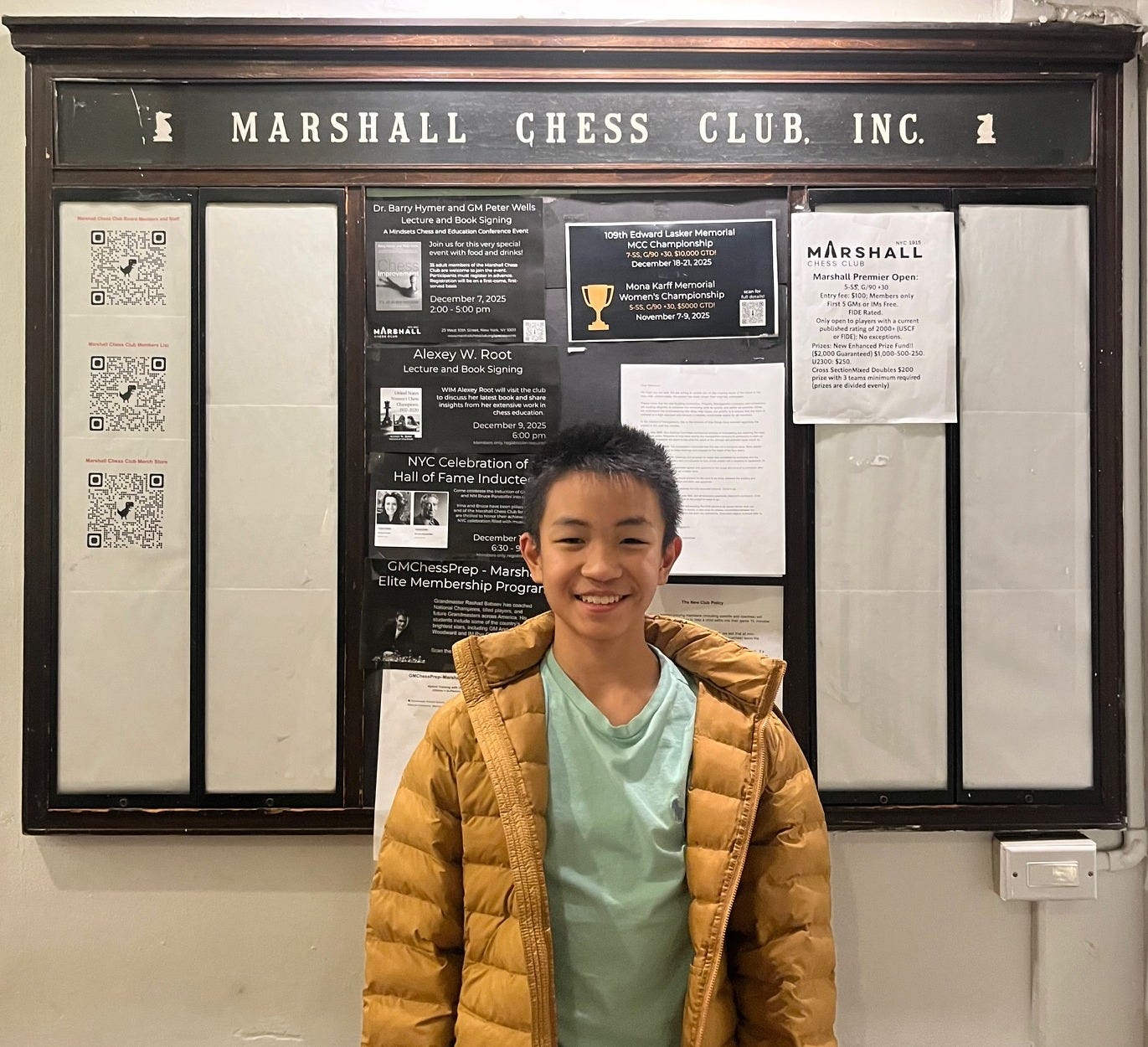
We are now entering the final stage of 2025 with our 109th Edward Lasker Memorial Club Championship, December 18-21
$10,000 GTD
$5000-2500-1000-500, U2300 USCF: $500, U2100 USCF: $500.
The title of “2025 Marshall Chess Club Champion” goes to highest-scoring MCC Member. The title will be determined by a blitz playoff in the case of a tie.
Club members only rated 2100+ USCF or FIDE, GMs, IMs, WGMs, WIMs, FMs & Qualifiers from the Marshall Women’s, Senior and Amateur Championships or by special invitation. Escalating entry fee, GM entry fee refunded upon completion of the tournament 1. $125 – Nov. 24 – Dec. 7 2. $150 - Dec. 8 - 17
No day-of registrations. Register here.
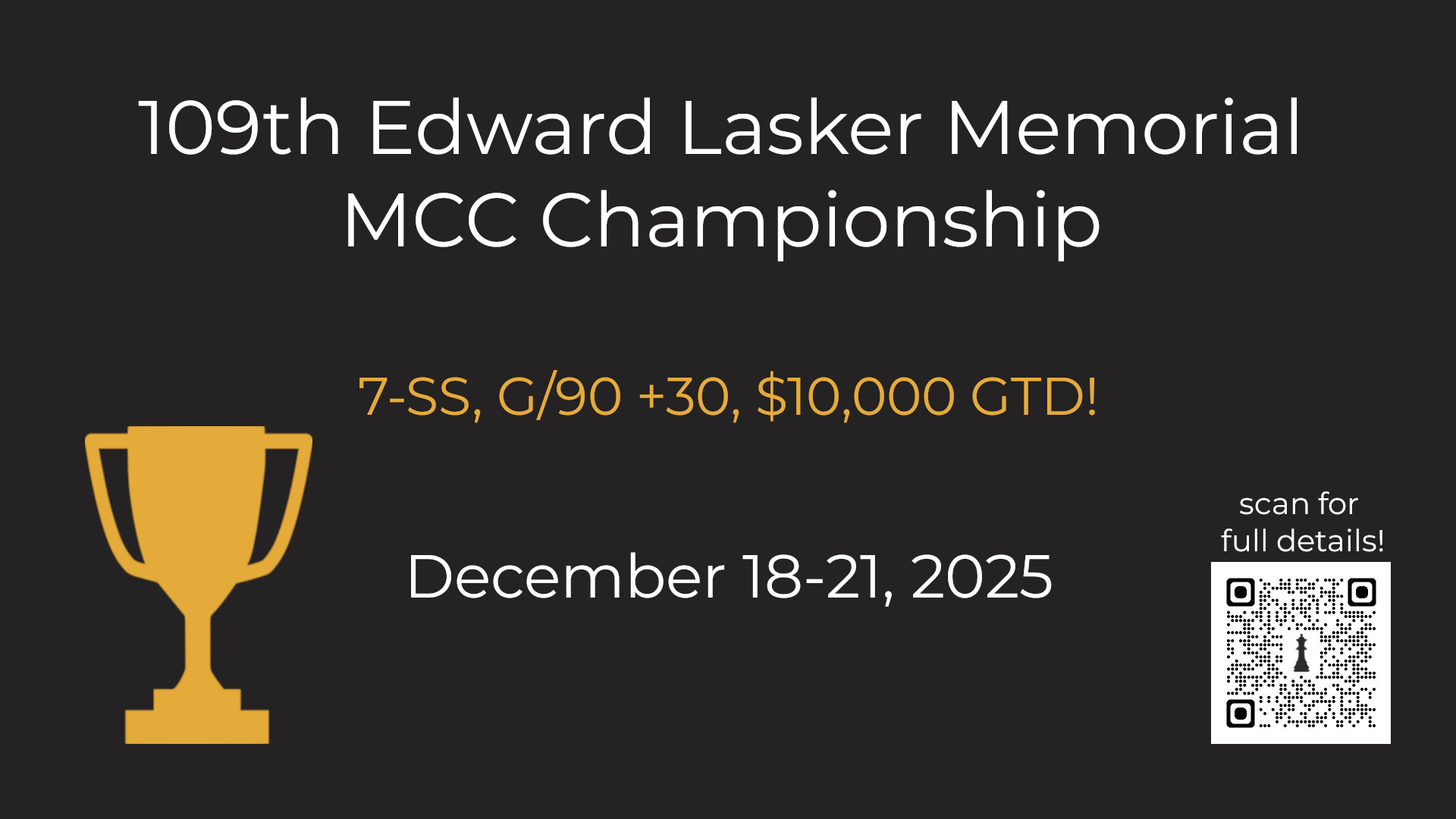
Our Black Friday Camp Sales are now live for next summer! Save up to 25% on each week of camp that you purchase! You can purchase discounted weeks here.
This summer, we had 10+ GM and IM instructors and guests, including simuls with GMs Andrew Tang, Vojtech Plat, Alexander Shabalov, IMs Carissa Yip, and Mykola Bortnyk.
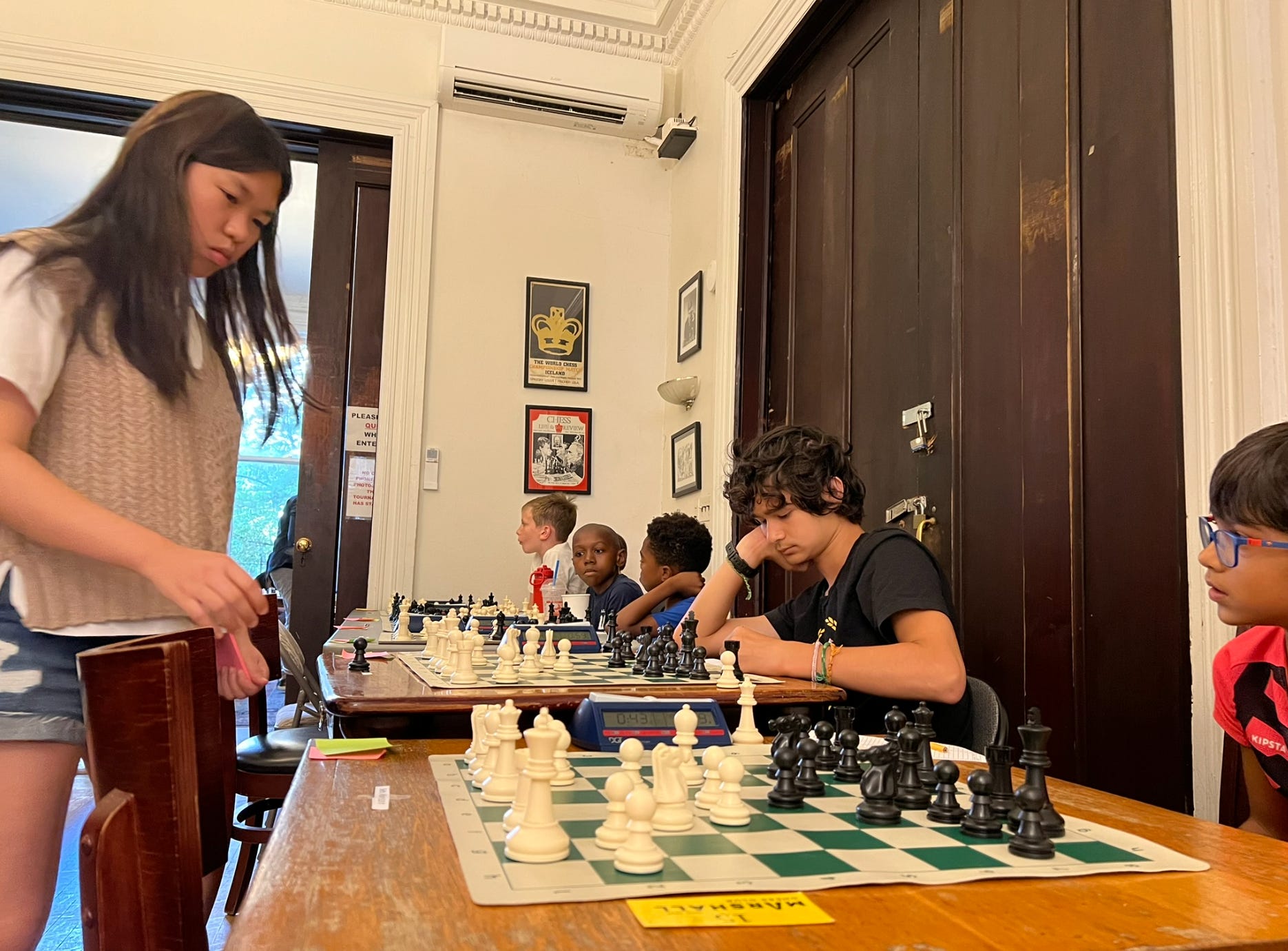
That’s not all- our top five most active campers saw huge rating growth, with an average gain of 140 rating points since attending their first summer camp!
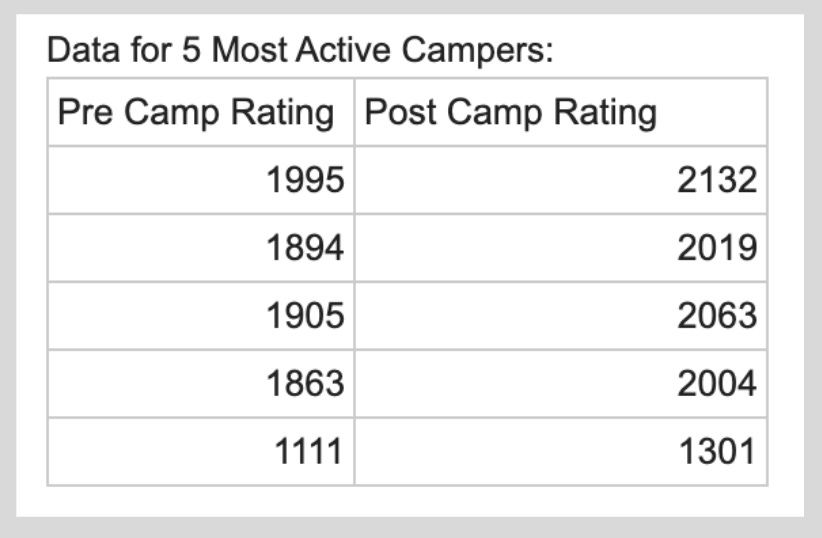
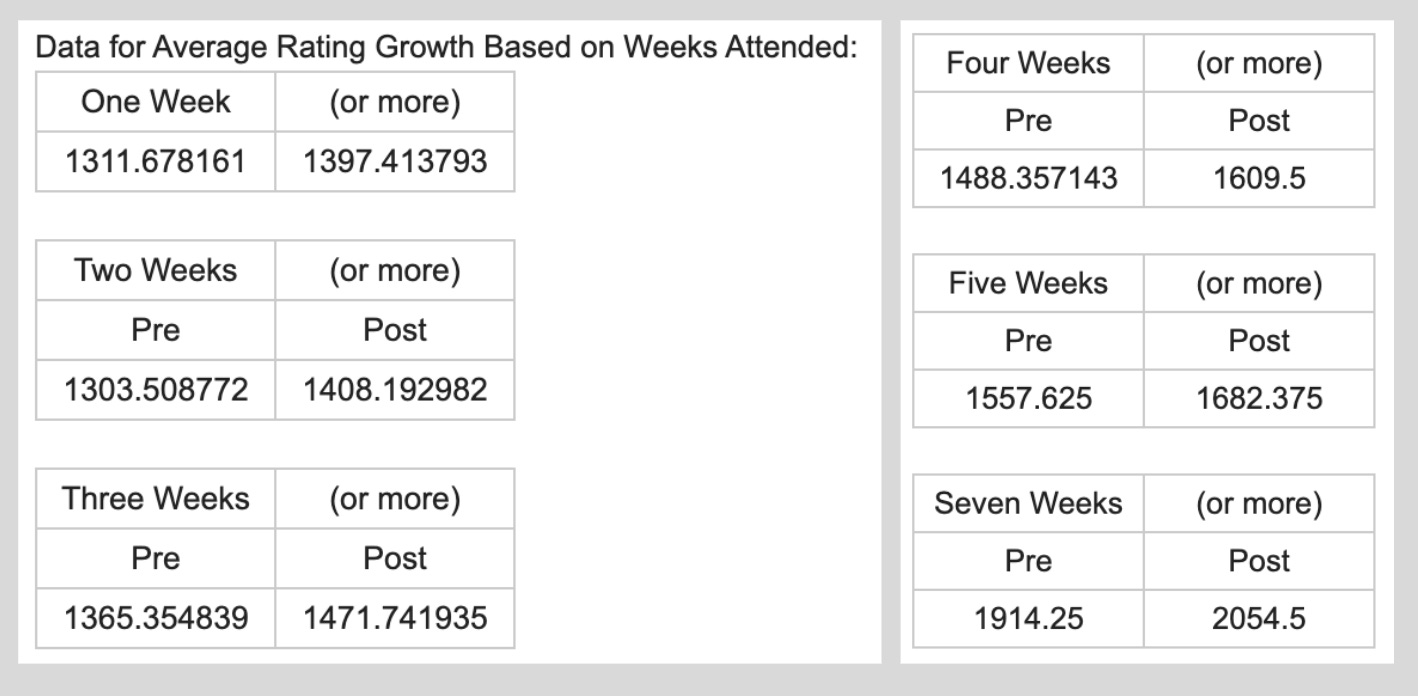
Not only that, our data shows that kids who attended one or more weeks of camp saw their ratings jump an average of 86-125 rating points, with the value increasing the more weeks they attended. The data below was compiled on November 24, and is based on a campers current live rating and live rating prior to attending their first camp.
You can purchase the package here.
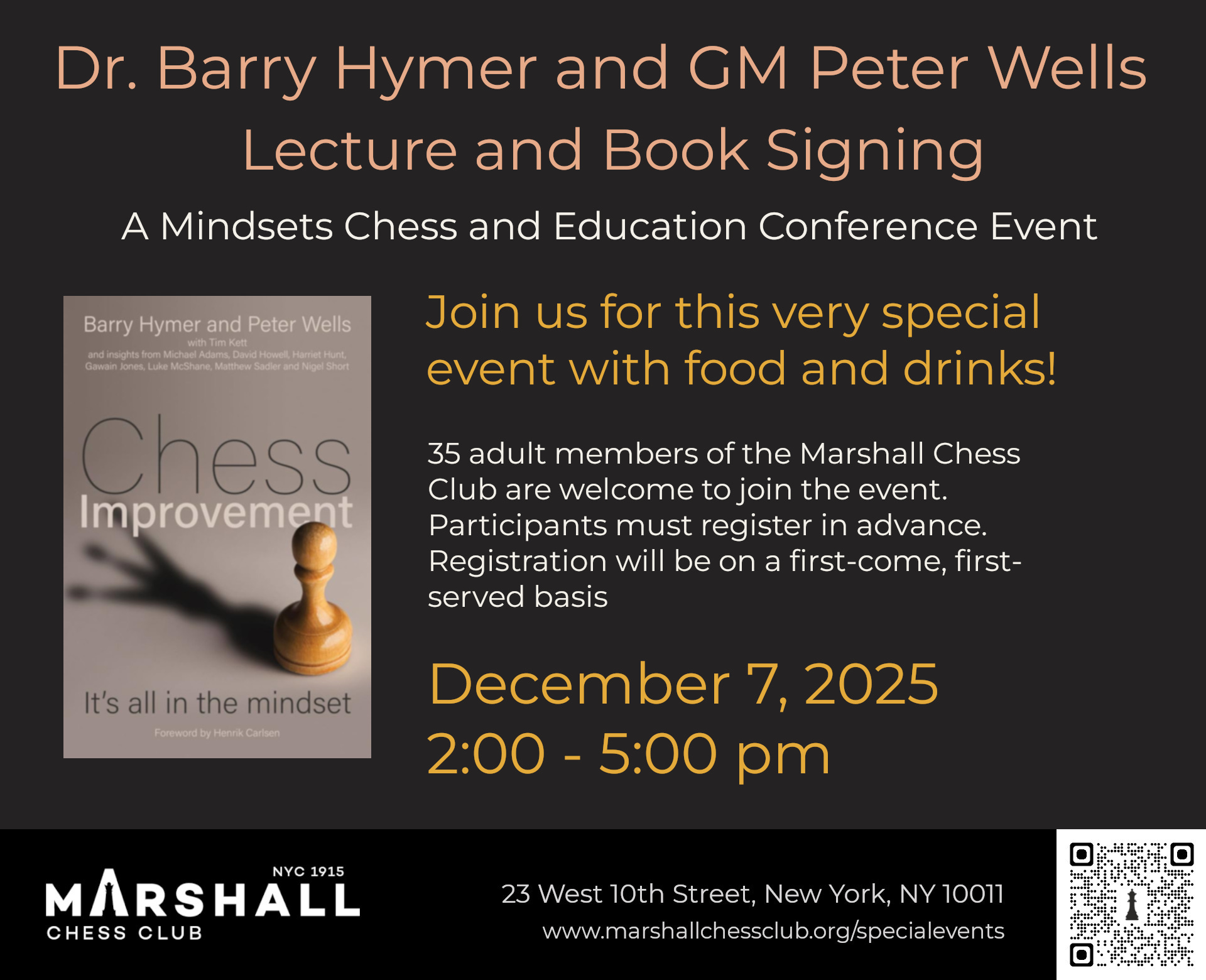
Looking ahead on the calendar we have an action packed month of events, starting with a lecture and book signing on Sunday, December 7 featuring Dr. Barry Hymer and GM Peter Wells who will be discussing their book “Chess Improvement: It’s all in the mindset” as part of the Education Conference Event.
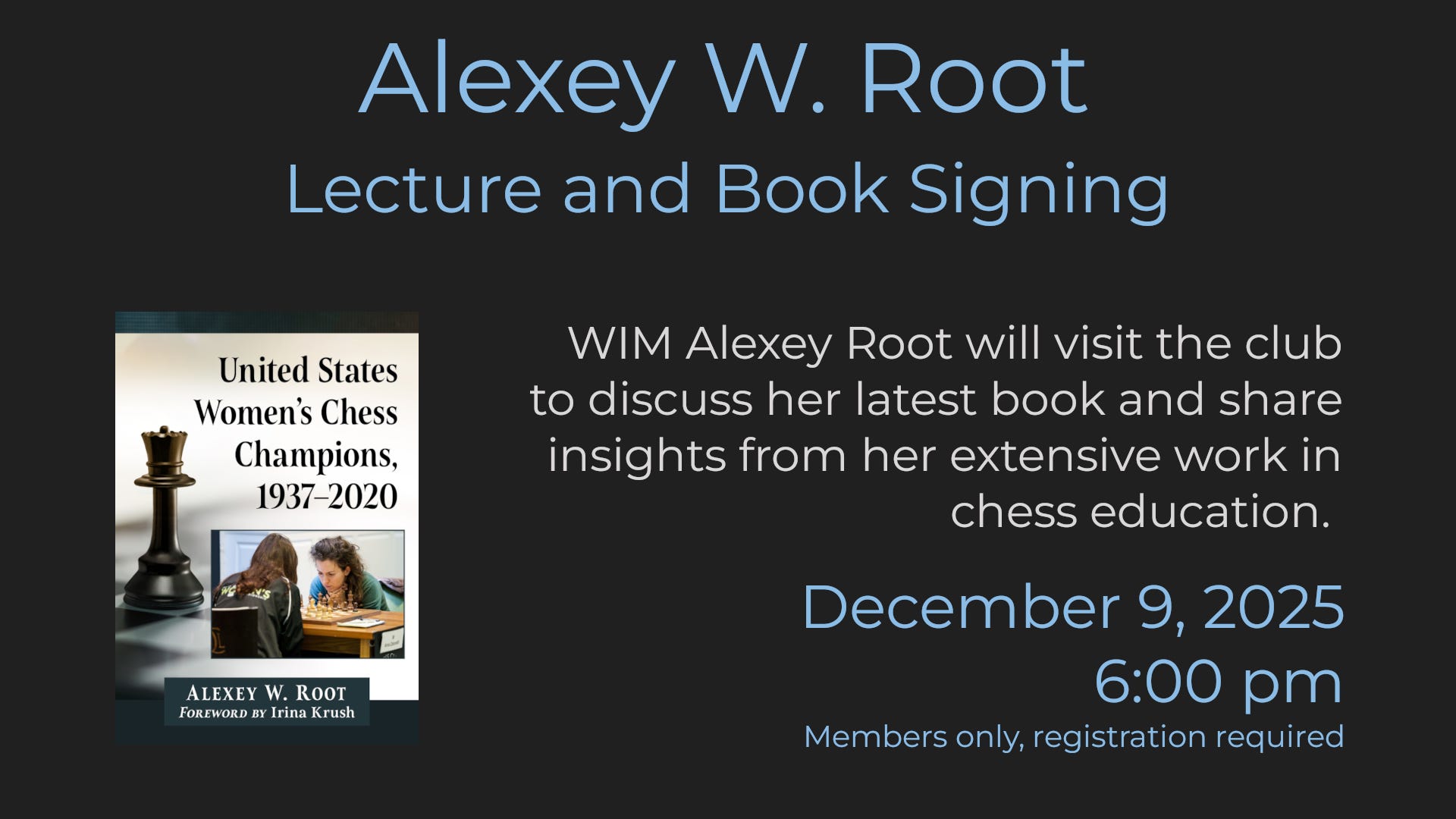
On Tuesday, December 9, WIM Alexey W. Root will be giving a lecture and book signing as well as discussing and sharing insights from her extensive work in chess education.
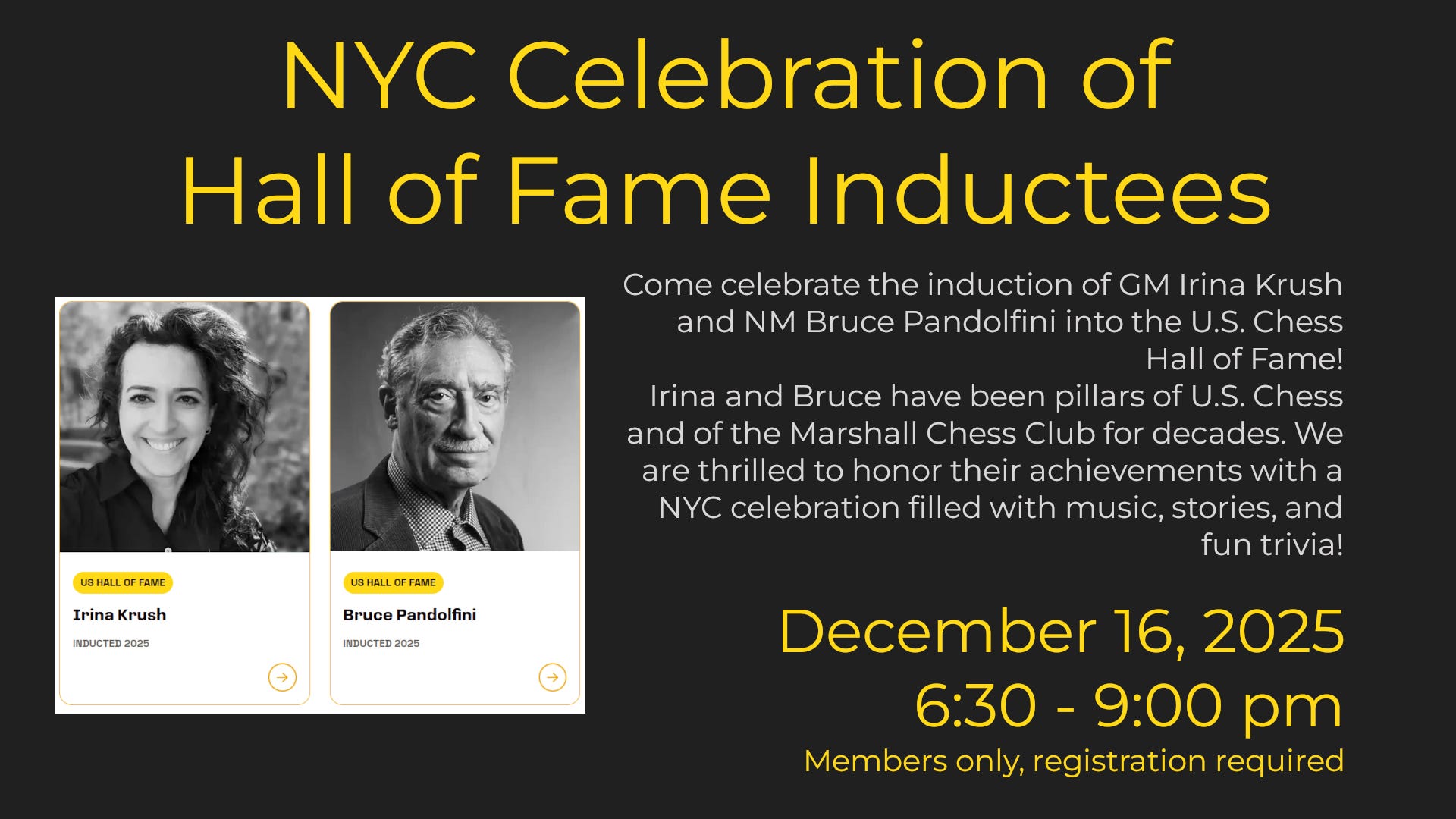
One of the most exciting events on our calendar will be held on December 16, when we will be joined by Chess Hall of Fame Inductees NM Bruce Pandolfini and GM Irina Krush, to celebrate their achievements and highlight some of the most memorable moments from their careers with a celebration filled with music, stories, and fun trivia.
Finally, if you’re looking for some GM Chess Prep, consider joining the Elite Membership Program featuring Grandmaster Rashad Babaev, who has a track record of success with working with some of the country’s brightest chess stars.

Looking back over the last two weeks, we have had a plethora of events for our members to participate in.
The Rated Beginner Open on November 23 had 39 players registered and was won by Jayden Roh, Aidan K Young, Cheikh Diamanka, and Matthew Egelhof who scored a perfect 3 out of 3 to win $122 each.
The Morning Masters on November 22 had 10 players registered and was won by FM Aditeya Das and Richard Yi who scored a near perfect 2.5 out of 3 to win $62.50 each.
The Under 2000 Morning Action on November 22 had 63 players registered and the following players won $91.88 each for their perfect 3 out of 3 score: Rohit Jagga, Nikhil Shah, Sean Huang, Amiel Akiva Urilov, Hugh Verrier, and Preston Delgadillo. Mason Lally won a class prize of $236.25 for a perfect score.
The Thursday Action on November 20 had 37 players registered and was won by GM Mark Paragua and FM Aditeya Das who scored a perfect 4 out of 4 to win the $112.50. Tarun Ravindranath and Cameron Hull won $34 each for their 3 out of 4 score, while the following players won $22.67 each for the same score: IM Jay Bonin, NM Bryan Weisz, Vladimir Bugayev, William Aepli, Alan Stolyarov, and Aaron Kudryavsky.
The Weekly Under 2200 that concluded on November 16 had 32 players registered and was won by Luke Leon Robin Anatol who scored 5 out of 6 to win $320 for first place, while Quand Anh Le and Robert Donald, Jr Olsen won $160.50 each for their 4.5 out of 6 performance and Marca Ramdas won a $107 class prize for his is 4 out of 6 score.
The Weekly Under 1600 that concluded on November 16 had 28 players registered and was won by James Basuk who scored a near-perfect 5 out of 6 to win the $225 first-place prize, while Reginal Denis and Caleb Rakestraw-Morn scored 4.5 out of 6 to win $112.50 each. Trevor Craig Lanford won a $90 class prize for his 4 out of 6 performance.
The Marshall Masters on November 18 had 9 players registered and was won by NM Bryan Weisz who scored 3.5 out of 4 to win the $120 first-place prize. IM Jay Bonin and Miles Hinson scored 3 out of 4 to win $60 each, while. Mike Ching scored 2.5 out of 4 to win a $30 prize.
The Rated Beginner Open on November 16 had 45 players registered and was won by Taran Mehta, Aitan Tang, Benjamin Frye, and Jake Bernstein who scored a perfect 3 out of 3 to win $125 each.
The Premier Under 2000 that concluded on November 16 had 38 players registered and was won by Aaraav Singh who scored a near-perfect 4.5 out of 5 to win the $634 first-place prize. Anson Leong scored 4 out of 5 to win the $254 second-place prize, while Santiago Fernandez-Aller and Haoyang Wu scored 3.5 out of 5 to win $95 each. Darwin Wong Okyere and Alexander Wu shared in a class prize winning $95 each for their 2.5 out of 5 score.
The Marshall Premier FIDE Open that concluded November 16 had 60 players registered and was won by GM Aleksandr Lenderman who scored a near-perfect 4.5 out of 5 to win the $1000 first place prize. GM David Brodsky, IM Tanitoluwa Adewumi, IM Justin Sarkar, and FM Aditeya Das scored 4 out of 5 to win $187.50 each, while CM Luc Hoffman and NM Elliott Goodrich scored 3.5 out of 5 to win $125 each.
The Under 2000 Morning Action on November 15 had 71 players registered and was won by the following players who scored a perfect 3 out of 3 to win $88.86 each: Tarun Ravindranath, Nikhil Shah, Cameron Hull, Kenny Bollin, Sean Huang, Kyle Cheng, and Marko Scekic. The following players scored 2 out of 3 to win $26.70 each: Holden Wen, Aisultan Rakhimbayev, Sean Carter, Eli Sidman, Assau Temir Mailybayev, Jia Rui Weng, Dario Golden, Rayyan Sayeed, Brandon Li, and Benjamin Ginsberg.
The Morning Masters on November 15 had 9 players registered and was won by Daniel Wang and Evan Kauffmann who scored 2.5 out of 3 to win $56.50 each.
The Afternoon Action on November 14 had 6 players registered and was won by William Aepli who scored a perfect 3 out of 3 to win the $38 first place prize, while Kenny T Bollin and James Souce scored 2 out of 3 to win $12.50 each.
The Thursday Action on November 13 had d33 players registered and was won by FM Aditeya Das and Vladimir Bugayev who scored a perfect 4 out of 4 to win $97.50 each. Arhan Javeri and Leon Chu shared in a class prize, winning $59 each for their 3 out of 4 score, while the following players won $19.67 each for scoring 3 points: NM Bryan Weisz, CM Hairan Liang, and Oliver Chernin.
The Monthly FIDE that concluded on November 11 had 28 players registered and was won by the following players who scored 4.5 out of 6 to win $130.25 each: FM Grant Y Xu, GM Michael Rohde, Ethan Kozower, and Quan Anh Le. Takki Tanaka and Jaron Bernard scored 3 out of 6 to share in a class prize, winning $65.50 each.
The Monthly Under 1800 that concluded on November 11 had 35 players registered and was won by Gary Chan who scored 5.5 out of 6 to win the $227 first place prize, while Yuvik Umapathy, Andrew Ferrante, and Reid Katzovitz scored 4.5 out of 6 to win $132.67 each. Thyge Knuhtsen and Gavin W Jones scored 3.5 out of 6 to in $28.50 each.
The Marshall Senior Championship that concluded on November 9 had 30 players registered and was won by IM Yury Lapshun who scored 4 out of 5 to win the $750 first placed prize. Stanislav Busygin, IM Jay Richard Bonin, and FM Nathan Resika scored 3.5 to win $333.33 each, while Aleksandr Gutnik and Jose De Villa won $125 each for their 3 out of 5 score.
The Mona Karff Memorial and Marshall Women’s Championship that concluded on November 9 had 37 players registered and was won by GM Irina Krush, who scored a perfect 5 out of 5 to win the $2,500 first place prize. WIM Chloe Gaw and NM Jessica Hyatt scored 4 out of 4 to win $875 each, while the following players won $83.33 each for their 3 out of 5 performance: Elizabeth Moshkevich, Zoe Zelner, Kara Chan, Nico Alvarado-Yoshida, Summer Loh, and Keyla Acevedo. Sam Sharf won a class prize of $125 for her 2 out of 5 score, while Sydney Strauss also won a $125 class prize in addition to a special $200 upset prize that was generously donated by Marshall Chess Club long time member and supporter of women’s chess, Dorothy Teasley.
We look forward to seeing you at the club soon!
Recent Games Analyzed, by GM Aleksandr Lenderman
In the first round of the Marshall Premier, I was paired against a strong expert, Justin Dalhouse, who has been showing good improvement recently.
Round 1: Dalhouse, Justin vs. Lenderman, Aleksandr
You can play through the games with annotations here.
1. e4 e6 2. d4 d5 3. e5 c5 4. c3 Nc6 5. Nf3 Bd7 6. Be2 Nge7 7. Na3 cxd4 8. cxd4 Nf5 9. Nc2 f6 10. O-O fxe5 11. Nxe5 Bd6 12. Bf4 Bxe5 13. Bxe5 O-O 14. Bd3 Nxe5 15. dxe5 Qb6 16. b3 Rac8 17. Rc1 Bb5 18. Bxb5 Qxb5 19. Nd4 Rxc1 20. Nxb5 Rxd1 21. Rxd1 Rc8 22. h3 a6 23. Nd4 Nxd4 24. Rxd4 Rc1+ 25. Kh2 Rc2 26. Rb4
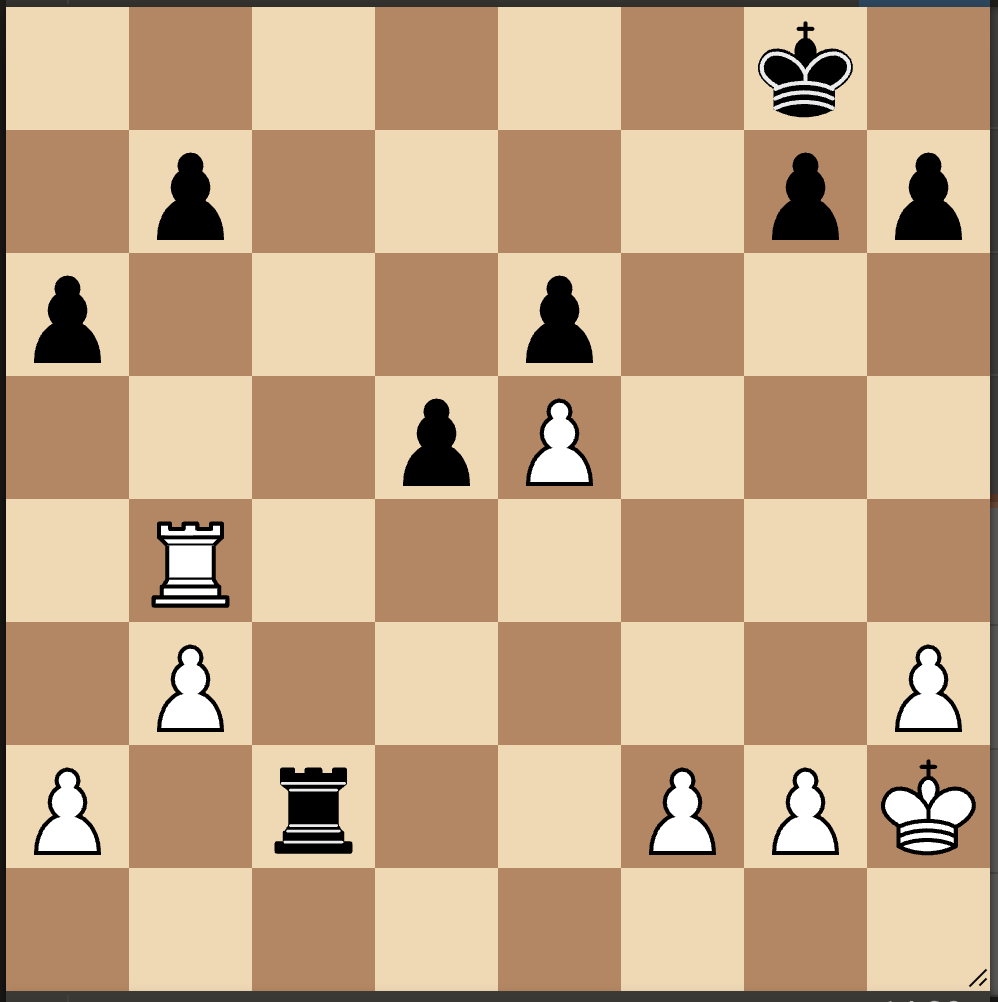
It was a tough game up to this point, where we reached a rook endgame where I’m better on paper, but white should hold with perfect play. I was happy that I was able to pose problems in the best way here to my opponent, and it worked out well.
26... b5! 27. a4 Rxf2 28. axb5 axb5 29. Rxb5 Re2 30. Rb7 Rxe5 I won the pawn but objectively, white is still within drawing range with proper play.
31. Rd7? The decisive mistake, which was played fairly quickly, in about two minutes. This surprised me, as I definitely expected b4, and I thought it was unclear whether it is winning for me or not. As it turned out, white is objectively drawing, though they are in for a long defense. (31. b4! Kf8 (31... d4?! This was the move Justin feared, with idea of Rd5, but it can easily be met with Rd7. 32. Rd7 Rd5?? This would even lose. (32... Re4 33. b5 e5 34. b6) (32... Re3 33. Rxd4 Rb3) 33. Rxd5 exd5 34. Kg3 Kf7 35. Kf2 Ke6 36. Ke2) 32. b5 Re4 33. b6 Rb4 34. g4 d4 35. Kg3 d3 36. Kf2 e5 37. Ke3 e4 38. Rd7)
31... Re4 Not the only winning move, but the simplest. 32. Kg1 Rb4 Here, Justin resigned since Re7 is met simply with Rb6. 0-1
Round 3: Lenderman, Aleksandr - Pan, Zachary
After a half-point bye in round 2 due to work, I had 1.5/2 and played a young player around 2200 USCF, Zachary Pan.
1. d4 Nf6 2. Nf3 d5 3. g3 e6 4. Bg2 c5 5. O-O Nc6 6. c4 dxc4 7. dxc5 Qxd1 8. Rxd1 Bxc5 9. Nbd2 c3 10. bxc3 Bd7 11. Ng5 Rd8 12. Nde4 Nxe4 13. Nxe4 Be7 14. Be3 O-O (14... b6) 15. Nd6
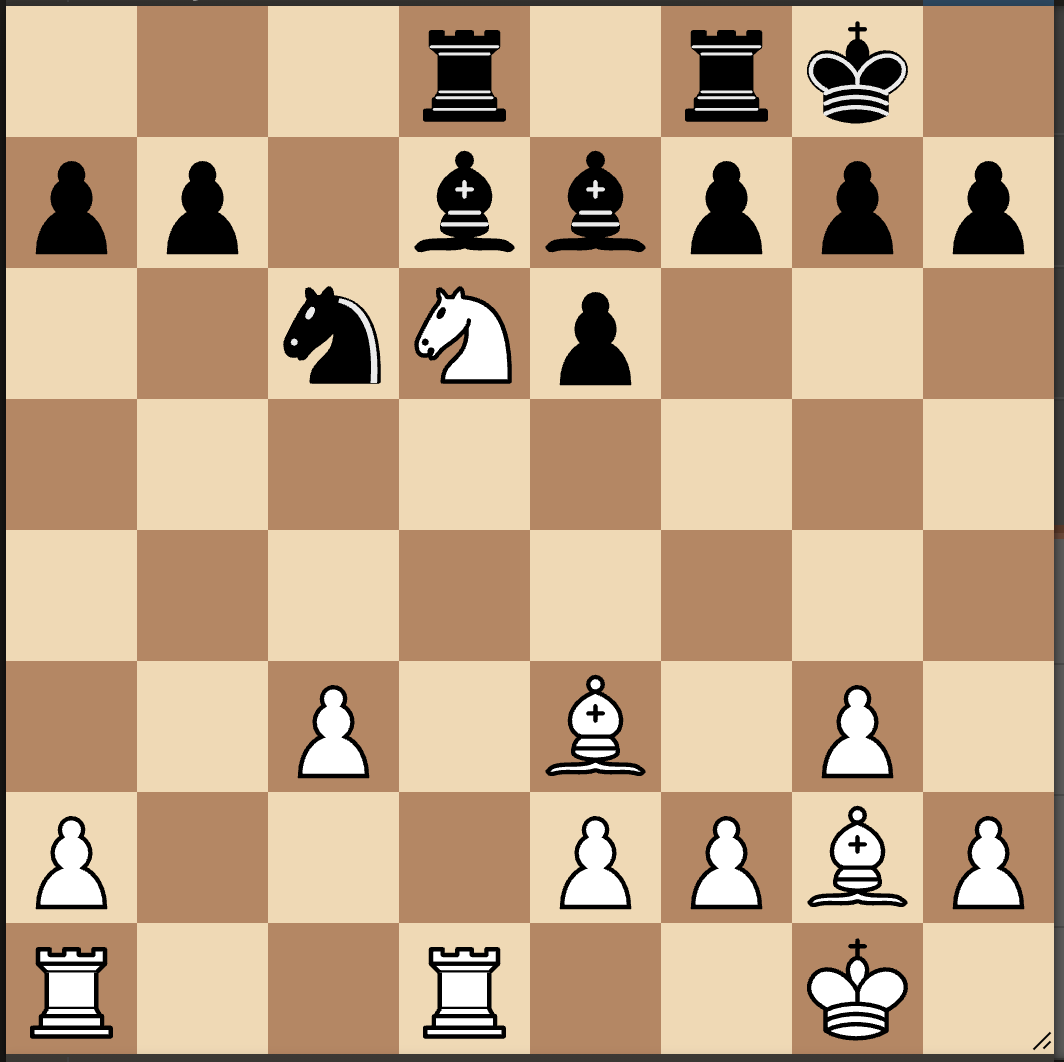
I like this move since I think this poses the most problems. (15. Nc5!?)
15... Bc8? Now, I get a huge advantage. (15... Bxd6 16. Rxd6) 16… e5 Would still offer black good equalizing chances in the endgame.)
16. Nxc8 Rxc8 17. Rd7 Bf6 18. Rxb7 Bxc3 19. Rc1 Nd4 20. Bf1! The most accurate since Kf1 wouldn’t threaten Rxc3 yet. (20. Kf1 a5 21. Rxc3?? Rxc3 22. Bxd4 Rc1#)
20… e5 21. Rxa7 Nf5? 22. Bh3 Nd4 (22... g6 23. Bh6 (23. Bxf5 gxf5 24. Ra6))
23. Bxd4?! I correctly assessed this as winning but still, I am giving more chances here to my opponent due to opposite colored bishops. (23. Bxc8 Was a complicated way to get an advantage, and likely, the objectively best. 23... Nxe2+ 24. Kf1 Nxc1 25. Bb7! (25. Bf5 Bd4) 25... Bd4 I discarded this line due to this move. (25... Bb2 26. a4) (25... Nd3 26. Ra3) 26. Bxd4 exd4 27. a4 It turns out, this position is +4, which was hard to foresee that it’s this good.) (23. Kf1 Was likely, simpler.) 23… Bxd4 24. Bxc8 Bxa7 25. Ba6?! (25. Rc6 Rd8 26. Ba6)
25... g6? (25... Bb6! I was surprised Zachary didn’t at least, try this move. Here, he stops my rook from invading, and putting pressure on his f7 pawn weakness. Here, I am probably still winning with perfect play, but it would require more precision from me. )
26. Rc7 Now, I win the game easily due to the principled of two weaknesses, in particular, the f7 pawn tying his rook down to passivity, and also, my extra passed pawn on the queenside.
26…Bb6 27. Rb7 Ba5 28. Bc4 Kg7 29. a4 h5 30. h4 Kf6 31. Ra7 Bb4 (31... Bb6 32. Ra6) 32. a5 Bc5 33. Rc7 Bd6 34. Rd7 Bc5 35. a6 1-0 White wins. 1-0
Round 4: Lenderman, Aleksandr - Hebbar, Eshaan
In the fourth round I got paired against a young IM Eshaan Hebbar, who beat Mark Paragua with black in the last round last time I played in the Marshall Premier, so I knew that he’s very dangerous.
1. d4 Nf6 2. Nf3 g6 3. g3 Bg7 4. Bg2 O-O 5. O-O d6 6. b3 A bit of a sideline to try to avoid main lines in the Kings Indian. 6… c5 7. Bb2 cxd4 8. Nxd4 d5 9. c4 dxc4 (9... e5!? Is a very serious alternative option for black, leading to very interesting play.) 10. bxc4 a6?!
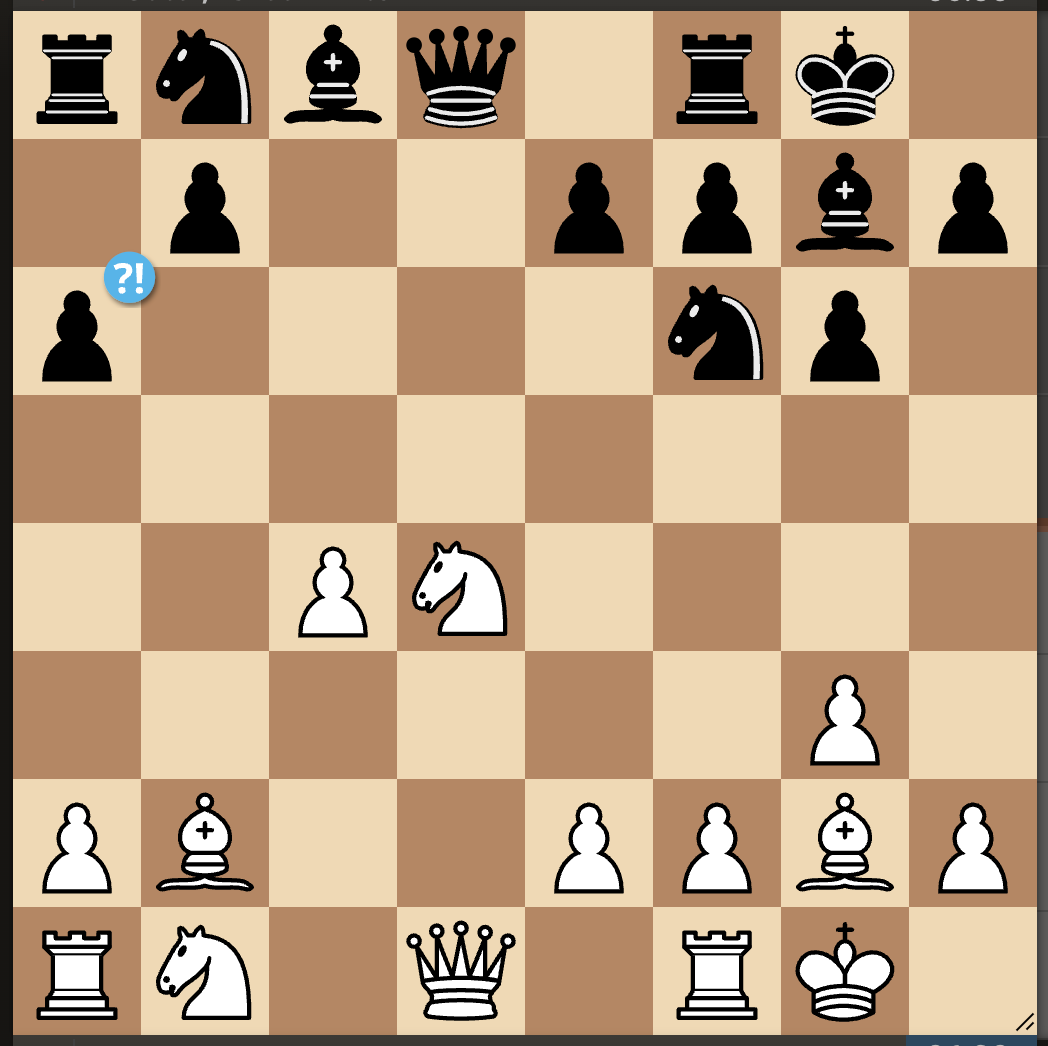
At this point, I was out of book. (10... Qb6 Is the main move here, and what I was the most familiar with.)
11. Nc3! I was very happy I found this move. Since I thought that the main idea of a6 was to be able to play Qc7 or e5 without allowing Nb5, I tried to develop my pieces in a way to discourage both of these ideas for black, and that’s why Nc3 came to mind. 11... Qc7?! This move plays into my plan, so I was happy to see it. (11... e6 12. c5 (12. Ba3 Re8 13. Rb1))
12. Nd5 Nxd5 13. cxd5 Here, I thought I was much better since my c4 pawn was teleported to d5, bolstering my center, depriving me for a weakness, and dominating his pieces by preventing moves like Nc6. From there on, my conversion was not perfect, but nonetheless, a relatively smooth win for me.
13…Rd8 14. Qb3 (14. Rc1! Qb6 15. Bc3) 14… Nd7 15. Rfd1 Qb6 (15... Nc5) 16. Qa3 Qd6 17. Rac1 Nf6 18. Qb3 Ne8 (18... Nxd5 19. e4 (19. Nc2)) 19. e4?! (19. Ba3! Qf6 20. Bc5! Was a bit more accurate.) 19…e5 20. Nf3?! (20. dxe6! Bxe6 21. Nxe6 Qxe6 22. e5! I missed e5 and underestimated the power of the bishops here.
20... Bg4 21. h3 Bxf3 22. Bxf3 Bf8?! (22... Qd7 Here, he’d have some chances for defense.) 23. Rc2 Rab8 24. Bg2 Nf6?! 25. Rdc1 Nd7 26. Rc7?! Admittedly I simply missed Qb4. I only saw it once I played Rc7 (which I played too fast). Sloppy play by me. (26. h4! Was more accurate to activate my bishop.) 26... Qb4 (26... Qf6 27. Ba3) 27. Qc2! Since black’s king is weaker, I wanted to keep queens on the board.
27…Qb6 28. Rc4 Bd6 29. h4 Qa5 30. Bc3 Qb6?! 31. Bd2 My bishop did its job on b2, and now, it’s transferring to the kingside.
31…Re8 32. Bh3 Nf8 33. Bh6 Qd8 34. Qb3 Qa5?! 35. Qf3 Qd8 36. Rc8 (36. Bg5 Be7 37. Rc7) 36…Qe7 37. Rxe8 Rxe8 38. Bg5 f6 39. Qxf6 Qxf6 40. Bxf6 h6 41. Rc8 Kf7 42. Bd8 b5 43. Ba5 Rxc8 44. Bxc8 Nh7 45. Bxa6 I won two pawns, and now, it’s a matter of technique as they say.
45…b4 46. Kg2 Nf6 47. f3 g5 48. hxg5 hxg5 49. Bc8 Ne8 50. Kh3 Kg6 51. Bb6 Nc7 52. Bd7 Kh5 53. Be3 Be7 54. f4 gxf4 55. gxf4 1-0 White wins. 1-0
Round 5: Adewumi, Tanitoluwa - Lenderman
In the last round, I played Tanitoluwa (Tani), who had 4/4, and showing good form, while I had 3.5, meaning I was in a must-win game if I wanted to win the tournament. Therefore, my opening choice dictated the tournament situation.
1. d4 d6!? In my opinion, this is a good way to play in a must-win game.
2. e4 Nf6 3. Nc3 e5 (3... Nbd7 Is another interesting move order to try to avoid the dxe5 line in the Phillidor, but it allows some other nasty options like f4 or g4. } 4. f4 (4. g4))
4. Nf3 (4. dxe5 Might’ve been a safer way to play, but I expected to still get winning chances in this endgame. 4... dxe5 5. Qxd8+ Kxd8)
4... Nbd7 5. Bc4 Be7 6. O-O O-O 7. Re1 c6 8. a4 h6 9. h3 Re8 10. Ba2 Qc7 One of the many plans black can choose from. My idea to protect e5 in order to play Nf8-g6.
11. Be3 Nf8 12. Qd3 (12. d5 Might be the strongest plan for White here.)
12... Ng6 13. Rad1 (13. a5) 13... Bf8 14. Bc1 a6 15. Ne2?! b5 16. Ng3 c5 Here, I was already starting to feel very optimistic about my chances.
17. c3 cxd4 18. cxd4 bxa4 19. Bd2 Bd7 20. Bc3 Bb5 21. Qd2 Qb7 (21... Rac8! Was a bit more accurate since after 22. h4 Ng4 23. Nf5 a3 I have this counterplay.)
22. Ra1 (22. h4! Would have been annoying to deal with. 22... Rad8 (22... Ng4 23. dxe5 dxe5 24. h5 Nf4 25. Nxe5))
22... Bc6 This move was likely an inaccuracy, since I underestimated Bb1. (22... Rac8)
23. Bb1 Nd7 Played after a bit of a long thought. I decided to keep the tension. (23... exd4 Was my original intension, but then I disliked it after not finding something I liked after Qxd4. 24. Qxd4 (24. Nxd4 Might be the better move is hard to play in my opinion 24... Bxe4 25. Nxe4 Nxe4 26. Bxe4 Rxe4 27. Rxe4 Qxe4 28. Qe2! Where white has excellent drawing chances.) 24... Rad8! This idea I didn’t see though. 25. Bc2 d5! 26. e5 Ne4!)
24. Qe3 (24. h4 would have been principled, taking advantage of my knight moving away from f6.) 24... Nb6 (24... Rac8) 25. Nd2 (25. Ba2)
25... Rac8 (25... d5 Was what I spent some time calculating, but ultimately, decided to keep the tension, again. 26. dxe5 Nxe5 27. Nf5 Ultimately, I didn’t want to allow his knight to get to f5.)
26. Ba2 Bd7 27. Nh5 Be6 28. Bxe6 Rxe6 29. d5 Ree8 30. Qe2 30... Be7?! Inaccuracy. Rc5 was best. (30... Rc5)
31. Ra2?! Inaccuracy. Nf1 was best. (31. Nf1! Was a very strong plan, aiming to bring the knight to f5, and thus, making my Be7 move look a bit silly.)
31... Bg5 32. Nf3 (32. Nf1 Nf4 Already too late for Nf1. It doesn’t have its desired effect anymore.)
32... Bd8 We did this bishop dance several times, where I wanted to both gain time on the clock due to the increment (and me being lower on the clock compared to Tani), and also trying to optimize my bishop placement (e7 versus d8).
33. Rea1 Rf8 34. Nd2 Bg5 35. Nf3 Bd8 36. Nd2 Kh7 37. Qg4 Bg5 38. Nf3 Be7 39. Nd2 Rg8 40. Qf5 Bg5 41. Nf3 Bd8 42. Ne1 Kh8 43. Nd3?? Blunder. Ng3 was best.
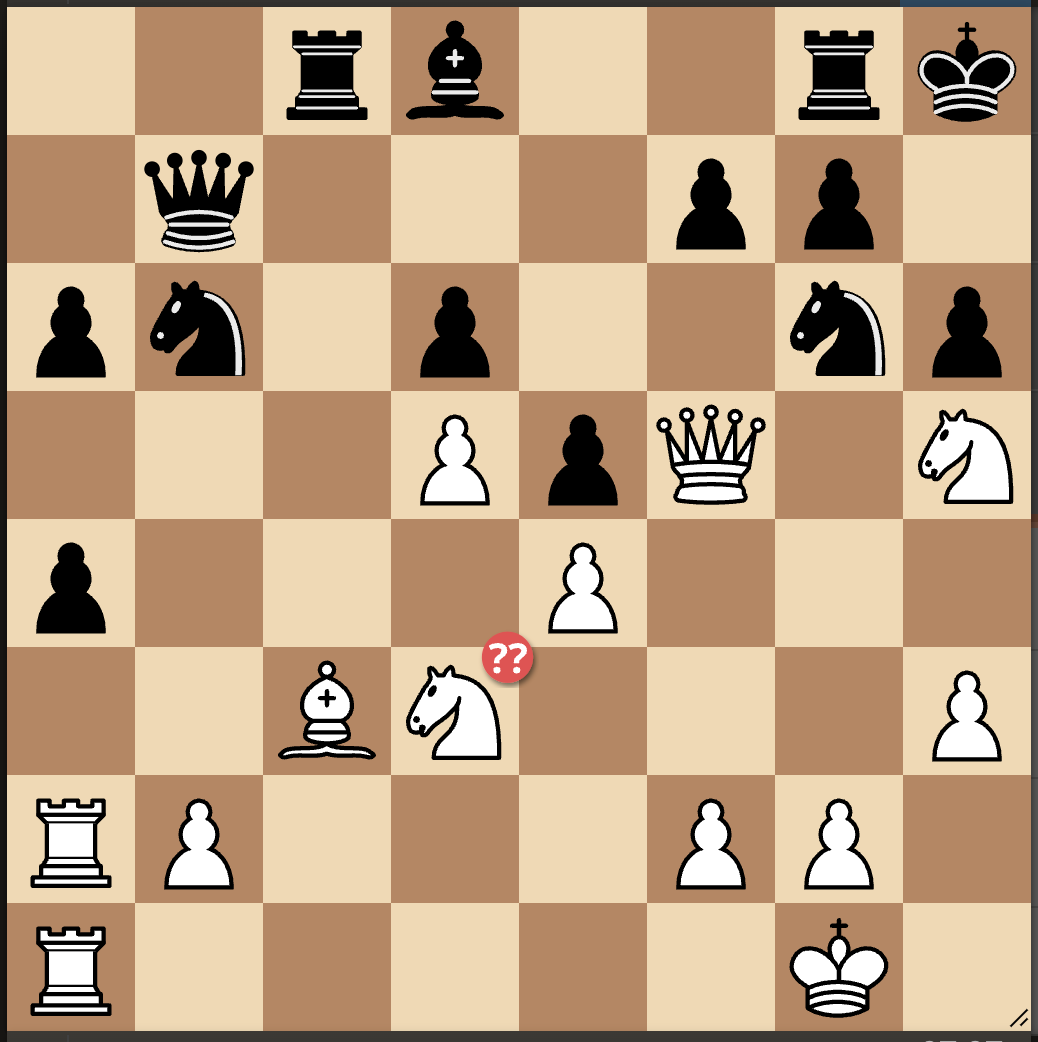
43... Rc4? Mistake. Nh4 was best. This was a strange decision for me (most likely I overthought this). (43... Nh4 Was, of course, my original intension.
44. Qg4 f5! (44... Rc4 Was also strong. 45. exf5 Rc4 46. Qe2 Qxd5 White’s position is falling apart here. 44. Ng3 Bh4 (44... Nh4 45. Qh5)
45. Nf1 Bg5! Here, I was happy to find this move, though, the only move that still keeps an advantage. I want to play Nh4 or in some cases, Ne7. I’m also discouraging Nd2/Ne3. (45... Ne7 46. Qxf7 Rxe4 47. Nd2) 46. g3 (46. Ng3 Nh4 47. Qg4 Nxd5)
46... Ne7! 47. Qxf7 Rxe4 48. h4 Bf6 49. Nd2 Rg4 (49... Re2?! 50. Qh5 Rxd2 51. Bxd2 Nexd5 (51... Qxd5? 52. Bxh6! Qxd3 53. Be3+ Qh7 54. Qxh7+ Kxh7 55. Bxb6) 52. Qe2 I evaluated this as unclear.) 50. Qe6
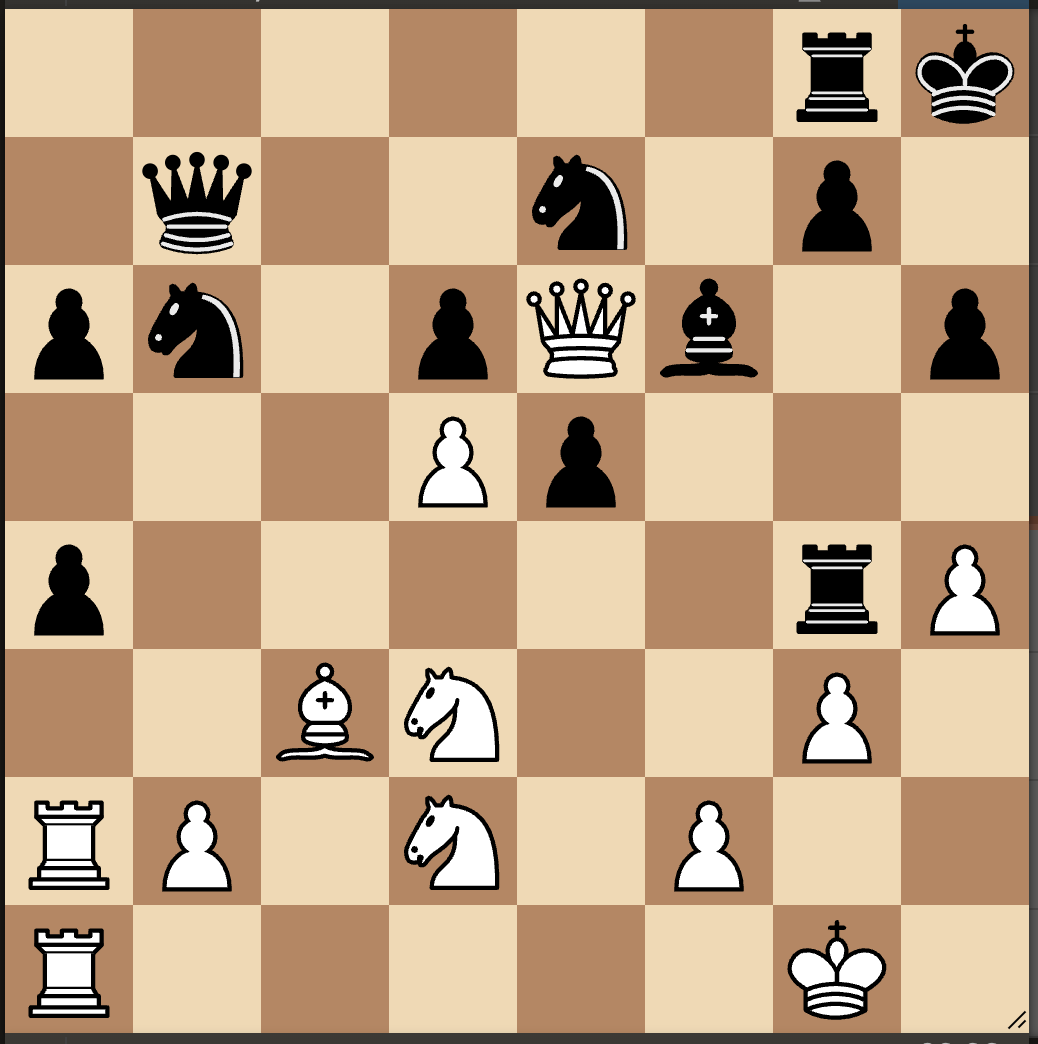
50... Qc8! I spent about half of my remaining time on this move and was very happy that I had the guts to play this move. I couldn’t quite calculate everything, of course, but I knew that it’s at least, promising for me, and was the only way for me to keep winning chances alive realistically. I correctly assessed that because of his weak king, I’ll always have practical chances. As it turned out, I was also objectively better here. (50... Qd7?! Would be a cop out since after 51. Qxd7 Nxd7 52. Rxa4 Rxa4 53. Rxa4 Nxd5 54. Rxa6 Be7 55. Bb4 Only White can now, be better in this endgame, where I have very miniscule winning chances.) (50... Rg6 Would also be a bit clumsy after 51. h5 (51. Ne4!? Bxh4 52. Nxd6) (51. Qxd6!? e4 (51... Nf5) 52. Nf4) 51... Rg5 52. Ne4 Rxh5 53. Nxf6 gxf6 54. Qxf6+ Rg7 55. Nxe5! dxe5 56. Bxe5) (50... h5 Finally, this is strongly met with 51. Qf7 Rg6 52. Ne4)
51. Qxd6? (51. Qxc8 Rxc8 The difference now, compared to the Qd7 line, is that I preserve my a4 pawn.)
51... Nbxd5? (51... Nexd5 This was more accurate according to the engine, but with 2 minutes left on the clock, it’s almost impossible to figure out the subtle differences. 52. Nxe5 Bxe5 53. Bxe5 Kh7!) 52. Nxe5 (52. Bxe5 Rd8) 52... Nxc3 53. bxc3 (53. Nxg4 Ne2+)
53... Bxe5 54. Qxe5 Ng6 Here, we were in mutual time pressure, and I was getting quite optimistic again due to having the initiative against his king.
55. Qd5?? Blunder. Qe2 was best. This was awkward for white, stepping into a tempo with Rd8. (55. Qe2 Nf4 56. Qd1 Would objectively be close to holding for white.)
55… Rd8 56. Qh1 A sad necessity to avoid another tempo on the queen.
56... Qxc3?! (56... Rf8 Is the top engine move, but I feel like it would be a very difficult move for a human to spot, especially in time pressure.)
57. Qf3 Qc8! Of course, I want to keep queens on the board since I’m attacking. To be fair, I missed Qf3, and I was a bit lucky I had Qc8, but sometimes you have to be a bit lucky to win an important game. (57... Qb4 58. Rxa4) 58. h5?? Blunder. Qe2 was best. 58... Ne5?? Blunder. Nh4 was best. During the game I thought it’s a normal move, but it missed the mark. (58... Nh4! This would be a killer blow, since the difference now is that if the queen leaves the h1-a8 diagonal, I can get my queen there, and attack the g2 square. 59. Qe2 (59. Qh1 Qf5 (59... Rf8)) (59. Qe3 Qc6) 59... Qc6) (58... Nf4 59. Nf1)
59. Qe2 Qf5 60. Re1?? The final mistake. From this point, my conversion was flawless. (60. Ra3!
60... Qxh5 61. Re1 Would still give white good holding chances despite being down two pawns.)
60... Nd3 61. Rf1?! Nf4 62. Qf3 Rd 363. Qa8+ Kh7 64. Qe8? (64. Qe4 Importantly doesn’t work due to 64... Nh3+) 64... Nh3+ From here, I was able to calculate out a forced win.
65. Kg2 Nxf2 66. Rxf2? Rdxg3+ 67. Kf1 Qd3+ 68. Ke1 (68. Re2 Rg1+ 69. Kf2 R4g2#) 68... Re3+ 69. Qxe3 Qxe3+ 70. Kf1 Qd3+ 71. Re2?! Rg1+? 72. Kf2? (72. Kxg1 Qxe2)
72... Qg3# This was truly an epic battle, with lots of ups and downs, and I am very grateful that I was able to come out on top in this game and this gives me a lot more confidence going forward for my future tournaments to be able play important games with everything on the line at a fairly high level. 0-1
GM Aleksandr Lenderman, Marshall Spectator Contributor
Across the Table, with Sydney Strauss
Q: When did you start playing chess and how did you learn?
I learned how to play chess in 2023 after an ex-boyfriend taught me one day. I was instantly taken by the game and became obsessed without missing a beat. I was 29 at the time and had no conception of the world of chess — the only player I’d ever heard of was Bobby Fischer, and only because of that one SNL skit with Will Ferrell.
I spent that entire year spending almost literally all of my time playing chess online, taking notes, and consuming as much chess content as I could. While my friends were out having fun that summer, I spent most of it inside working on my game. I hired my first chess coach that June.
The one fun thing I did that summer was visit New York. While there, I peeked into the Chess Forum and glanced at the Washington Square Park games from a distance; I felt too much like an impostor to throw myself into any of it. I left the city, returned home to Seattle, and felt strongly that I needed to live in NYC if I wanted to become a serious chess player.
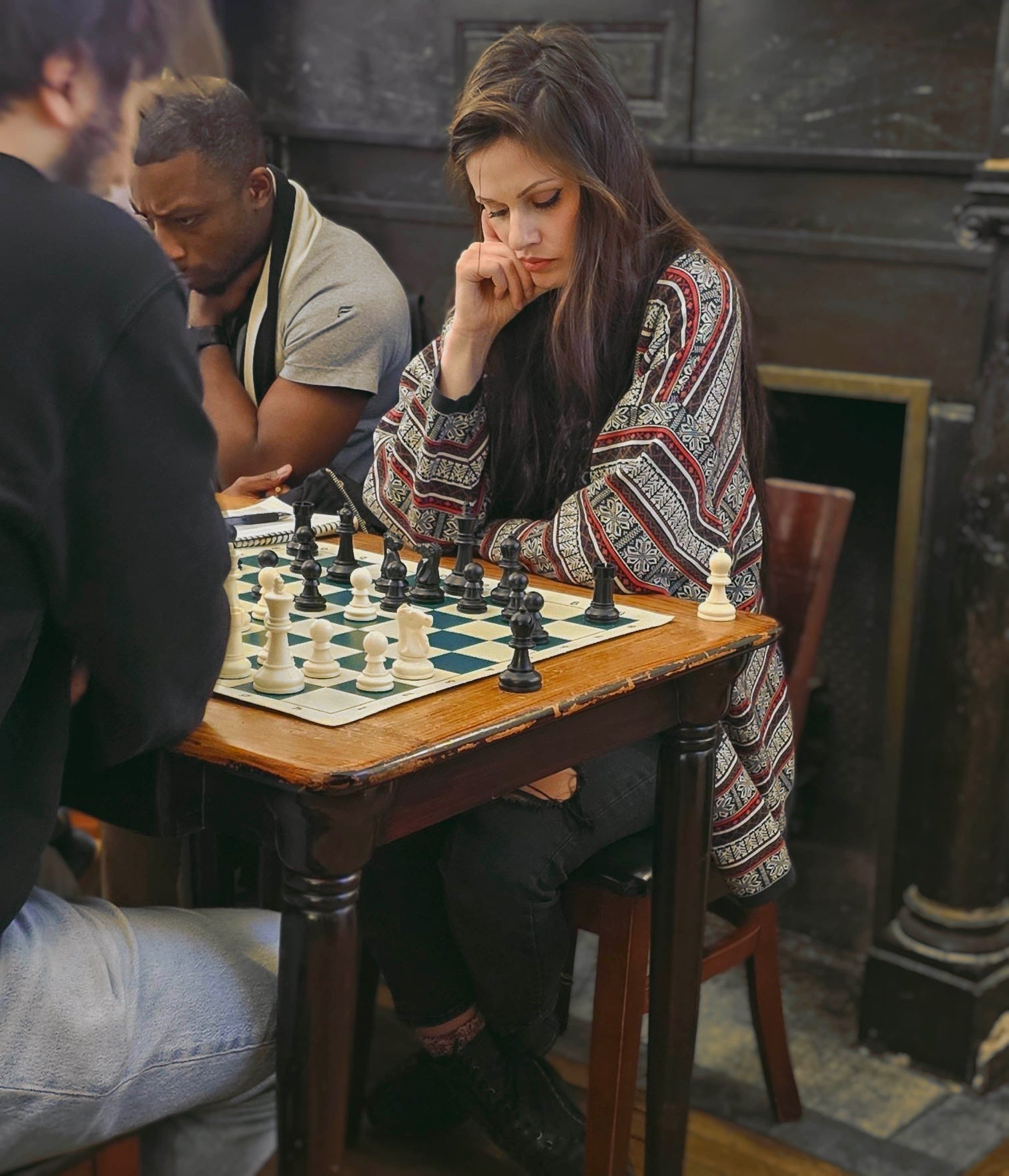
Q: When did you move to New York and become a member of the club?
After my NYC trip, I told everybody that I would be living there within a year’s time. I dedicated the rest of 2023 to paying off debts and preparing my move, and by January 2024, I had moved back into my parents’ house in Portland, OR for a few months as a rest stop before continuing on my way to New York. While I was there, I hit 1600 on chess.com and played my first two OTB tournaments.
Finally, I moved to New York in May of 2024 and became a member of the Marshall within my first few days of moving. I played in the Beginner Open later that month.
Q: What do you love about chess?
Chess is the pursuit and celebration of truth. I love and feel empowered by that, because all my mistakes are within my control to fix. Much like life, when you are on the right track and in alignment with truth, many things appear to effortlessly fall into place. My life as soon as I moved to New York started to feel like a really well-played chess game.
Q: What are your chess goals?
I have no delusions about the notion of becoming a grandmaster after learning how to play chess at 29 years old. Which is fine; my sole motivation with chess is a stubborn love for the game. That being said, I would love to reach 1700 sometime next year, and I would love to hit 2000 in my lifetime. Maybe even candidate master. Maybe I’m selling myself short.
Q: Is there anything about yourself that you’d like other members to know, that we may not know?
Not really. Well actually, I have a tattoo of a knight on my left wrist and tattoos of the other chess pieces on my left knuckles. I would like club members to also know that they should say hello if they see me at the club. I moved across the country without knowing anybody, and although I’ve made friends, I’m still always open to connecting with others.
Q: Any great game you’ve played at the Marshall you’d like to share?
Yes, I would like to share the game that won me Top Upset prize at the 2025 Marshall Women’s Championship tournament. This game was against a 1900, about 400 Elo higher than my rating.
Marshall Chess Club: 2025 Women’s Championship — Top upset prize
Sydney Strauss v. Allison Yu
1. c4 e5 2. Nc3 Bb4 3. g3 Bxc3 4. bxc3 I became an English player sometime last year. I used to play 1.d4, but I find this suits me better. I only play 1.e4 in online blitz but I’d like to give it a real chance someday. In my experience, the doubled pawns here don’t actually hurt me and feel rather useful for claiming the center.
4... d6 5. Bg2 f6 This move felt unfamiliar to me.
6. d4 I usually go for a Botvinnik setup with c4, d3, and e4, but I was under the impression I needed to strike in the center here. I recently learned from my coach that this was a misguided mistake, as the doubled pawns are less advantageous this way; the Botvinnik structure would still work here.
6... Ne7 7. e3 There’s no place for my dark-squared bishop on the kingside anyway, so playing e3 didn’t feel like a concession. My coach did not like this move.
7... c6 The first thing I noticed was that this move weakens Black’s d6 pawn.
8. Ba3 Felt like the natural square for my bishop, attacking the weak pawn. 8... Be6 9. Qb3
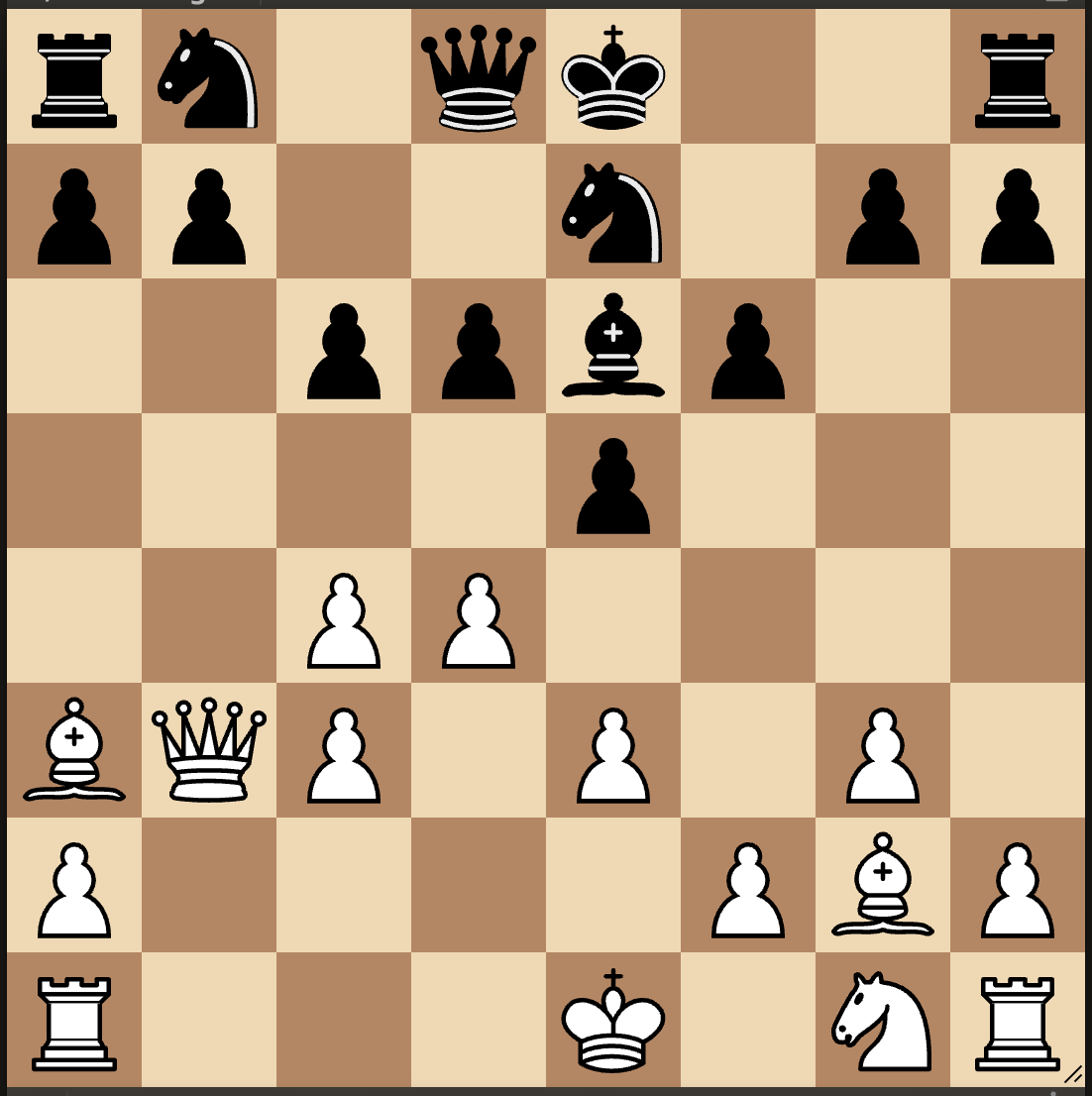
I thought for a long time about how to protect this pawn. I considered Rb1 for a while to attack b7, but then I lose a2 and it felt like too much. I also considered d5, but I wasn’t ready to close up my light-squared bishop, nor to make a bunch of trades. I didn’t love placing my queen in the line of Black’s bishop, but it felt more or less safe due to it adding extra pressure to Black’s queenside pawn structure. I felt I could induce some weaknesses here.
9... b6 Now c6 is very weak, and Black’s b-knight might have a hard time developing to a useful square. I was happy here.
10. Ne2 Later in the game, I somewhat wished I had developed my knight to f3 instead because I felt d2 was a more useful square. But I opted for e2 to avoid being kicked away by e4, and it’s the reason I played e3 in the first place. But I do think Nge2 makes less sense here than it does in my usual English Botvinnik structure.
10... Qc7 I was trying to figure out for a good while what the purpose of this move was. Eventually, I decided that Black probably wanted to protect both the c6 and d6 pawns and to eye my weak c4 pawn.
11. h3 At this point, I was pleased with my position and wasn’t convinced that it was time for me to castle yet — maybe I want to initiate a kingside attack later, and maybe if I castle too early, Black will begin a kingside pawn storm now. The center is closed, so I’m not really in a rush.
I considered Qa4 to take away the one square Black’s knight can develop to, but it left too much room for other variables.
I looked at Qb4 to attack d4, but didn’t like how things looked after Black responds with c5.
I was standing at the board for probably 15 minutes before I played h3 as a waiting move. I’m likely to play it anyway, and it restricts Black’s bishop — her most active piece.
11... O-O 12. Rd1 Still wasn’t sure if I wanted to castle, as Black’s rook is now on my f-file. I played Rd1 with ideas of attacking Black’s d6 pawn (see variation).
12... Rd8 (12... Na6 13. dxe5 dxe5 14. Bd6) 13. f4 Really questionable move, and I knew that even when I played it. I just thought it was time to up the ante.
The computer wants me to play dxe5 instead and at several points throughout the game, and I don’t really see why. Need to spend more time analyzing that.
13... Ng6 I saw this move as my signal to finally castle. 14. O-O Comes with tempo, threatening a fork with f5. 14... Bf7 15. Kh2
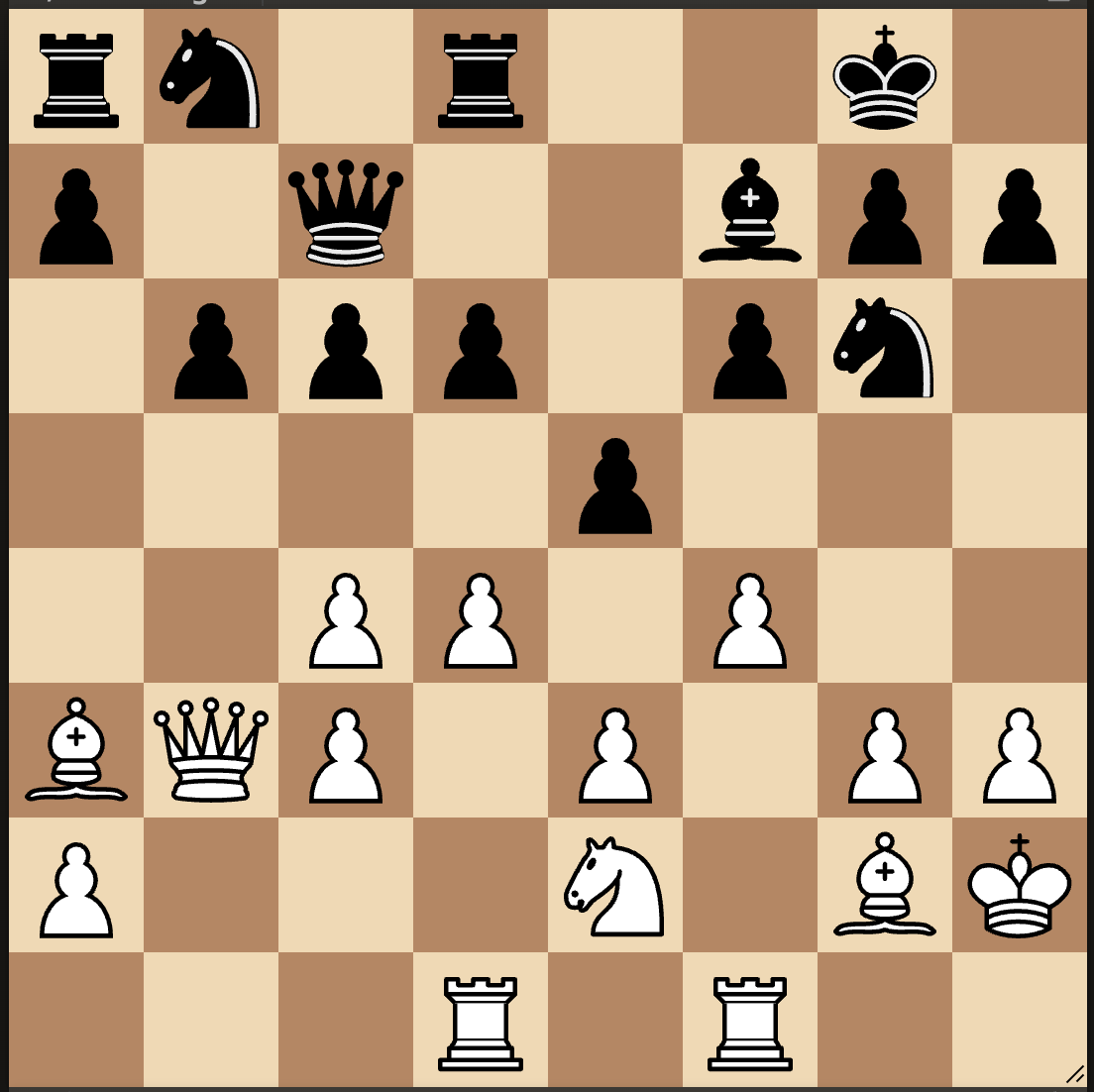
Another waiting move, but not great. What I really wanted to play was f5, but I was thinking about something my new coach said while reviewing a recent game of mine. In that game, I played f4 as Black to kick away one of White’s pieces. He noted that it took away a square to which my knight might’ve otherwise been interested in going. The position here reminded me of that, as I wondered if I wanted to play Ng3-Nf5 one day.
Unfortunately, f5 is my best move here, so I didn’t apply my coach’s advice correctly. This is one of the challenging aspects of chess — learning to identify when a certain principle does and does not apply to a position.
15... b5 I was ready for this move, had thought about it a lot throughout the game thus far, and wasn’t concerned.
16. d5 bxc4 17. Qxc4 c5 18. f5 Keeping my light-squared bishop’s diagonal open for so long was a big asset that led to what I felt was positional superiority. But now I had to adapt; it now felt like the right time to push my pawns and control the light central squares.
18... Ne7 19. e4 To secure my center. 19... Nd7 20. Qd3 g5 I wonder what Black’s idea was here. But on my end, I felt this allowed me to rip open her kingside.
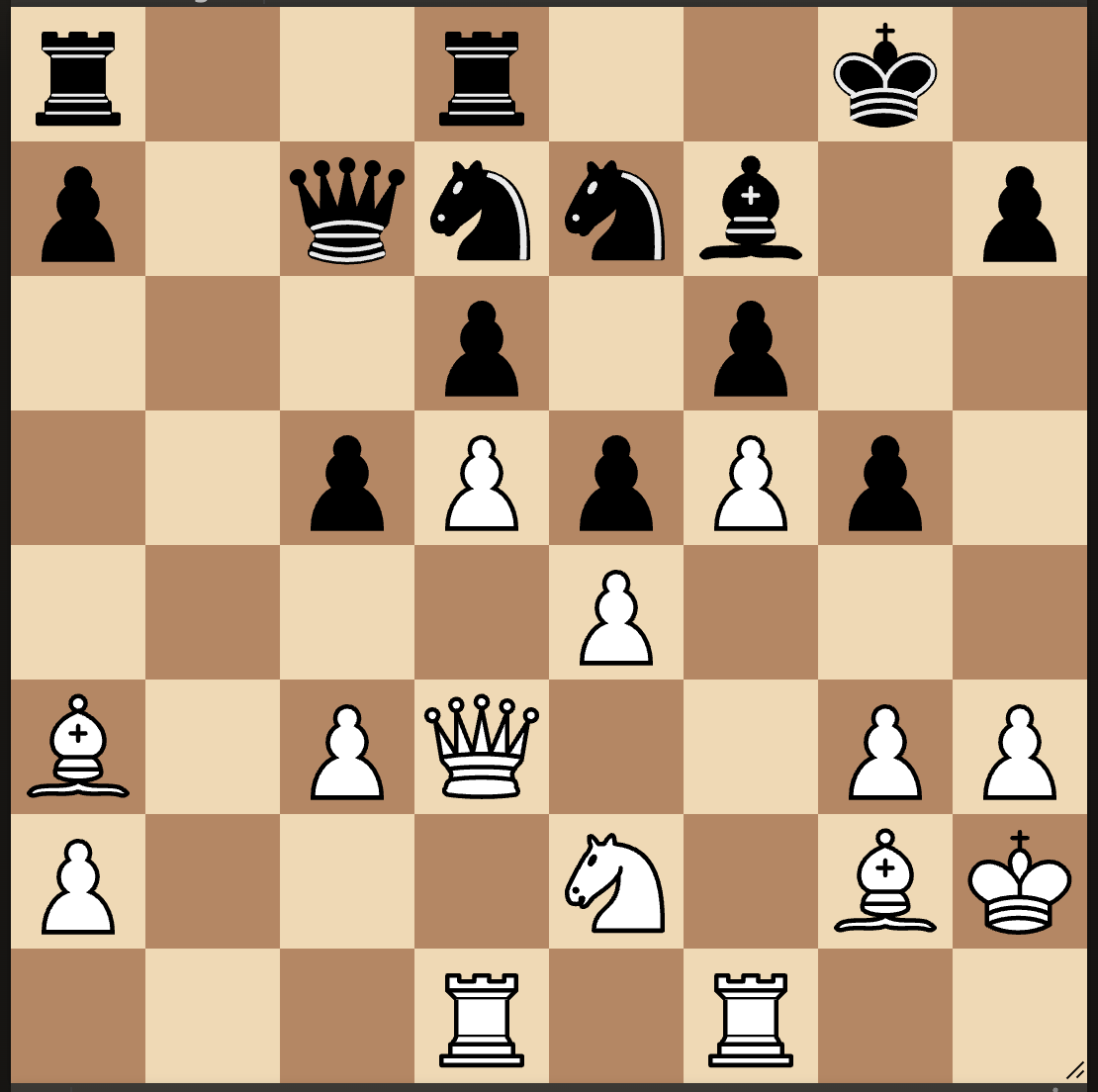
21. fxg6 Bxg6 22. g4 Kg7 23. Ng3 Rf8 24. Nf5+ I barely thought twice about this move, which is unlike me, but I had already used up so much of my time and this move felt correct. Maybe I should’ve considered other options, but I didn’t like the idea of letting the f-file open up.
24... Nxf5 25. gxf5 Bf7 26. Qg3+ The rest of the moves in this game came to me extremely quickly and naturally. I moved my queen here because I figured Black’s exposed kingside meant it was time for me to start moving in.
26... Kh8 27. Rd3 Rg8 28. Qh4 Rg7 29. Rg3 The engine says I lose my advantage here. I’m very surprised by that. Preventing Black from doubling up rooks felt very advantageous. Will look into this more.
29... Rag8 30. Rxg7 Rxg7 31. Bc1 Bringing my bishop back into the game, which I possibly should’ve done a couple moves earlier.
31... Qa5 32. Bh6 There’s no time for Black to attack my hanging pawns.
32... Rg8 33. Rf3 Qd8 Black saw that if she took a2, I would’ve moved my rook to g3 to eventually enable my queen to find her way to the g2 checkmating square.
34. c4 I thought this move was sort of clever. I can’t exactly threaten checkmate yet, so I thought I would grant my rook lateral movement to switch back to the queenside if a diversion is needed. All I need is the g7 square, and maybe I can even get the f6 square if I can distract its only defenders.
34... Qe7 Felt like she was trying to free up her knight from pawn defense. Not 100% sure though.
35. Ra3 Luckily I had played c4! My idea was mostly to take the hanging pawn and pin the knight, or even better, induce Black to leave the g-file with Ra8 to defend the a-pawn.
35... Nb6 I saw the following tactic immediately:
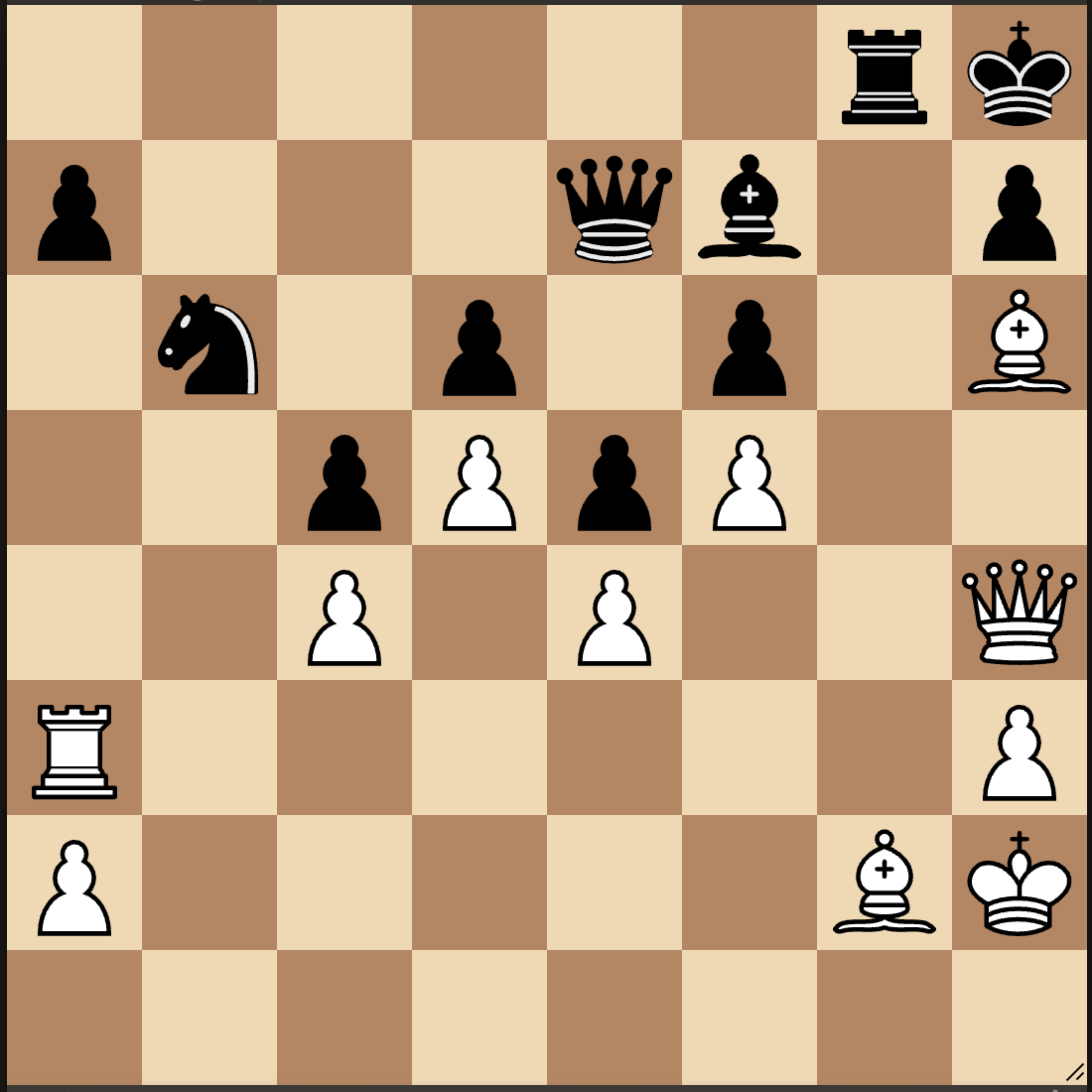
36. Rxa7! If Black’s queen loses sight of the f6 pawn, the game is over. 36... Qd8 37. Rxf7 1-0, Black resigns
Sydney Strauss, Marshall Chess Club Member
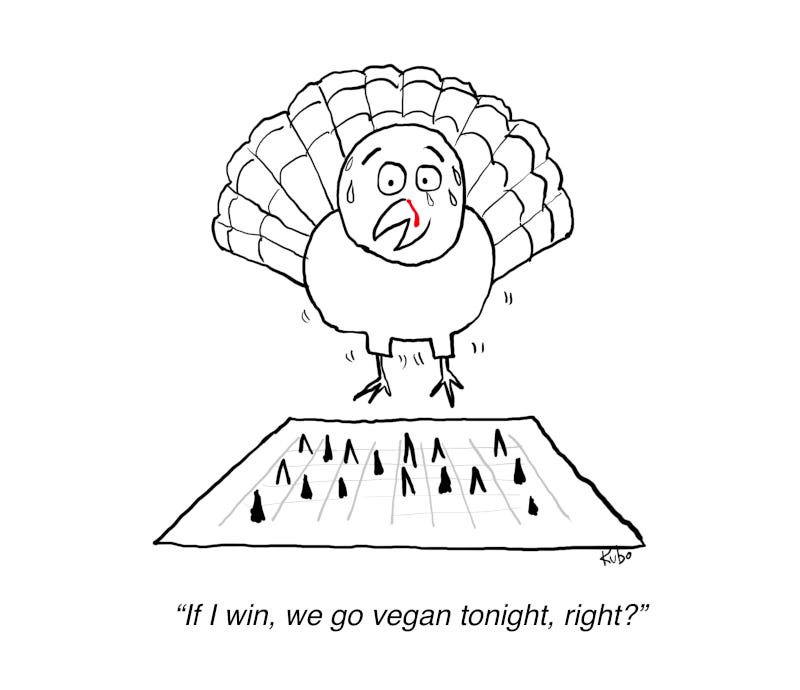
Chess Toons
En Passant
The Tata Steel Chess tournament takes place in Wijk aan Zee 16th Jan - 1st Feb 2026. The fields for both the Masters and Challengers have been set and they reflect the state of professional chess today.
FIDE has opened its new Global Survey on Chess in Education, inviting federations, schools and partner organisations to contribute before 28 February 2026. The initiative will inform FIDE’s Educational Strategy for 2027–2030, building on the findings of the 2021 survey and the rapid growth of educational chess since. With results to be shared with major international institutions, the survey aims to support policy development and prepare for the 2026 Year of Chess in Education.
At the FIDE World Cup…Sindarov’s preparation paid off as he took the first rapid game converting a winning endgame. The second game was more tense, with Yakubboev finding real chances to strike back, but the players eventually drew, sending Sindarov through as the first player to reach the finals as well as the 2026 FIDE Candidates.
Problems, Problems, curated by Alexander George
W. Shinkman, 1887
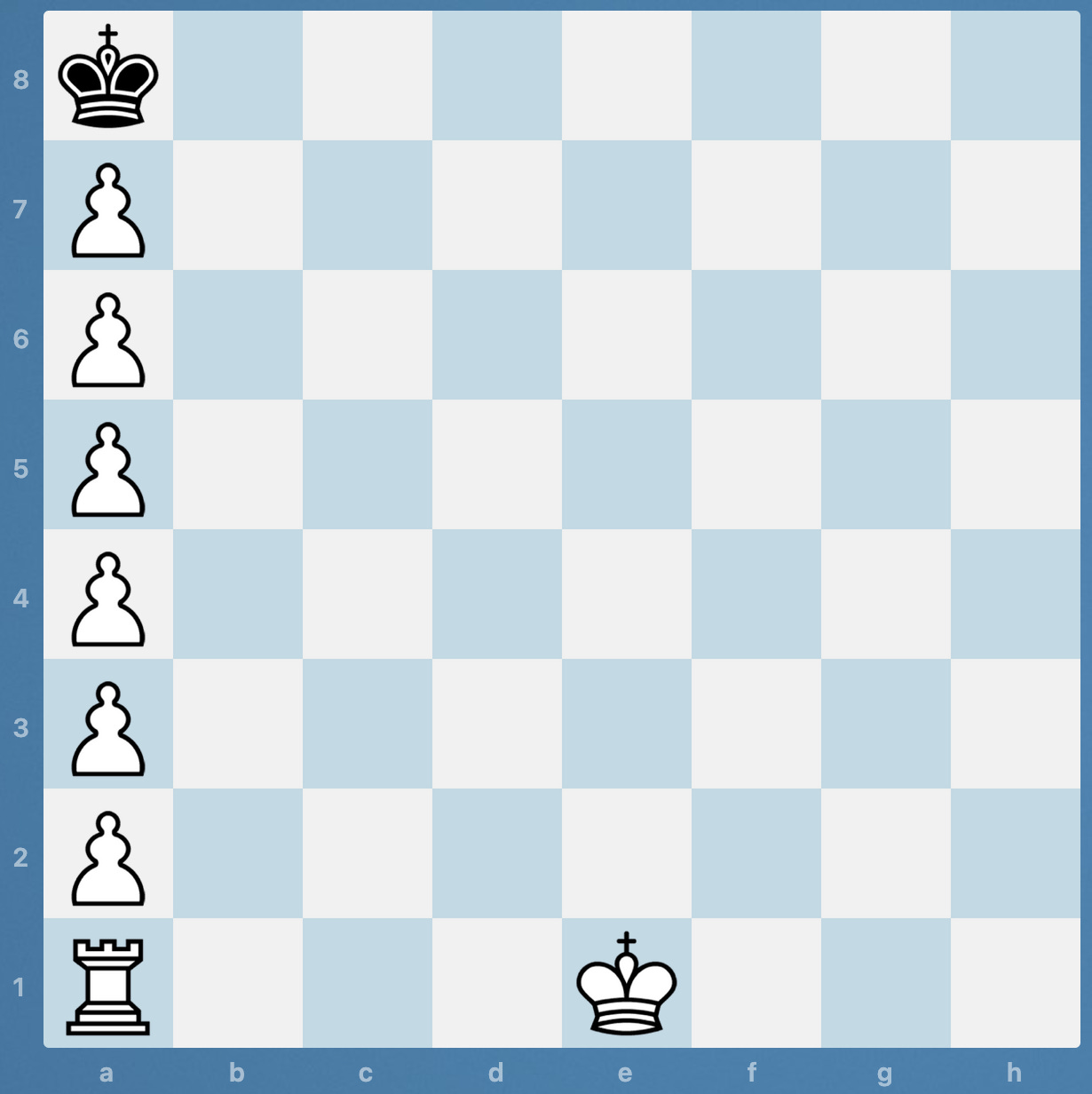
White to move and mate in 8
This is a famous, humorous problem. It’s actually unsound, with at least one unintended solution. (The intended solution is likely the easiest one to find.) More on its history next time.
---
Solution to last issue’s problem (Anthony Taffs, 1981):
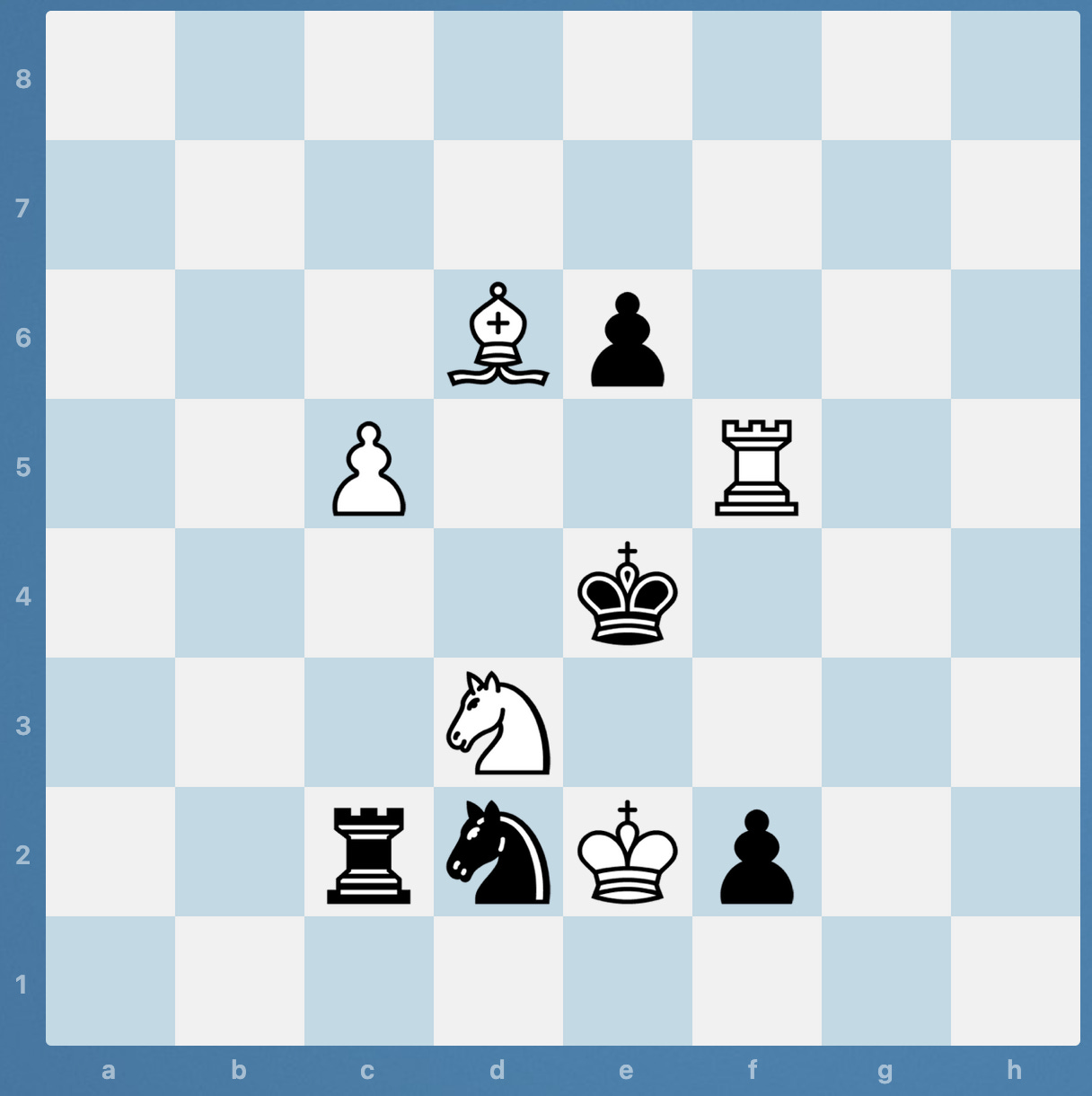
(a) White to move and mate Black in 2.
(b) Black to move and mate White in 2.
Solutions:
(a) 1.Rf4+ Kd5 2.Nb4 mate. (b) 1.Nc4+ Kf1 2.Ne3 mate.
---
Alexander George
Editor’s Note
As always, if you have any feedback, comments, or would like to submit an article please contact us directly at td@marshallchessclub.org.
Enjoy, and thanks for reading!
The Marshall Chess Club
23 West Tenth Street New York, NY 10011
212.477.3716

Thanks for reading The Marshall Spectator! Subscribe for free to receive new posts and support the club.