


In This Issue:
From The Skittles Room
Bill Goichberg’s Games Analyzed, by GM Aleksandr Lenderman
Bill Goichberg, A Force Behind American Chess, Dies at 83, by Greg Keener
Chess Toons
En Passant
Problems, Problems, curated by Alexander George
Editor’s Note

Welcome back, fellow chess players, to this edition of the Marshall Chess Club’s fortnightly bulletin, The Marshall Spectator.
It’s been more than two weeks now since the passing of legendary chess organizer Bill Goichberg. Last night, there was a visitation service held in Monroe, NY, and next week there will be another service for him in Pennsylvania where he will be interred next to his wife, Brenda. Once details are finalized, they will be made available on the CCA website.
Last week we welcomed Atiyab Sultan, the grand daughter of the legendary player Sultan Khan, for a discussion and lecture about her recent book entitled Endgame Of Empire. The discussion was a fascinating dive into the complexities and contradictions of colonialism together with a careful consideration of Sultan Khan’s remarkable chess career and the geopolitical context in which it took place. If you were unable to attend the event, you will be able to see the discussion soon on our events replay page.
We are also thrilled to recognize this year’s Maurice Ashley Chess Fellowship winners, which includes 4 Marshall Chess Club members: Dervin Kouyate, Ayden Spellman, Maxwell Gachiri, and Nia Skerritt. The Fellowship continues GM Ashley’s commitment to expanding access and opportunity for talented young players while addressing the severe underrepresentation of African Americans at the highest levels of chess. GM Ashley and 2025 Fellow recipient GM Brewington Hardaway remain the only two African Americans in the US to have earned the grandmaster title. Fellows receive financial support, mentorship, and access to a growing network designed to help them rise through the ranks.
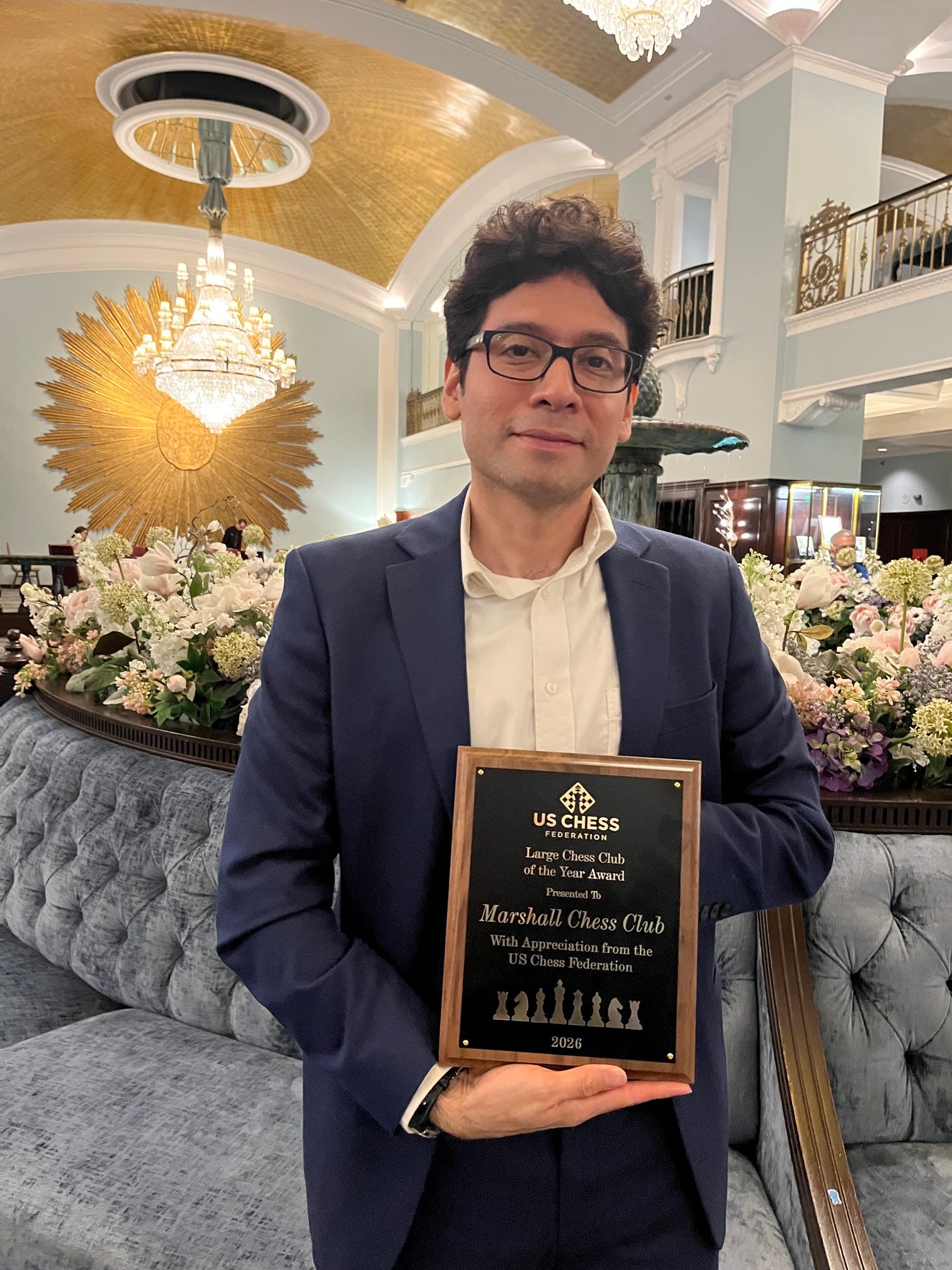
We are also proud to announce that the Marshall Chess Club has been recognized by USChess as the best chess club of the year for 2026! Our executive director, Carlos Chavez, traveled to Grand Rapids Michigan to accept the award on behalf of the club.
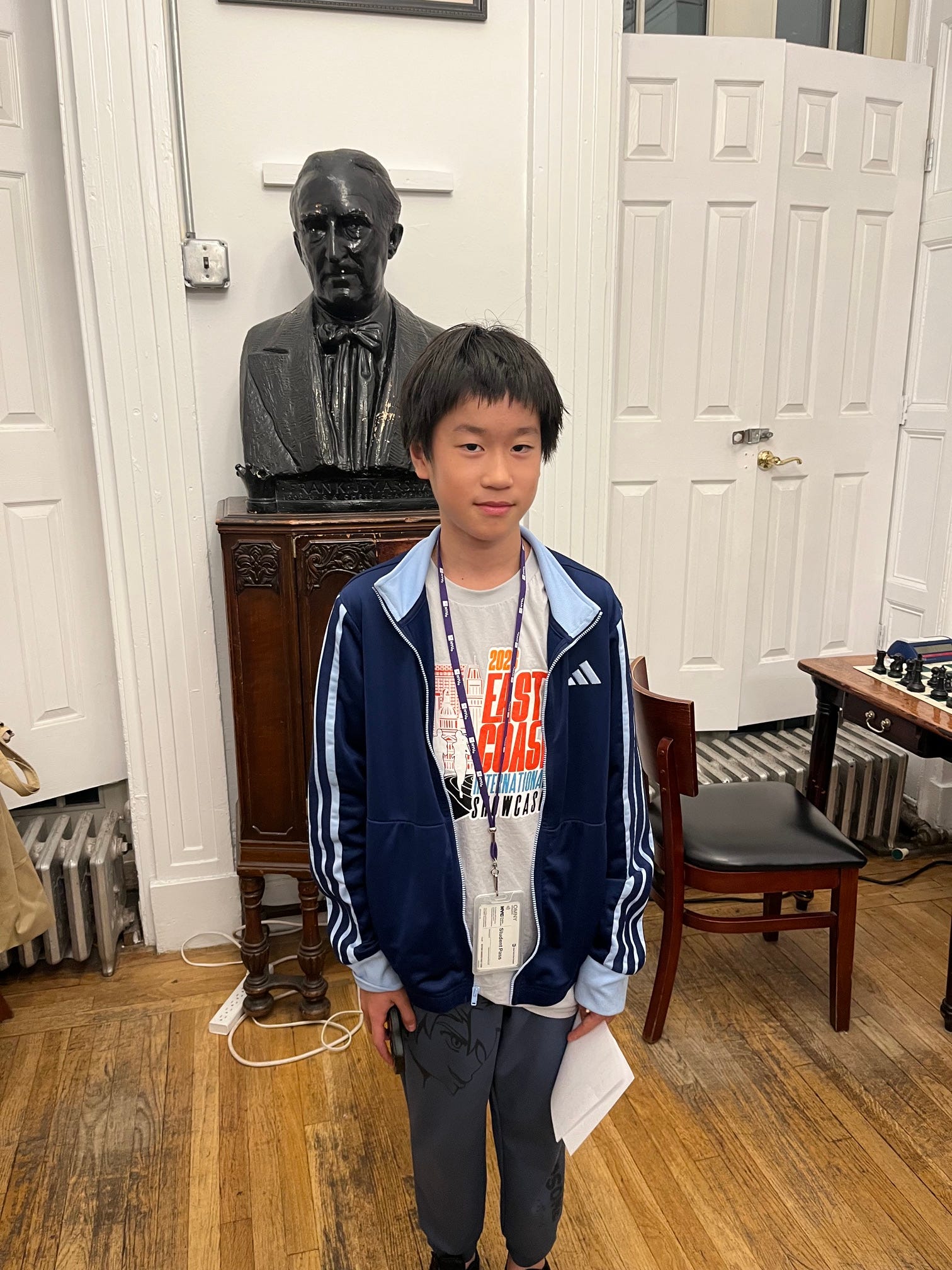
In other celebratory news, congratulations are in order for the Marshall Chess Club’s newest National Master. Lucas Lu crossed the 2200 rating threshold last night in the August Marshall Masters.
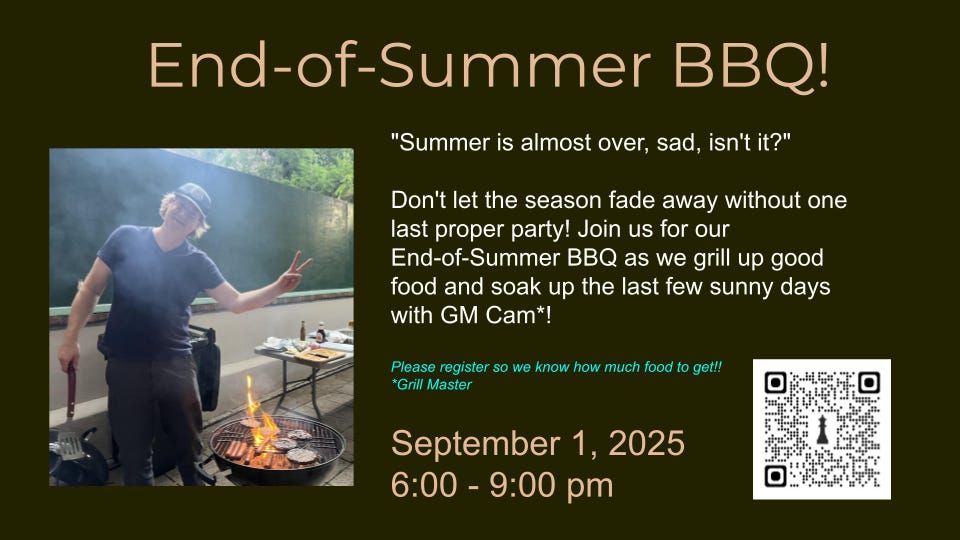
Looking further ahead on the calendar, we’re thrilled to announce our annual End-of-Summer BBQ with GM (grill master) Cameron Hull. GM Cam will be grilling up some of the finest hot dogs and burgers in the West Village on September 1st. If you intend to attend, please be sure to register in advance.
In other summer news, our Summer Camps are are soon coming to an end, but there’s still a couple weeks left with GM Djurabek Khamrakulov onsite.
August 17, 18, 19, 20, 21
August 24, 25, 26, 27, 28
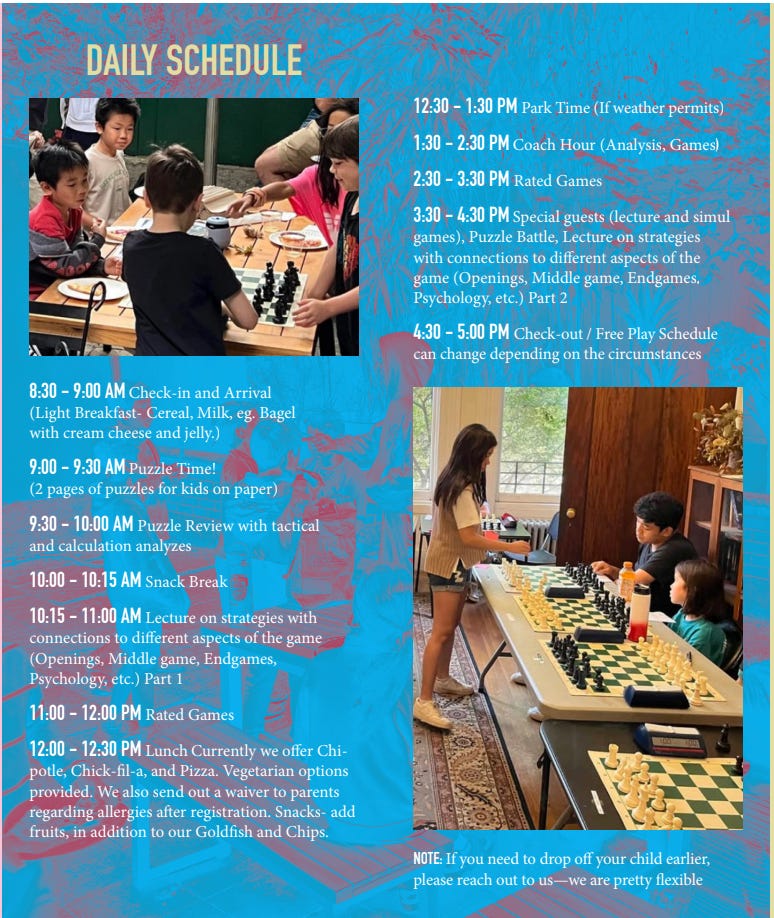
For all questions related to camp, please reach out directly to Kevin at kevinf@marshallchessclub.org
Looking back over the last two weeks, we have had a plethora of events for our members to participate in.
The Morning Under 1600 on August 9 had 40 players registered and was won by the following players who scored a perfect 3 out of 3 to win $175 each: Edison Ho, Rayyan Sayeed, Martin Daniel Salazar-Schuster, and Rishi Baveja.
The Premier Open that concluded on August 9 had 45 players registered and was won by IM Tanitoluwa Adewumi who scored a near-perfect 4.5 out of 5 to win the $1,000 first-place prize. Jessica Hyatt and Theodore Shin scored 4 out of 5 to win $375 each, while the following players won $35.71 for their 3.5 score: Winsley Wu, IM Jay Richard Bonin, CM Shawn Xu, Kevin Stern, GM Michael A Rohde, Armaan Chandragupta Jain, and WCM Alice Chovanec.
The Rated Beginner Open on August 9 had 23 players registered and was won by Brian Gootzeit and Lucas Gootzeit who scored a perfect 3 out of 3 to win $144 each.
The Premier Under 2000 that concluded on August 9 had 50 players registered and concluded with the following players winning $283.60 each for their 4 out of 5 score: WCM Hema Vikas, Hudson Wong, Hudson Seales Belelieu, Nikola Stojsin, and Alexandra Lussie. Rakshaanth Premkumar won a $250 class prize for scoring 2.5 out of 5 in the event.
The Morning Masters on August 8 had 12 players registered and was won by Corin Gartenlaub and Kylan Z Huang who scored 2.5 out of 3 to win $96.50 each.
The Under 2000 Morning Action on August 8 had 20 players registered and was won by Kenny Bollin and Daisy Yuen who scored a perfect 3 out of 3 to win $122.50 each, while Thomas C Moore scored 2 out of 3 to win a $105 class-prize.
The Friday Rapid on August 7 had 21 players registered and half of them won a prize. Jesse N Hoffman and Alec Hyunmook Choi scored 3.5 out of 4 to win $79 each, while Alexander Golosovker, Sumit Sohani, and Denys Bashmakov scored 3 out of 4 to win $9 each. Mason Tobias won $27 for his 2 out of 4 performance, while the following players shared in the remaining prize funds winning $13.50 each: Ratan Kumar Chinni, Tarun Ravindranath, Corbin William Wood, and Pei Ning Li.
The Thursday Action on August 6 had 44 players registered and was won by NM Bryan A Weisz who scored a perfect 4 out of 4 to win the $231 first-place prize. NM Nathaniel Mullodzhanov and IM Kevin Wang won $135 each for their 3.5 out of 4 score, while the following players won $29 each for their 3 out of 4 performance: Sarathi Ray, Armaan Chandragupta Jain, Alexander Golosovker, Aaron Kudryavsky. Riju Bhattacharjee scored 2.5 out of 4 to win $116 as a class prize, while Arlo J Scherr won the Upset prize.
The Thursday Open that concluded on August 6 had 21 players registered and was won by Nkosi Nkululeko and Chase Knowles who scored 4.5 out of 6 to win $175 each, while Ben Davar won $70 for his 3 out of 6 score. Alan Frank McMichael won a $35 class prize for his 2.5 score, while the following players shared in the remaining prize funds winning $23.33 each for their 4 out of 6 performance: Miles Griffin, George P Berg, and Aleksandr Gutnik.
The Morning Under 1600 on August 2 had 30 players registered and was won by Ryan Chen and Ashwin Agnihotri who scored 3 out of 3 to win $254 each.
The Sunday Game 50 Open on August 2 had 26 players registered and was won by the following players who all scored a near-perfect 3.5 out of 4 to win $146 each: Alexander Golosovker, IM Jay Richard Bonin, and Jay Krishna Yalamanchili.
The Sunday Rated Beginner Open on August 2 had 22 players registered and was won by the following players who all received $91.67 each for their perfect 3 out of 3 performance: Maria Camila Barutcu, Alex Wiegand, and Calvin Lawrence.
The Sunday Game 50 Under 1600 on August 2 had 23 players registered and was won by Sarvesh Sakthivel and Maddie Y Moradi who scored a near-perfect 3.5 out of 4 to win $147.50 each, while Mekhi Forde scored 3 out of 4 to win $91.
The Under 2000 Morning Action on August 1 had 15 players registered and was won by Yusuf Mansurov and David Campbell who scored 3 out of 3 to win $86 each, while the following players won $18.50 each for their 1 out of 3 score: Elliot Zenman, Vasu P Varun, Corbin William Wood, and Daniel Han.
The Morning Masters on August 1 had 18 players registered and was won by NM Elliot Goodrich who scored a perfect 3 out of 3 to win the $160 first-place prize, while Brian Arthur and Armaan Chandragupta jain scored 2.5 out of 3 to win $60 each.
The Saturday Game 50 Open on August 1 had 43 players registered and was won by Adam Gordon, Arhan Javeri, Jose Lahoz, and Mark DeDona who scored 3.5 out of4 to win $137.50 each. The following players shared in the remaining prize fund, winning $56.33 each for their 3 out of 4 score: Johji David Nakada, Rhyan Grennan, and Yusuf Mansurov.
The Saturday Game 50 Under 1800 on August 1 had 28 players registered and was won by Mingyang Li who scored a perfect 4 out of 4 to win the $224 first-place prize, while the following players won $50.67 each for their 3 out of 4 score: Seamus Francis Brady, Mingrui Ju, and Aldar Badmaev. Abeer Sethi scored 2.5 out of 4 to win $58, while Beckett Houston Lasch also won $58 for his 2.5 out of 4 score.
The FIDE Blitz on July 31 had 67 players registered and was won by IM Tanitoluwa Adewumi who scored 8 out of 9 to win the $455 first-place prize. FM Linxi Zhu scored 7.5 out of 9 to win $228, while FM Marcus Ming Miyasaka scored 7 out of 9 to win $114. Jason Jiang, Semen Platovskyi, and WCM Audrey Wang won a class prize of $114 each for their performance.
The Thursday Action on July 30 had 37 players and was won by FM Leif Pressman and IM Kevin Wang who scored a perfect 4 out of 4 to win $162.50 each, while Richard Alexander Major won a $98 class prize for his 2.5 out of 4 score and Jan Michalski won the upset prize. The following players won $32.67 each for their 3 out of 4 performance: FM Megan Althea Paragua, Aaron Kudryavsky, NM Nathaniel Mullodzhanov, Xinlong Zhong, Arhan Javeri, and NM Bryan A Weisz.
We look forward to seeing you at the club soon!
FM Bill Goichberg’s Games Analyzed, by GM Aleksandr Lenderman
When I was growing as a chess player, playing Bill Goichberg’s Continental Chess Association (CCA) tournaments was of course, a big part of my journey. I first started playing them as early as 2001, in a U1200 section and I was able to win several big prizes in under sections as a kid growing up. Eventually, I earned 2 IM norms and 2 GM norms in his tournaments and won numerous big tournaments including the World Open in 2015. What I never realized is that he was quite a strong player himself before he went into organizing full-time, and even peaked above 2500 FIDE, which gave him the FM title, and he would have great chances to pursue IM and GM titles had he chose playing over organizing. When I started to look at his older games, what stood out the most to me was that he seemed to be quite ahead of his time when it comes to opening theory (similar as to how he was ahead of his time in terms of knowing the important attributes to organizing good tournaments). Some of the principled opening lines he played are still very apparent to this day, which is very impressive given that back then there were no chess engines to instantly tell you the right path.
You can play through the games with analysis here.
Goichberg, William vs Potter, Robert BM
US Open-68, Atlanta
French Defense: Rubinstein Variation, Blackburne Defense
1. e4 e6 2. d4 d5 3. Nc3 dxe4 4. Nxe4 Nd7 5. Nf3 Ngf6 6. Nxf6+ Nxf6 7. Bc4 Not the main line but very decent line nonetheless. This game was very interesting for me to see given that I play this opening as Black.
7... h6?! Probably too slow. (7... c5 This is of course, more principled.)
8. Qe2 Be7 9. Bf4 O-O 10. O-O-O Nd5 11. Bd2 a6 12. h4 b5 13. Bd3 Qd6 14. Ne5 Bb7
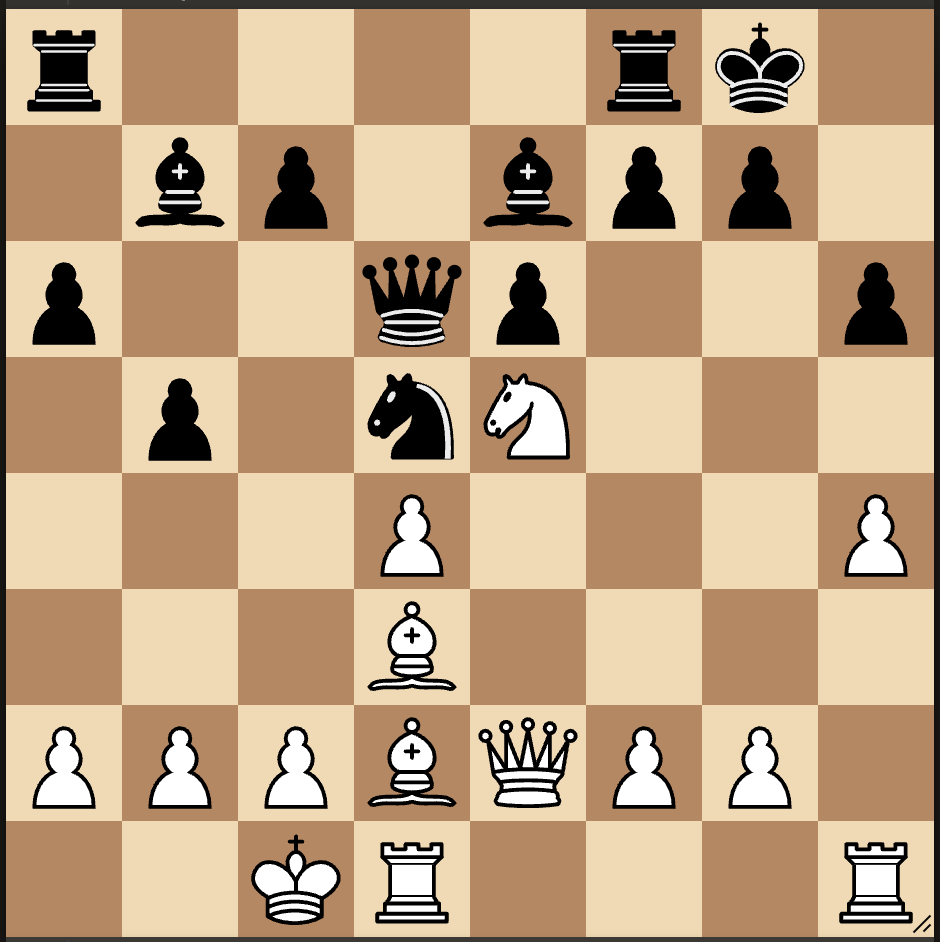
15. Bxh6! White’s pieces are ready and white goes straight for the attack. Bill was a very principled attacking player and calculated well.
15... gxh6 16. Qg4+ Kh8 17. Qh5 Kg7 18. Rh3! The key! Without this rook lift, which is a very thematic attacking idea, the attack wouldn’t be as powerful. Now, with the rook joining the attack though, it’s all over for Black.
18... Nf4 19. Qg4+ Bg5 20. hxg5 Nxh3 21. gxh3 Qe7 22. gxh6+ Kxh6 23. Rg1 Of course! The last piece joins the attack.
23... f5 24. Qg6# 1-0 White wins. 1-0
Goichberg, William vs Diesen, Bruce
US Open-74, Chicago
Sicilian Defense: Nyezhmetdinov-Rossolimo Attack, Fianchetto Variation
1. e4 c5 2. Nf3 Nc6 3. Bb5 g6 4. O-O This game really stood out to me since the gambit idea Bill played is still relevant to this day.
4... Bg7 5. Re1 Still one of the main lines to this day. (5. c3 e5 6. d4 Is another topical line where white sacrifices the pawn.)
5... e5 6. c3 Nge7 7. d4 cxd4 8. cxd4 exd4 9. e5 Qb6?! Too ambitious. The queen is misplaced here and Bill punishes Black swiftly. (9... O-O Black should just be content with giving back the pawn.)
10. Na3 O-O 11. Bg5 a6 12. Bxc6 Nxc6 13. Nc4 Qc5 14. Rc1 Now, White has a huge initiative. (14. Nd6!)
14... b5? (14... d5 15. exd6 Be6 Was Black’s best chance.)
15. Ne3 Qa7 16. Nd5 Bb7 17. Qd2 Nxe5 18. Ne7+ Kh8 19. Nxe5 Bxe5 20. Rxe5 f6 21. Bf4 Rae8 22. Rce1 Qa8 23. Qxd4 Bxg2 24. Nxg6+ Kg7 25. Rxe8 Rxe8 26. Qxd7+ 1-0 White wins. 1-0
Goichberg, William vs Strauss, David J
Lone Pine, 1974
French Defense: Steinitz Variation, Boleslavsky Variation
1. e4 This game, while not perfect, also stood out to me given the topical opening.
1... e6 2. d4 d5 3. Nc3 Nf6 4. e5 Nfd7 5. f4 c5 6. Nf3 Nc6 7. Be3 Qb6 8. Qd2 cxd4 9. Nxd4 Qxb2 10. Rb1 Qa3 11. Bb5 Bill plays the best move. Either knight to b5 can be tempting, but Bb5 is the most accurate move according to modern theory and the engines.
11... Na5 (11... Nxd4)
12. O-O (12. f5 This first was even stronger.)
12... Bb4
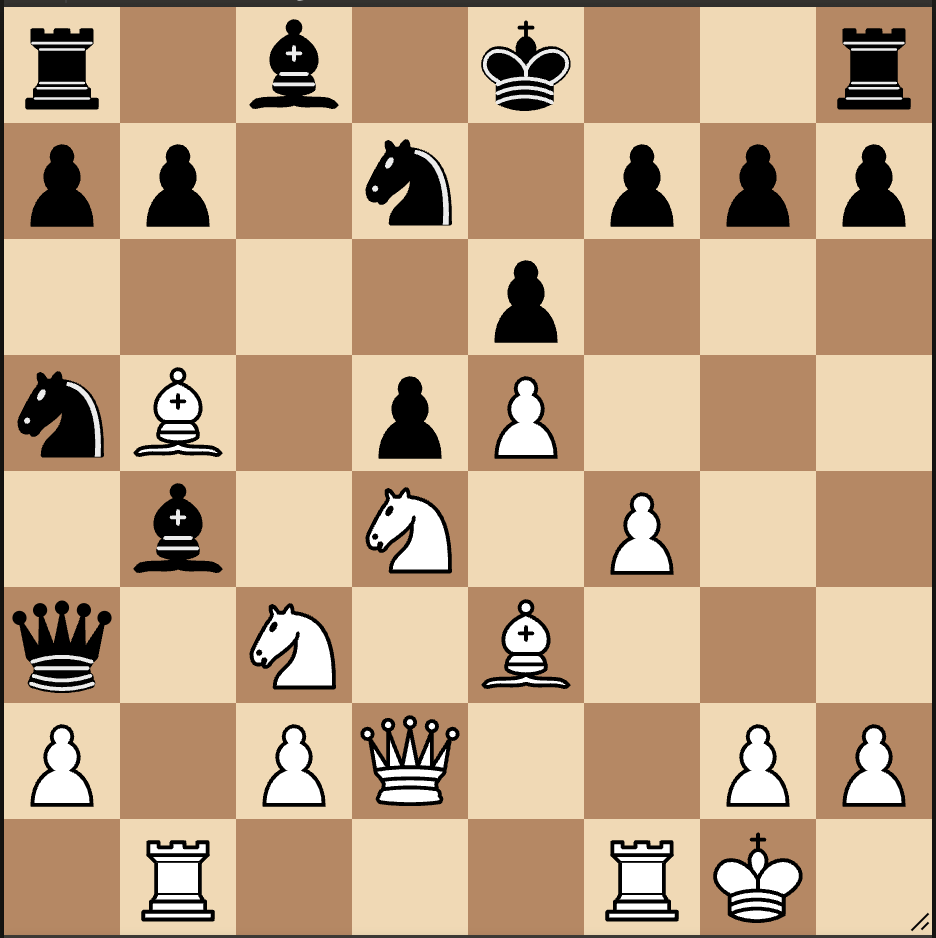
13. Rxb4! Of course! White plays principled. (13. Nde2? a6 Would give Black chances to consolidate and would be too passive for White.)
13... Qxb4 14. f5 O-O 15. Rf4 Nc4 16. Bxc4 dxc4 17. Rg4 g6 18. f6 Nxe5 19. Rh4 Nd7? Not an obvious mistake. (19... Rd8 Was the only move to hold the balance.)
20. Nb3!! While not every move Bill played this game was engine perfect, he did play a brilliancy here. Nb3 is an amazing retreating move, combining attack and defense. Black’s main idea is Nxf6 and he prevents it by setting up Bc5. However, if Black doesn’t take on f6, then Bc5 followed by Qh6 comes anyway! Deadly retreats are often silent but lethal.
20... Nxf6 21. Bc5 Qxc5+ 22. Nxc5 e5 23. Qg5 1-0 White wins. Very nice miniature win by Bill. He’s played numerous other attacking games but these 3 were my favorite. Rest in peace, Bill. 1-0
GM Aleksandr Lenderman, Marshall Spectator Contributor
Bill Goichberg, A Force Behind American Chess, Dies at 83
William “Bill” Goichberg, a tournament organizer, chess player and longtime force in American chess, died Aug. 2, 2026. He was 83. Over more than 60 years, he helped create many of the institutions and competitions that came to define competitive chess in the United States. Nearly every single member of the Marshall Chess Club with whom I have spoken over the past two weeks has shared an anecdote or a memory with me of their first time playing in one of his events or meeting him in person. Such was the enormity of his impact. He leaves behind one of those most active chess circuits in the world, the Continental Chess Association, which has vowed to continue running events as normal, together with a profound sense that the chess world as we know it has lost an important figure who did more for the game and its players than anyone else in recent memory.
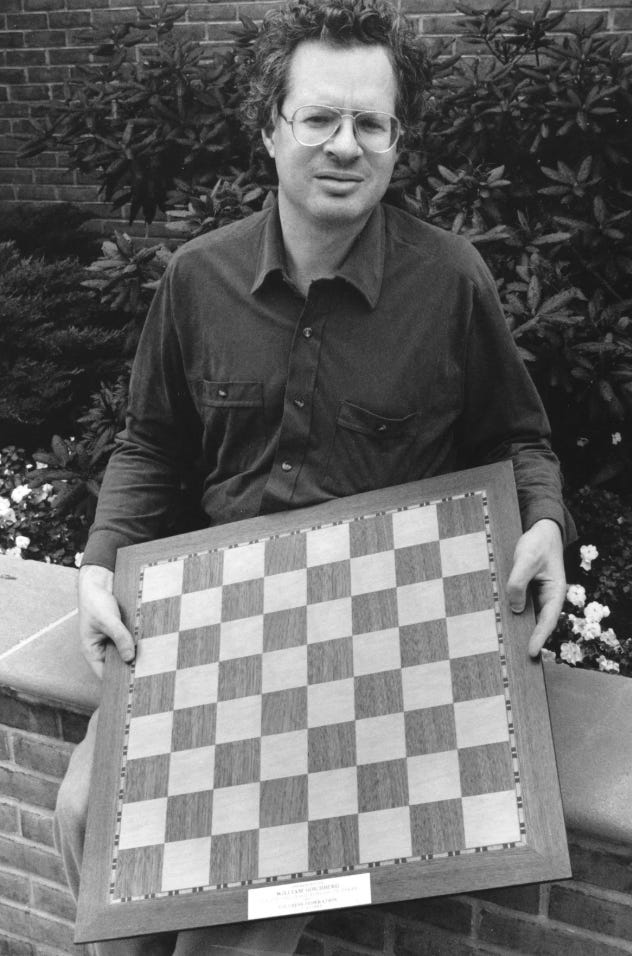
One of Goichberg’s greatest influences was on the growth of scholastic chess. In 1966, he organized the first U.S. Chess Federation-rated tournaments for young players, challenging the prevailing assumption that children would not participate in organized, rated competition. He soon began creating tournaments specifically for elementary-school students and went on to establish national championships for high school, junior high and elementary-school players. The events were eventually turned over to the U.S. Chess Federation and have grown into some of the largest and most important annual competitions in American chess.
He brought the same ambition to open competition for adults. In 1973, Goichberg launched the World Open. The tournament attracted 732 players in its first year and grew to more than 1,500 participants by 1986, setting a record for an open tournament that stood for years. Through the Continental Chess Association, which he founded and expanded into a national enterprise, Goichberg also established enduring events including the Chicago Open, the Liberty Bell, and North American Open. His tournaments provided opportunities not only for elite players but also for amateurs and aspiring professionals to compete for substantial prizes, improve their ratings and pursue international titles.
Goichberg was also instrumental in bringing international opportunities to American players. At a time when aspiring masters had to travel to Europe to find tournaments that could provide the necessary international ratings and norm opportunities, he began organizing qualifying events in the United States. Many generations of American players earned important norms in his tournaments as a result. He also privately helped promising players who could not afford entry fees, providing support for countless talented players that went unpublicized.
His involvement with the U.S. Chess Federation was nearly as extensive as his work as an organizer. Over the course of his career, he served as the federation’s rating statistician, co-editor of Chess Life, a member of its governing board on several occasions, executive director and president. This past week in Grand Rapids Michigan where the USChess Delegates meeting was held, numerous delegates stood up to share anecdotes, memories, and express gratitude for his lifetime of service to Chess. One anecdote that stood out was when he used his own funds to purchase years worth of advertisements in Chess Life magazine in advance in order to inject cash into the organization at a time when it was under financial duress and on the verge of being insolvent. He also served as the non-playing captain of the U.S. team at the 1976 Chess Olympiad in Haifa, Israel, where it won the gold medal. He was inducted into the U.S. Chess Hall of Fame in 2018.
Goichberg was born Nov. 11, 1942, in Manhattan, to Sol and Fannie Goichberg, and grew up in Mount Vernon, N.Y. His father taught him chess when he was about 2, and by his early 20s he had become one of the country’s strongest players. He earned the FIDE Master title and reached a peak U.S. rating of 2530, but his competitive career increasingly gave way to organizing. After creating the New York City Chess Association in 1964, he expanded it into the Continental Chess Association four years later.
Goichberg’s legacy is therefore measured less by his own games than by the thousands of tournaments he made possible. The tournaments he created introduced generations of children to serious competition, gave professionals a place to build their careers and helped establish the infrastructure through which American chess continues to grow.
Greg Keener, Marshall Spectator Editor
Chess Toons

En Passant
The Cairns Cup, one of the strongest women's tournaments in the circuit, is being held at the renowned Saint Louis Chess Club from 10 to 20 August. It is a 10-player single round-robin with a classical time control. The contenders battle for a share of the $250,000 prize fund. Bibisara Assaubayeva, Anna Muzychuk and Humpy Koneru head the strong field.
GM Magnus Carlsen has retained his Esports World Cup title after a dominant victory over GM Denis Lazavik. Carlsen won both sets 3-1, with two wins in each, and ended his Paris run without losing a single game. Carlsen takes $250,000, Lazavik $190,000, while GM Hikaru Nakamura clinched third place and $145,000.
Records tumbled at the biggest-ever British Chess Championships as the nine-day event at the University of Warwick, Coventry, ended with two record-breaking young superstars of the game winning the two top prizes.
Three tickets are officially in the race: Timur Turlov and Viswanathan Anand; Wadim Rosenstein and Gordon Tang; Jan Henric Buettner and Malcolm Pein. And after weeks of endorsements, arguments and increasingly energetic campaigning, the first outlines of an electoral map are beginning to emerge.
Problems, Problems, curated by Alexander George
Bonus Socius, 1290
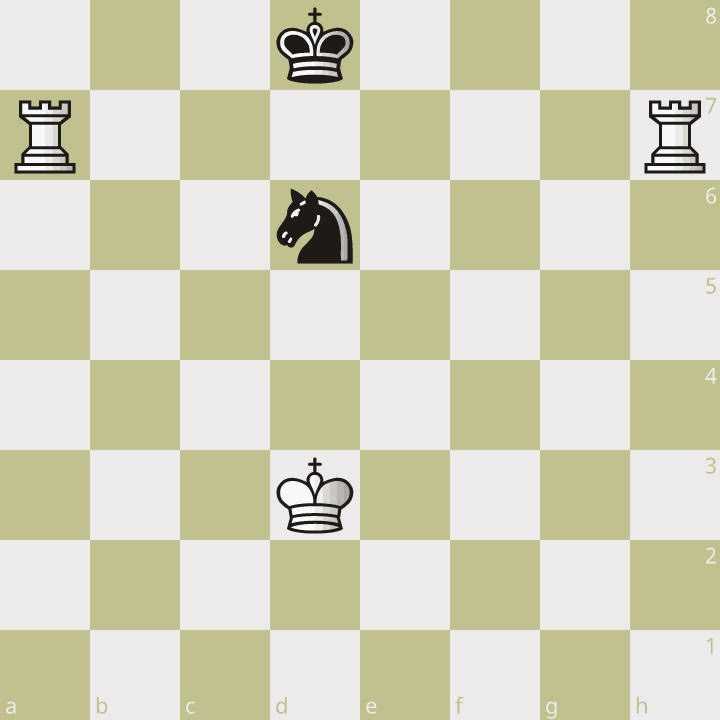
White to move and mate in 2.
Considered to be the oldest collection of chess problems in Europe, Bonus Socius (Good Companion) was written in Latin in Lombardy, Italy toward the end of the 13th Century (Chaucer wasn’t even a thought yet). The preface reads: “I, a good companion falling in with the wishes of my companions, have taken the trouble to collect into a book all the problems which I have discovered in chess.” It was translated into a number of languages and beautifully illustrated. There are copies in some of the world’s great libraries, for instance one at the Morgan Library, which has a copy of a French translation. To get a sense of the beautiful drawings—in ink, tempera, and gold leaf—here’s a sample page.
---
Solution to last issue’s problem (A. Salvio, 1604):
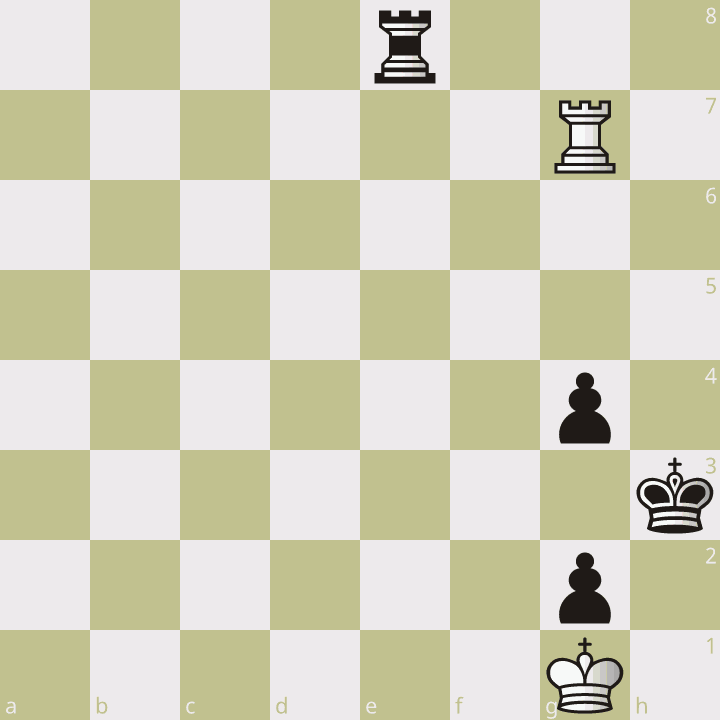
White to move and draw.
1.Rh7+ Kg3 2.Re7! Ra8 (2…Rxe7 Stalemate. And now it’s clear what a mechanism to draw will be.) 3.Ra7 Take me, please, take me! Draw.
---
Alexander George
Editor’s Note
As always, if you have any feedback, comments, or would like to submit an article please contact us directly at td@marshallchessclub.org.
Enjoy, and thanks for reading!
The Marshall Chess Club
23 West Tenth Street New York, NY 10011
212.477.3716
Thanks for reading The Marshall Spectator! Subscribe for free to receive new posts and support the club.
Never a time I walk past the old McAlpin without thinking about Bill’s tournaments there and his parent’s little book room.
Steve